When British Major General James Robertson stood before Parliament to explain how the colonies had been lost, he passed on what Washington’s captured second-in-command had told him, that “half the rebel army is from Ireland.” Irish names run through the muster rolls, the printing of the Declaration by Tyrone emigrant John Dunlap, and the signatures of James Smith, George Taylor, and Matthew Thornton, and as the United States marks 250 years, the Hibernians say it is time those names were put back where they belong.
When Irish Americans gather to celebrate the 250th Anniversary of American Independence this July 4th, many will naturally think with pride and gratitude of the republic that welcomed generations of their ancestors.
Yet that is only half the story.
Long before the great waves of Irish immigration, Irishmen were already helping to create that republic. Irish Americans were not simply the heirs of the republic that welcomed their ancestors in the nineteenth century; Irishmen had helped build that republic in 1776. Sadly, history has largely marginalized this extraordinary contribution, leaving important work to restore the Irish to America's founding narrative.
The Irish contribution begins with the Declaration itself. Three signers of the Declaration of Independence, James Smith, George Taylor, and Matthew Thornton, were born in Ireland, representing more delegates of foreign birth than any other country. Thomas Lynch, Edward Rutledge, Thomas McKean, George Read, and Charles Carroll were either the sons or grandsons of Irish immigrants. Their roots spanned Antrim, Limerick, Galway, Tyrone, Dublin, and King's County (now Offaly).
The Irish role in the Declaration extended beyond the signatures themselves. Charles Thomson of Derry, the Secretary of the Continental Congress, attested to the document. John Dunlap, an immigrant from Tyrone, printed the first copies, and Colonel John Nixon, the grandson of a Wexford emigrant, gave the document its first public reading.
The Irish contribution only intensified after the signing. It is estimated that Irishmen composed 25% to 33% of Washington's army, though contemporary British sources place the number much higher. In testimony before Parliament, Philadelphia loyalist Joseph Galloway testified that Washington's army was "half Irish." This matched the testimony of British Major General James Robertson, who told Parliament that George Washington's captured second-in-command informed him that "half the rebel army is from Ireland." While The Royal Gazette mocked the high number of Irish immigrants by describing the Continental troops as "an Irish rabble, more fit for the shillelagh than the musket," British General Henry Clinton, Commander-in-Chief for North America, held a far more serious view: "The Emigrants from Ireland were in general to be looked upon as our most serious Antagonists."
American records confirm the same pattern. Commodore John Barry from Wexford was the most successful captain of the Continental Navy. He took its first prize, made numerous captures, and fired the final naval shot of the Revolution from the Continental Navy's last ship afloat. Stephen Moylan, a Cork native, served as Muster-Master General and Commander of the Fourth Continental Light Dragoons, and historians credit him with the earliest known use of the phrase "United States of America." Washington's Chief of Artillery was Henry Knox, a bookseller born to Derry immigrants. The Pennsylvania Line contained so many Irish soldiers that Colonel "Light Horse Harry" Lee quipped it should be called the "Line of Ireland."
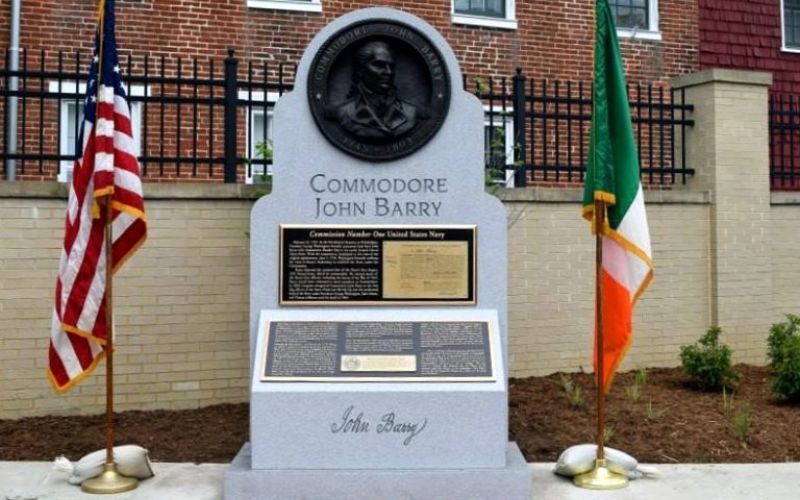

A memorial to John Barry that the AOH erected in 2014 on the grounds of the Naval Academy, Annapolis.
Why, then, is this definitive chapter of the American founding so widely unknown today? How does a contribution so massive get airbrushed from the national memory?
The answer lies in the era around America's centennial, when the Revolution passed from living memory into the history books. That history was written almost exclusively by New England establishment figures, such as George Bancroft and Henry Cabot Lodge, who viewed the past through a rigid Anglo-Saxon lens. Their histories portrayed the Revolution largely as a struggle among Englishmen defending English liberties. This ideological filter systematically scrubbed African Americans, women, and Irish Catholics from the founding story.
Yet there remained an obvious problem for those trying to tell an exclusively Anglo-Saxon story: the Revolutionary records were filled with unmistakably Irish names. The Irish of the Revolution were not one sect or one province; they came from Connacht, Leinster, and Munster as much as Ulster, Catholic and Protestant alike, and at the time were simply "Irish," a label the British generals who fought them used just as readily. The term "Scotch-Irish" was rarely used in the Revolutionary era. It only caught on a century later, after the Famine, when some descendants of the earlier Protestant arrivals adopted it to distance themselves from the poor, Catholic refugees now arriving in droves, amid a wave of American nativism that believed that Catholics were incompatible with American democracy. That 19th-century label was then projected backward onto the Revolution itself, carving an Irish contribution into two separate stories. American history books have followed that divisive script ever since: one comfortably assimilated into the founding myth, the other systematically minimized or dropped.
Too often, historians treated the absence of evidence as evidence of absence. Historians have traditionally failed to consider that Penal Laws outlawing Catholicism were in effect in both Britain and the American colonies at the time of the Revolution. This legal oppression suppressed the survival of Irish Catholic paper trails, yet few historians factored it in.
They also ignored the logistics of Atlantic trade. The Linen Exception to the British Navigation Acts, which restricted trade with the colonies to ships originating from English ports, meant that direct trade between Ulster and the colonies was legal and lucrative. It was cheaper and more practical for an Irishman from Tipperary to travel north and sail out of Belfast than to leave from a southern port. Upon arrival in Philadelphia, port officials would accurately record them as Irish arriving from Ulster. Later historians confused a point of departure with a heritage identity. By ignoring the economic realities of shipping routes and the legal realities of the Penal Laws, later historians split one Irish story into two. In doing so, they imposed a nineteenth-century identity on eighteenth-century people. One became central to America's founding narrative; the other was relegated to its margins.
What is deeply troubling is that modern professional historians, who pride themselves on their skepticism toward early American mythmaking, have allowed this specific form of airbrushing to persist. Over the last several decades, academia has rightfully and aggressively expanded the founding narrative, bringing the vital contributions of African Americans, Native Americans, and women into the light. Yet, while modern historians have been active in dismantling old biases for other groups, they have paid scant attention to cross-examining the sectarian biases built into their own source material when it comes to Irish Catholics.
Instead of interrogating the 19th-century marginalization of the role of Irish Catholics in the Revolution, modern academics continue to repeat it without scrutiny. They apply a rigorous skepticism to every other aspect of early American history. Still, when it comes to the Irish of the Revolution, they uncritically accept a retroactive division that dilutes the singular, massive weight of the total Irish contribution.
As the United States approaches its 250th anniversary, Irish America must stop waiting for mainstream academia to correct this double standard. The historical data is sitting in plain sight, preserved in the letters of British generals, the realities of the shipping lanes, and the muster rolls of the Continental Army. Restoring these names, counties, and numbers to the national narrative is not an exercise in ethnic vanity. It is a matter of historical justice.
This July 4th, as the nation looks back to its origins, Irish Americans must boldly reclaim their history, reminding the republic that they were never just guests in the house of American liberty; they built the foundation. We should remember with pride the words spoken before Parliament in 1784 by Lord Mountjoy, who told his fellow Englishmen that "America was lost by Irish emigrants… I am also informed it was their valor that determined the contest." What Mountjoy mourned as a colony lost, Irish America should claim with pride as its gift to the nation.
If learning about the Irish role in America's founding has sparked your curiosity, we invite you to explore the Ancient Order of Hibernians. Join thousands of Irish Americans dedicated to preserving our heritage, serving our communities, and ensuring our history continues to be told.