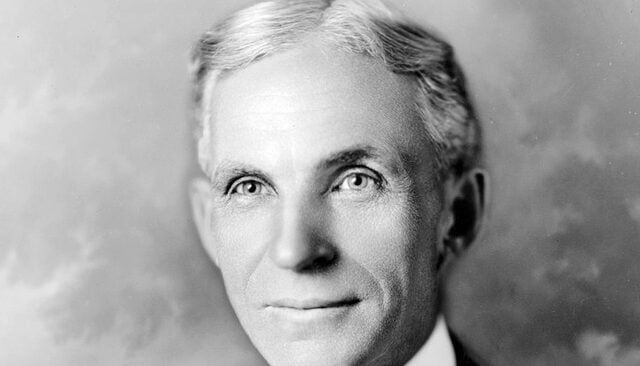
He was the Michigan-born grandson of a County Cork emigrant who revolutionised the modern world with the assembly line and the affordable motor car. Yet Henry Ford also used his vast wealth and media power to spread antisemitic conspiracy theories that won praise from Adolf Hitler and left a stain on his formidable legacy.
Having come from a family of immigrants, he has transformed the American car industry, yet he still feels obligated to uncover the nefariousness of leftists and Jews. He owns a prominent news outlet, using it as a pulpit to promote those who pledge to destroy this malevolent cabal. He is one of the richest men on Earth, yet he is threatened by this heinous conspiracy.
I am talking about Henry Ford, a 20th-century plutocrat with a familiar story. A resourceful businessman and engineer, Ford made cars affordable for the American middle class. He was a proponent of “welfare capitalism” and consumerism, insisting that both would assuage revolutionary sentiment. He was also a notorious anti-Semite, believing that socialism and Jewry endangered American civilization. He was not a nice man, but he was an important man – his story reverberates through to the present.
Born in small-town Michigan in 1863, Henry Ford was the son of a carpenter and farmer who had left County Cork during the Irish Potato Famine. An enterprising young man, he spent his youth in a small machine shop that he had constructed himself. By age 15, he had built his first steam engine and could take apart and reassemble pocket watches.
Ignoring his father's wishes to take over the family farm, he left home in 1879 to work as an apprentice machinist in Detroit. Though Ford never attended secondary school, he would also attend a university in the city to supplement his instinctive love of machinery, studying bookkeeping, mechanical drawing, and general business practices.
Read more
The world of business appealed to Ford, and he knew that he wanted to manufacture automobiles. They were still a new phenomenon at this time - in 1886, German engineer Karl Benz was granted a patent to produce the Motorwagen, the first practical automobile to be powered by an internal-combustion engine. However, the invention of the pneumatic rubber tyre, coupled with an explosion in the availability of cheap rubber from the Congo, made the mass production of cars feasible. Ford was primed to take advantage.
After completing his apprenticeship, Ford worked as an engineer for a utility company owned by Thomas Edison, a renowned inventor with more than 1,000 patents. By 1896, he had constructed his first model car, and, with Edison’s blessing, he decided to set up a business of his own.
Financed by prominent Detroit industrialists, Ford founded the Ford Motor Company in 1903, providing him with the platform to “build a motor car for the great multitude”. By 1908, the first Model T would be wheeled out of Ford’s Detroit factory. Capable of seating five people, it was an instant success – by 1918, half of the cars in the United States were Model T’s. It cost just $850 to buy, making it affordable for most of the American middle class.
Ford made his vehicles cheaply by building them on an assembly line. His philosophy of assigning set tasks to employees on the moving assembly line meant that vehicles could be built in 90 minutes, but the workers found their duties rather boring. To satiate them, Ford paid them $5 a day, more than double the average blue-collar wage. Increasing employee pay significantly reduced turnover costs, making Ford one of the most profitable companies in the world. The Model T typified early 20th-century American life; when production ceased in 1927, 15 million had been sold.
Ford was an advocate of “welfare capitalism", the notion that poverty could be eradicated by the benevolence of employers, rather than government action. He endeavoured to inculcate his employees, many of whom were immigrants from Eastern Europe, with “American values”. He set up a “Sociological Department”, which would send investigators to employees’ homes, and look at bank records to ensure that employees were not wasting their earnings on alcohol or gambling. He also set up an English school for foreign workers, even withholding some of their pay if they didn’t attend.
Read more
Ford’s innovative streak was never abandoned – he replaced the Model T with the Model A, selling over 4 million of them over a four-year period. He retained his hands-on approach to the business – he refused to employ accountants, instead preparing the company accounts himself, and never had the company audited during his lifetime. He would also expand the business to manufacture racing cars, ambulances and even aeroplanes.
Having amassed a fortune, which at its peak totalled $200 billion in today’s money, Ford had the space to become more vocal about political and social matters. He opposed unions and socialism, maintaining that paternalistic business magnates were better able to assess workers' needs than union leaders.
He employed a “Service Department”, a group of ex-boxers and petty criminals who would beat up and occasionally murder striking mechanics and engineers – in 1932, they massacred five auto workers who had lost their jobs. One reporter even christened him the “Mussolini” of Detroit.
A witness to the Communist agitation that engulfed Europe and North America in the interwar period, Ford found a convenient scapegoat for its rise – the Jews. In 1919, he purchased the Dearborn Independent newspaper, in which he blamed the “International Jew” for the Russian Revolution, the First World War and even jazz music. The paper was widely read, reaching almost a million readers every week.
A posse of Jews, asserted Ford, were instigating “revolutionary programs” to control “the machinery of commerce and exchange … these world-controllers are exclusively Jews”. Ford’s impassioned writings were noticed in Europe – he was the only American to be praised in Mein Kampf. Indeed, Adolf Hitler would hang a portrait of Henry Ford in his private office, and in 1938, Ford would even receive the highest medal that Nazi Germany could bestow on a foreigner.
Ford never recanted his sympathy for the Nazis, but he did take measures to end boycotts of his business by Jews and liberals. He ended the publication of his newspaper in 1927 and issued apologetic statements to the Anti-Defamation League. In 1945, with his health failing, he appointed his grandson, Henry Ford II, to be the president of the company. He died two years later, bequeathing most of his fortune to the Ford Foundation, a philanthropic organization still in operation today.
I have presented an account of Henry Ford, an industrialist of the last century whose story resonates in this one. His invention would irrevocably alter our world – the suburbanization of our cities and towns are a consequence of the car. He was an innovator and an anti-Semite, a combination not unknown amongst contemporary captains of industry, and we cannot ignore him.
This article was submitted to the IrishCentral contributors network by a member of the global Irish community. To become an IrishCentral contributor click here.



Comments