This spring, a new exhibition at The Grolier Club explores the formation of Irish identity through the Irish Literary Revival of the late 19th and early 20th centuries and the parallel political quest for Irish nationhood.
Presented in collaboration with The New York Public Library and featuring newly discovered material from their collection, Risings: The Irish Literary Revival and the Making of a Nation is on view in The Grolier Club’s ground floor gallery from April 29 through July 25, 2026.
Curated by Alexander Neubauer and Alan Klein from their collections, Risings features approximately 150 objects, with more than 30 items drawn from the Henry W. and Albert A. Berg Collection at The New York Public Library.
The exhibition features rare books, manuscripts, letters, theatre pamphlets, political propaganda, and photographs that situate a prolific period of literary production in the broader context of political unrest. An accompanying catalogue, published by The Grolier Club, will be available in spring 2026, and the Club will present a Risings festival of related programming, including lectures, readings, and performances (more details below).
Exhibition Overview
Risings examines the collaborative partnership of a broad circle of writers, most notably W.B. Yeats, one of the foremost poets of the 20th century, and Lady Augusta Gregory, a dramatist who co-founded the Abbey Theatre with Yeats. Together with Douglas Hyde, George Russell (AE), Elizabeth and Susan Yeats, J.M. Synge, James Joyce, and Sean O’Casey, among many others, they sparked a modern literary revival amidst the fervor for Irish nationhood. As the urge to renew Irish language and culture grew stronger, so did the push for political freedom, resulting in the 1916 Easter Rising. Following a violent struggle, Ireland achieved independence in 1922, and the Irish Literary Revival continued to influence movements around the world and inspire generations of Irish writers.
“By the turn of the twentieth century, the people of Ireland had already endured centuries of struggle for political independence and national identity,” said co-curators Neubauer and Klein. “Yet while outright freedom from Britain seemed impossible to achieve, a cultural movement known as the Irish Literary Revival came to serve as a crucial impetus for Ireland’s reemergent sense of self, while establishing this small country as a world-wide literary force.”
 8
8
“The Lake Isle of Innisfree.” Manuscript. W.B. Yeats. 1890. First published in The National Observer newspaper in 1890. Courtesy of the Risings co-curators, Alan Klein and Alexander Neubauer.
Exhibition Highlights
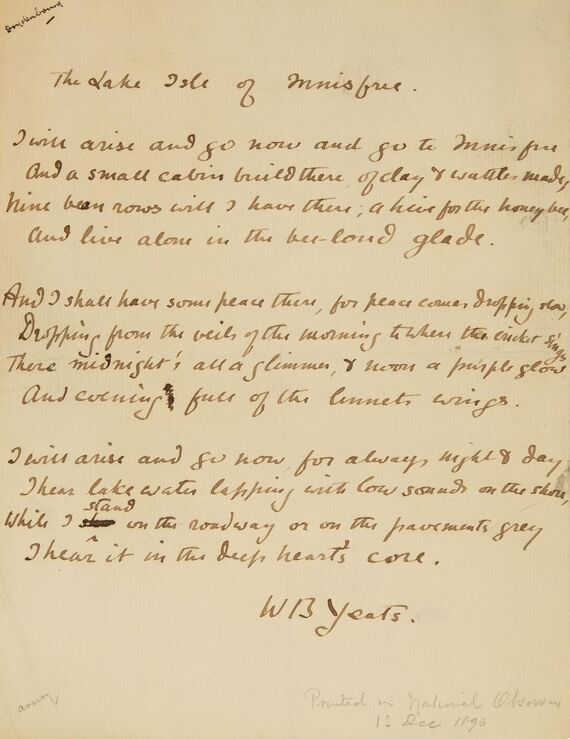
“The Lake Isle of Innisfree.” Manuscript. W.B. Yeats. 1890. First published in The National Observer newspaper in 1890. Courtesy of the Risings co-curators, Alan Klein and Alexander Neubauer.
Organized in nine chronological sections, Risings begins with The Fuse Is Lit, 1848–1900. Following the Great Hunger of the 1840s and massive emigration from Ireland, a national urgency for self-identity and autonomy grew. Early glimmers of the Irish Literary Revival featured the re-discovery of myths, songs, and poetry, published in the ancient language of Gaelic or translated into English. Among the early works on view in Risings are a copy of W.B. Yeats’s The Wanderings of Oisin (1889), a book of verse inspired by ancient Irish myths and inscribed to his muse, the independence activist Maud Gonne, and Yeats’s handwritten manuscript of “The Lake Isle of Innisfree” (1890), his most famous poem, based on a flash of memory from his childhood in Sligo, Ireland.
The second and third sections, The Revival in Bloom, 1900-1910 and The Abbey Theatre, 1900–1917, explore the collaborative work of W.B. Yeats and Lady Gregory, as they collected folklore, published influential volumes, and established an Irish national theater, often serving as directors and playwrights. On view is Yeats’s book The Celtic Twilight, inscribed in 1902 to Lady Gregory; and an inscribed first edition of J.M. Synge’s play “The Playboy of the Western World” (1907), which caused a riot at its premiere at the Abbey Theatre for its depiction of Irish rural life.
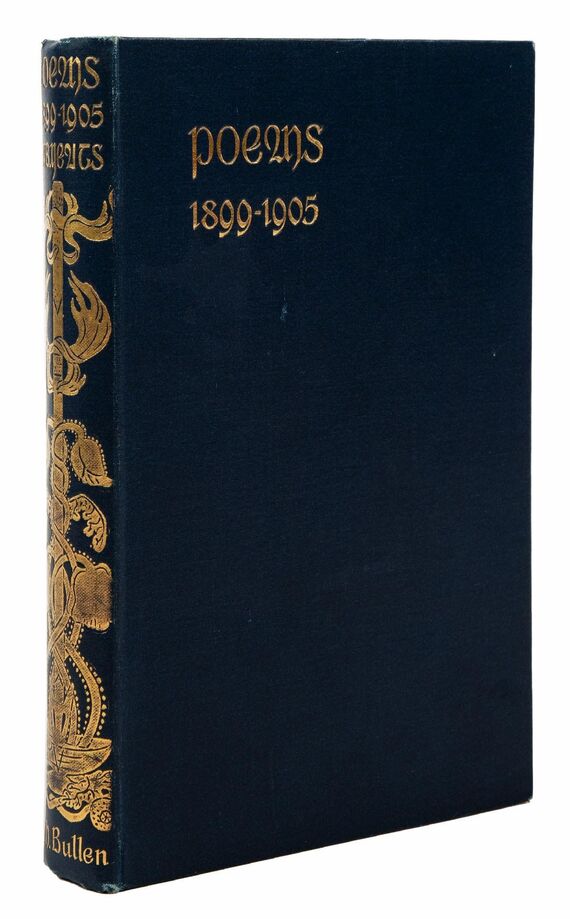
The Celtic Twilight. W.B. Yeats. Revised and Enlarged Edition. London: John Murray, 1902. Inscribed: “To Lady Gregory from W.B. Yeats July 7 1902.” With her bookplate. Courtesy of the Risings co-curators, Alan Klein and Alexander Neubauer.
The Cuala Press, 1903–1939 section focuses on the printing studios founded by Yeats’s sisters, Elizabeth and Susan Yeats, which became the preeminent publishers of Irish Literary Revival works. On view is a 1904 Dun Emer Press copy of The Stories of Red Hanrahan by W.B. Yeats, signed by Yeats with a rarely-seen astrological signature, indicating his interest in the occult; and a Cuala Press requiescat (memorial prayer card) commemorating the 1920 murder of Limerick Mayor Michael O’Callaghan by the Black and Tans, showing the Yeats sisters’ political sympathies with the cause of Irish independence.
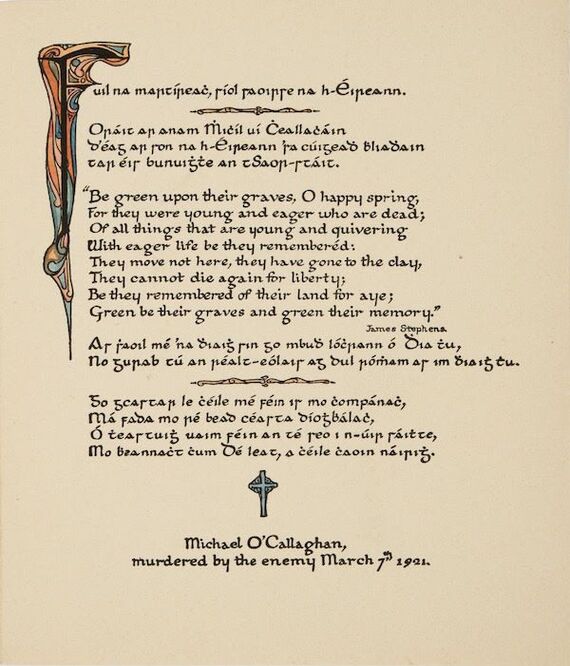
Detail of Requiescat. Dublin: Cuala Press, 1921. Memorial card for Michael O’Callaghan, Republican mayor of Limerick. Courtesy of the Risings co-curators, Alan Klein and Alexander Neubauer.
Subsequent sections of the exhibition explore how culture and politics reached a crescendo around the 1916 Easter Rising. In Lead Up to Rebellion, 1910–1915, a 1915 photograph shows Countess Constance Markievicz, an Irish suffragist and militant activist (who married a Polish count), wearing an Irish Citizen Army uniform with a handgun in her holster. An active combatant and leader in the Easter Rising, when her death sentence was commuted by the British, she said “I do wish your lot had the decency to shoot me.”
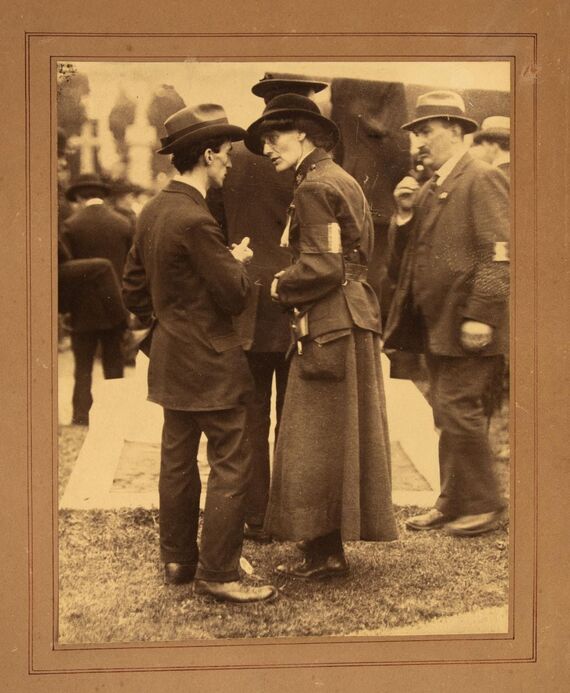
Countess Constance Markievicz. Vintage photograph, 1915. Courtesy of the Risings co-curators, Alan Klein and Alexander Neubauer.
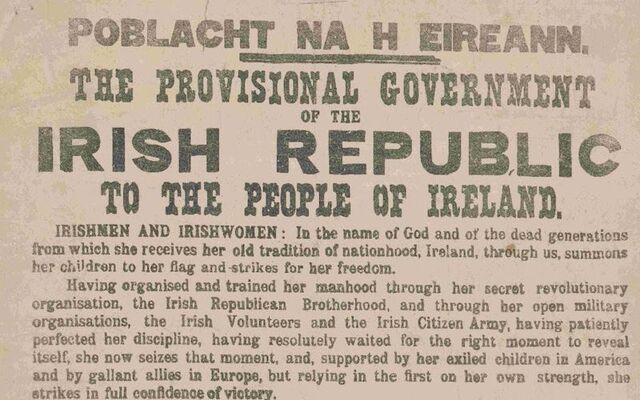
The 1916 Easter Rising section details the rebellion that began on Easter Monday, April 24, when approximately 1,200 Irish Volunteers began to capture key buildings in Dublin and southern Ireland. Padraig Pearse, commandant-in-chief of the rebel forces, read a hastily printed Proclamation of the Irish Republic, copies of which were then posted in central Dublin and handed out to the crowd. Despite fierce resistance against the British response, the Irish forces surrendered on April 29. After impromptu secret trials, British authorities executed fourteen leaders of the Rising between May 3-12, including all seven signers of the Proclamation.
A highlight of Risings is a rare, one-year anniversary poster of the Proclamation, Poblacht na hEireann / The Provisional Government of the Irish Republic to the People of Ireland (1917), printed with the same type as the original Proclamation read aloud by Pearse. Never before displayed, this copy was recently uncovered in the Berg Collection of The New York Public Library in a box described as “Irish Pamphlets: Easter Rebellion.” This exceedingly rare 1917 printing, initiated by the women’s nationalist movement Cumann na mBan to mark the first anniversary of the Easter Rising, was posted across Dublin using jam pots of glue, but most copies were quickly torn down by the police.
“The New York Public Library holds extraordinary collections documenting the literary and historical landscape of early twentieth-century Ireland, including the archives of W.B. Yeats, Lady Isabella Gregory, and others. Risings features recent discoveries in the Berg Collection, illuminating not only the significance of these materials to the historical record but also the profound impact archival research continues to have on shaping our understanding of the past,” said Carolyn Vega, Interim Associate Director, Rayner Wing and Curator, The Henry W. and Albert A. Berg Collection of English and American Literature at The New York Public Library.
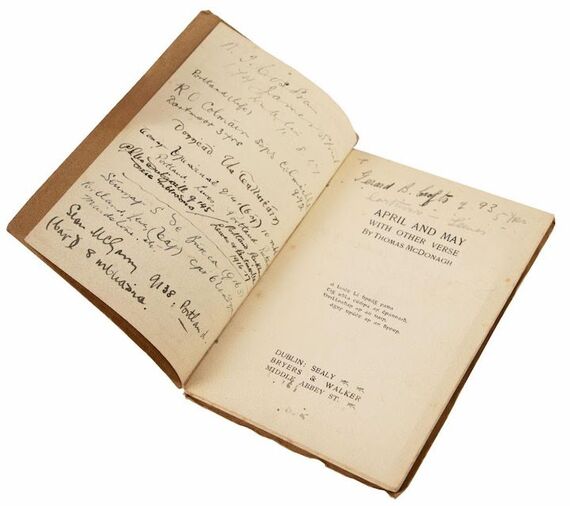
April and May. Thomas MacDonagh. Dublin: Sealy, Bryers & Walker, 1902. Courtesy of the Risings co-curators, Alan Klein and Alexander Neubauer.
Also on view is the poetry book April and May (1902) by Thomas MacDonagh, inscribed with signatures from 24 Irish prisoners who participated in the Easter Rising. A poignant memento, MacDonagh was a leader of the Rising who was executed by the British in May 1916.
The seventh section of Risings is The Road to Irish Statehood: World War I, the War of Independence, and the Irish Civil War, 1916–1923, a tumultuous time when support of British war efforts clashed with the independence movement in Ireland. After years of a guerrilla War of Independence led by Michael Collins, he signed the Anglo-Irish Treaty in 1921 to establish the Irish Free State. Sacrificing some northern counties to remain part of the United Kingdom, Collins said “I have signed my death warrant.” Former compatriots turned against each other in the Irish Civil War, and Collins was killed in an ambush in August 1922. A special newspaper edition about Collins’s murder is on view in Risings, as well as a December 1922 government-printed pamphlet of the Constitution of the Free State of Ireland, marking the hard-fought victory for Irish independence.
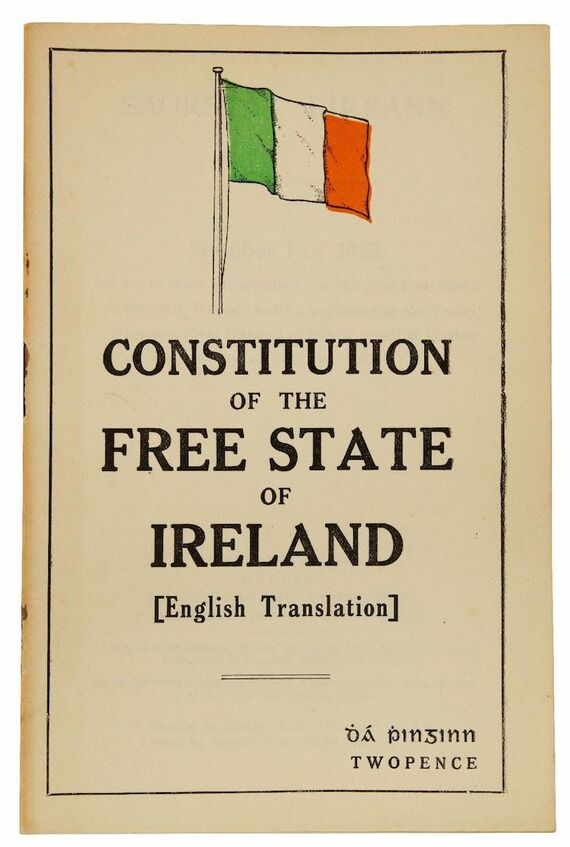
Constitution of the Free State of Ireland. Dublin: Published by the Stationery Office. 1922. Courtesy of the Risings co-curators, Alan Klein and Alexander Neubauer.
The eighth and final sections of the exhibition, Irish Literature in the Aftermath of Independence 1922–1939 and The Revival’s Legacy, showcase the long legacy of Irish arts. In the 1920s and 30s, James Joyce published Ulysses (1922), W.B. Yeats became the first Irish citizen to receive the Nobel Prize in literature (1923), and Sean O’Casey’s popular trilogy of urban tenement plays brought current events to the stage. On view is a first edition of O’Casey’s play The Plough and the Stars, a Tragedy in Four Acts (1926), inscribed to painter Augustus John. The exhibition closes with many examples of the ongoing strength of Irish literature, with works on view by poets Seamus Heaney and Patrick Kavanagh, playwright Samuel Beckett, and contemporary novelists such as Roddy Doyle, Colum McCann, Sally Rooney, Claire Keegan, and Colm Tóibín.
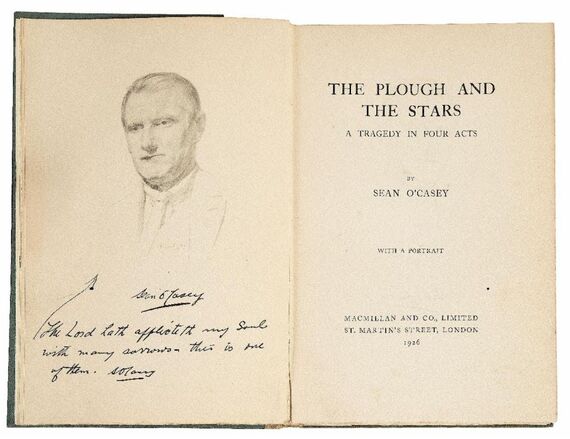
The Plough and the Stars, a Tragedy in Four Acts. Sean O’Casey. London: Macmillan and Co., Limited, 1926. Inscribed: “To Augustus John from Sean O’Casey with Warm Regards, 27/6/28.” Additionally inscribed by O’Casey, pointing to his portrait: “The Lord has afflicteth my soul with many sorrows & this is one of them.” Courtesy of the Risings co-curators, Alan Klein and Alexander Neubauer.
Publication
A related publication, titled Risings: The Irish Literary Revival and the Making of a Nation (Grolier Club, 2026; $20), is available for preorder through the University of Chicago Press. In addition to descriptions of the exhibition items, the illustrated catalogue includes an introduction by co-curators Alan Klein and Alexander Neubauer and four original essays: two by masters in the field of Irish studies and two by master Irish storytellers. R.F. Foster, author of the definitive biography of poet W.B. Yeats and numerous histories of modern Ireland, provides an overview of the Irish literary and political movements of the early twentieth century. Colm Tóibín, acclaimed Irish novelist and essayist, writes of James Joyce and the meaning of his characters’ names. Belinda McKeon, Irish playwright and novelist, views Yeats through his avocation as a collector. And scholar James Pethica, at work on the authorized biography of Lady Gregory, looks at her role as a political advocate and prime mover in the development of Irish cultural nationalism.
Programming
The Grolier Club will host a Risings festival of free public programs related to the exhibition.
More information and updates can be found at http://grolierclub.eventbrite.com.
Monday, May 4 at 6:30 PM
Exhibition Lecture: The Irish Literary Renaissance with Colm Tóibín
Award winning Irish novelist and critic Colm Tóibín will trace the legacy of the Irish Literacy Renaissance through successive generations of Irish writers.
Monday, May 18 at 6:30 PM
A Celebration of Irish Poetry with Paul Muldoon and Kevin Young
In association with Poets House
Paul Muldoon and Kevin Young will read a selection of poems by the leading poets of the Irish Literary Renaissance and their successors, as well as their own work.
Tuesday, May 19 at 6:30 PM
Person, Place, Thing with Randy Cohen, with Alan Klein and Alexander Neubauer
A live recording of Person, Place, Thing with Randy Cohen featuring the curators of Risings: The Irish Literary Revival and the Making of a Nation.
Tuesday, May 26 at 4:00 PM
“The Irish Literary Revival: Then and Now” Zoom Panel Program with R.F. Foster, Belinda McKeon, Fintan O’Toole, and James Pethica
Tuesday, June 16 at 6:30 PM
Live at The Grolier — Celebrating Bloomsday With An Evening of Traditional Irish Music
In association with the Irish Arts Center
Cashel Blake Day-Lewis will lead musicians in an evening of traditional Irish music.
Thursday, June 25 at 6:00 PM
Staged Reading of Colin Murphy’s “Inside the GPO”
First performed inside the General Post Office on O’Connell Street in Dublin during the 2016 commemoration of the Easter Rising, this play covers the five days in which the 1916 Rebels occupied the GPO after proclaiming an independent Irish Republic.
Wednesday, May 20; Wednesday, June 17; and Wednesday, July 15 at 1pm
In-person tour of Risings: The Irish Literary Revival and the Making of a Nation.
About The Grolier Club
Founded in 1884, the Grolier Club is America’s oldest and largest society for bibliophiles and enthusiasts in the graphic arts. Named for Jean Grolier (1489/90–1565), the Renaissance collector renowned for sharing his library with friends, the Club’s objective is to promote “the study, collecting, and appreciation of books and works on paper.” Through the concerted efforts of an international network of over eight hundred men and women—book and print collectors, antiquarian book dealers, librarians, designers, fine printers, binders, and other artisans—the Grolier Club pursues this mission through its library, its public exhibitions and lectures, and its long and distinguished series of publications.
Visiting The Grolier Club
47 East 60th Street, New York, NY 10022
212-838-6690, www.grolierclub.org
Hours: Monday–Saturday, 10 am to 5 pm
Admission: Exhibitions are open to the public free of charge


Comments