It has been a long time since Ireland has been considered so cool. The last peak of Irish popularity was in the Nineties when U2 released Achtung Baby, My Left Foot won two Academy Awards, and the success of the Republic of Ireland football team, in Italia '90 and USA '94, boosted national pride.
Then, as we grew economically and overcame our residual hang-ups, a new Ireland emerged that was creative, outward-looking and won international recognition via its artistic capital.
Now we are experiencing a highly enjoyable case of dé ja vu. Suddenly, there are talented Irish people everywhere: winning Oscars (Cillian Murphy and Jessie Buckley), starring in the West End (Éanna Hardwicke, Siobhán McSweeney, and Nicola Coughlan in The Playboy of the Western World), and headlining festivals (CMAT and Kneecap at Glastonbury).
Today, claiming Irish lineage has never been as popular, and that’s not just down to Brexit and Trump’s regime driving the demand for Irish passports – being Irish is increasingly perceived as cool.
This aura of attractiveness is thanks to a new wave of Irish actors, musicians, designers, and creatives embodying a new national confidence that is molding an identity that is more Paddy Cool than shamrocks and shillelaghs. The days of being embarrassed to be Irish are definitely over.
So, with Irish culture reaching its tentacles everywhere, it isn’t surprising that the fashion world has fallen for the charms of Irish designers, textiles, and handicrafts too.
Currently, two major international fashion houses are led by Irish designers, Jonathan Anderson at Dior and Seán McGirr at Alexander McQueen.
View this post on Instagram
Anderson has also enjoyed a clutch of awards from the British Fashion Council, including both the Best Menswear Brand and Womenswear Brand of the Year in 2015, and then the Designer of the Year in 2024 and 2025. On winning in 2024, he cheekily quipped, "It’s good to see Irish people are back in vogue."
While Dublin designer Peter O’Brien was a highly respected figure as the creative director at the Parisian house of Rochas for 12 years in the nineties and early noughties (where he referenced Irish culture and textiles), his name was known largely to industry insiders. However, he absolutely did pave the way for Irish designers at luxury brands today.
Simone Rocha impressed Paris too when she was the guest designer at Jean Paul Gaultier Haute Couture in January 2024 and won rave reviews. She has also enjoyed numerous awards, most recently winning the British Womenswear Designer of the Year in 2024.
In her work, she typically blends Irish craft techniques like lace, crochet, and hand knits with tailoring and evening wear to create a very distinct look that often explores Irish culture.
View this post on Instagram
Later this year, she will be the Guest Designer for the 110th edition of Pitti Uomo in Florence, Italy, where she will present her first-ever independent, full menswear runway show.
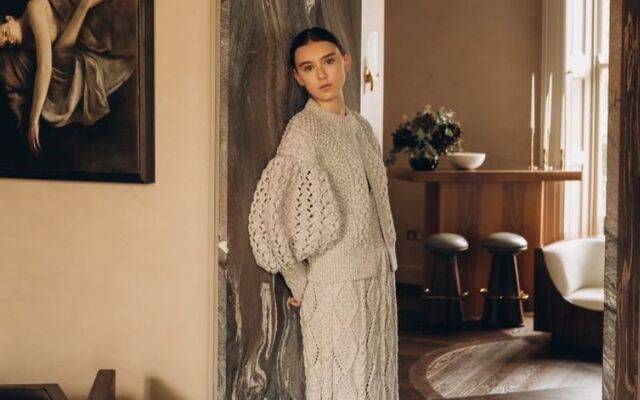
At home too, a new cohort of Irish designers has emerged in the last decade like The Landskein (who tailor coats and blazers from tweeds by fifth-generation weavers in County Donegal), Colin Burke (who re-imagines the Aran with dramatic voluminous sleeves), Sarah O’Neill (who taps into Irish folklore for her romantic prints) and Róisín Pierce (who re-invents traditional Irish handcrafts like crochet and lace in a unique aesthetic).
View this post on Instagram
All are rooted in Ireland’s rich heritage of textiles and handcrafts, which harks back to a legacy that also inspired 1950s designers Irene Gilbert and Sybil Connolly, who incorporated lace, linen and crochet into their luxury couture, which sold to wealthy American clients decades ago.
Today, what unites both established Irish design labels and emerging Irish designers is a respect and love for our island’s artisanal traditions.
Consumers are shopping brands like Magee 1866, Kindred of Ireland, Jack Murphy, Stable of Ireland, Inis Meáin and Aoife McNamara, who champion Irish fabrics and stitches in clothes that relish heritage but also incorporate a modern attitude.
View this post on Instagram
This fusion of old and new was recently exemplified by Jonathan Anderson, who used Donegal tweed in his debut Dior collection. This endorsement was amazing exposure for the fabric, which is currently seeking protective status under the EU’s Protected Geographical Indication (PGI) legislation.
Currently, anyone can identify their fabric as Donegal Tweed regardless of where it is woven, but this protection would ensure that only tweed actually made in Donegal could carry the title.
View this post on Instagram
The Irish are born communicators, and today the art of storytelling is no longer just confined to literature- it is in our music, film, theatre, animation, dance, art, design and also our fashion.
There are 35million people in the United States alone who claim Irish heritage, and America still represents a land of opportunity for Irish brands.
Aoife McNamara on the factory floor while her Irish wool fabric is being woven
There is also a growing awareness of Irish design in Europe: recently, the Council of Irish Fashion Designers brought its members to show at Paris Fashion Week, while designer Aoife McNamara exhibited at Copenhagen Fashion Week.
The upcoming Irish Presidency of the Council of Europe also offers a vital opportunity to promote Irish fashion.
There is incredible soft power in design, and it would be wonderful to see our native brands receiving additional state support to grow and thrive, rather than just survive.
That indeed would be really cool because these moments in the limelight don’t last, and we need to capitalize on them while we can.
* This article was originally published on Evoke.ie.



Comments