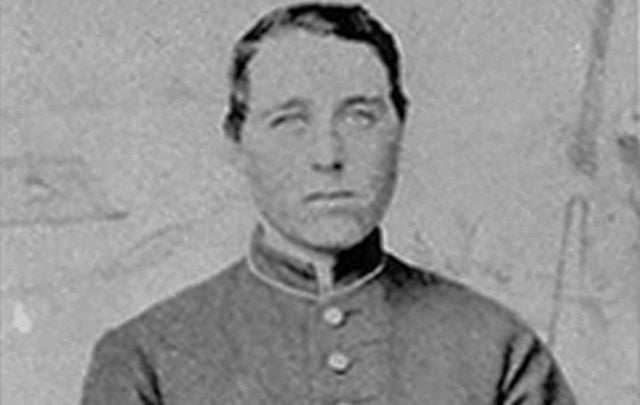
Ireland has produced many famous women who have made their mark in culture, politics, and the arts. Many are household names, but unfortunately, some are not. A different name, better known as Jennie Hodgers.
Born on Christmas Day 1843, in Clogherhead, County Louth, to Sallie and Patrick Hodgers, Jennie left her native land as a stowaway dressed in men’s clothes at the age of 18 and ended up in Illinois.
Jennie arrived in America just as its Civil War began. In those days women could not join the armed forces but Jennie, who had travelled to America disguised as a male, changed her name to Albert D.J Cashier and joined the Union army on August 6 1862.
Jennie enlisted in the 95th Illinois Infantry, and although she stood at a mere 5"3 and did not socialize well with the other soldiers, suspicions were not aroused as to the real identity of the small and quiet soldier.
Jennie’s regiment fought in over 40 battles, including the siege at Vicksburg and the battle of Guntown, Mississippi, where they suffered heavy losses.
In the heat of battle, Jennie proved her mettle. While on a reconnaissance mission in Vicksburg, she was captured by a Confederate soldier. Jennie managed to grab her captor's rifle and knock him unconscious with it before running away. Shortly after that, at another skirmish, Jennie witnessed as the enemy tore down her company’s flag. She took it upon herself to retrieve the flag and climbed a tree under heavy fire, where she hung it from a high branch. Throughout the war, she displayed extraordinary bravery and miraculously avoided any serious injury, a fact that helped her maintain her identity.
On August 17, 1865, Jennie was mustered out of the army, and she returned to Illinois, where she lived for over 40 years in the town of Saunemin. Because she was still living as a man called Albert Cashier, she could claim a veteran’s pension. Jennie didn’t just live off her army pension; she took various jobs, including lamplighter, janitor, and dry-goods clerk.
Read more
Jennie was proud of her war record, and every year on Memorial Day, she put on her uniform and joined the local parade with the other veterans, continuing to do so until she was injured in an unfortunate accident in 1910.
Jennie was working on the local estate of Senator J.M Lish, picking up sticks from his driveway, when he hit her with his car. The accident resulted in Jennie being left with a broken leg, and she was brought to the hospital. When a doctor examined Jennie, he discovered her real identity, but out of respect for the Civil War veteran, he kept it a secret.
The broken leg had left Jennie with a bad limp, and she decided it was best to retire to the Soldier and Sailors Home in Quincy, Illinois. Jennie still maintained her disguise, but over a two-year period in her new surroundings, she developed dementia and was moved to Watertown State Hospital for the Insane, where it was discovered the old soldier was not a man but a woman.
On March 29, 1914, The Washington Post reported on the woman who posed as a man in the army. It went on to state the sad fact that Jennie was committed to an insane asylum but reported how she had ‘participated in some of the bloodiest battles of the war and behaved with gallantry.’
At the asylum, Jennie was forced to wear women’s clothes, something she had not done in over 50 years. Jennie found it hard to wear long dresses, and one day she tripped over one and broke her hip. While recuperating from that accident, Jennie also came under investigation by the Pension Bureau. This arm of the government had decided to revoke Jennie’s pension, but with the aid of former comrades who claimed she had fought as tough as any man on the battlefield and was deserving of the pension, the government body backed down and let Jennie keep her well-earned pension.
On October 11th, 1915, Jennie died at the age of 72. She was buried in the uniform of the 95th Illinois Infantry with full military honors in Sunny Slope Cemetery in Saunemin.
In the aftermath of Jennie’s death, an article appeared in the Anglo-Celt newspaper of November 6th, 1915, looking for heirs of Jennie to claim money she had left behind, but none were found.
In 1977, the people of Saunemin replaced the standard military marker on Jennies grave with a much bigger one bearing the following inscription:
Albert D. J Cashier
Co. G, 95th Inf. Civil War
Born: Jennie Hodgers
In Clogher Head, Ireland
1843-1915.
* Originally published in 2017, updated in December 2025.


Comments