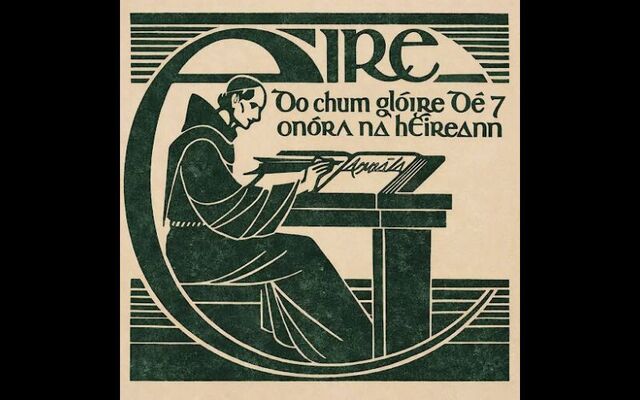
400 years ago under an Irish oak tree in the garden of St. Anthony’s College, Louvain, two south Donegal Franciscans changed Irish history forever.
Fr. Hugh Ward, Guardian of the Irish Franciscans in Louvain, sent Brother Mícheál Ó Cléirigh back to their beloved homeland in south Donegal on an eleven-year mission from 1626-1637 to collect, compile, and chronicle Irish history.
Boyhood neighbours Hugh and Mícheál were both well-respected learned members from two of Ireland’s most renowned Gaelic clans, patrons of the O’Donnell dynasty of Tirconnell. Hugh was descended from the bardic Wards that lived in Ballymacaward in Ballyshannon, and Mícheál was descended from the Ó Cléirigh historians that lived in three south Donegal parishes: Kilbarron, Drumhome, and Magh Ene.
Deeply rooted to her ancient coastal plain and parish of Magh Ene, Ireland’s premier seaside and surf town, Bundoran, possesses a 700-year recorded Ó Cléirigh history. Mícheál’s cousin and fellow compiler of the Annals, Cú Choigcríche's mid-17th century Ó Cléirigh Book of Genealogies records that the O’Donnells originally gifted their Bundoran land, "Drumacrin in Magh Ene" to the Ó Cléirighs in c.1348.
The Magh Ene Ó Cléirighs lived, farmed, and studied on their Bundoran lands through “The Golden Age” of the O’Donnells in the late 14th, 15th, and early to mid-16th centuries. The O’Donnells held their strategic stronghold and frontier-fortress at Bundrowes Castle, protected the parish churches at Finner and Ballyhanny and oversaw their famous fisheries, which stretched from the River Drowes in Bundoran to the River Erne in Ballyshannon.
Unfortunately, this Gaelic-inspired Golden Age was overshadowed by the English invasion of south Donegal during the Nine Years’ War (1593-1603). However, the scholarly spirit of the Ó Cléirighs survived through the wartime darkness, ultimately illuminating the native cultural wealth of that once-mighty Golden Age through chronicling Ireland’s poetically rich history.
After the end of the Nine Years’ War and at the beginning of the Ulster Plantation, An Inquisition record taken in 1603, “Meares and bounds of the territory of Tirconnell” highlights that the Bundoran Ó Cléirigh lands belonged to Mícheál’s chronicler-cousin and teacher, Lughaidh Ó Cléirigh, Chief Historian and Poet of Red Hugh O’Donnell. Lughaidh was the most powerful Ó Cléirigh in County Donegal at this time, making it striking to imagine him living and working as a chronicler amid Bundoran’s surf-music in Magh Ene, and not in Kilbarron, as has long been assumed.
Lughaidh is recorded residing in Bundoran as "Loy O’Clere of Doran, cronocler” (Lughaidh Ó Cléirigh of Bundoran, chronicler). One of my Donegal Democrat history articles illustrates that “Doran” was the old Gaelic name for the modern coastal district of Bundoran, where the Ó Cléirighs historically lived and held land since the 14th century. Another article presents scientific evidence from a 2019 DNA test that confirms the Bundoran Ó Cléirighs are genetically more closely related to Lughaidh than the Kilbarron Ó Cléirighs.
Although it has long been assumed that Lughaidh’s student, Mícheál, lived and was partly educated in Kilbarron, there are no historical records of Mícheál in Kilbarron, nor is there any documentary evidence that Kilbarron Castle stood during Mícheál’s childhood in the 1590s.
It is possible that a part of Mícheál’s boyhood learning as "a chronicler by descent and education" may have taken place with the most renowned Ó Cléirigh scholar, his chronicler-cousin and teacher, Lughaidh in Doran (Bundoran). Mícheál relayed in his Focloir no sanasain nua (1643) that he learned much of the Irish language from Lughaidh.
The only local historical records of Ó Cléirigh are his own words, which he wrote while living with the Donegal friars “at Drowes” and the Franciscan Louvain Papers record of The Convent of Donegal at “Bundrowis” from c.1626-1630. Together, these historical records unequivocally establish Mícheál writing The Annals of the Four Masters on the Donegal side of the Drowes, at Bundrowes friary in Magheracar, Bundoran, in Magh Ene, from 1626-1637.
With “Bundoran” appearing in Ulster Plantation records in 1606 and 1608 and with the Flight of the Earls (1607) leading to Lughaidh’s Bundoran lands being granted to Trinity College in 1610, Mícheál’s Gaelic world fell before his erudite eyes and he eventually took flight to continental Europe.
Years later, after possibly serving as a soldier in Spain in 1621 and then joining the Franciscan Order as a lay brother in Louvain, Ó Cleirigh’s journey back to Ireland in 1626 marks the beginning of one of the most defining moments in Irish history–the creation of Ireland’s most monumental history book of Gaelic scholarship, Annála Ríoghachta Éireann (The Annals of the Kingdom of Ireland or The Annals of the Four Masters).
The Louvain Papers record (1968) of the Franciscan friary of refuge at "Bundrowis" is a remarkable record of Irish history that creates the Franciscan bridge between Fr. Hugh Ward at Louvain and Brother Mícheál Ó Cléirigh during his work at Bundrowes.
Edited by Fr. Brendan Jennings and Fr. Cathaldus Giblin, the Louvain Papers record is "A Note of Some Monyes (Monies) sent over" and lists: "From Ardmach, 20 Ls. From Bundrowis, 20 Ls. From Multifernan, 26 L. 10 shillings. From Drogheda, 10. Ls. From Dublin, 10 Ls. From Kildare, 11 Ls."
The Convent of Donegal at Bundrowes is recorded on equal Franciscan footing with other contemporary Irish friaries that sent money from their respective convents to Louvain. The fact that the record dates to the period of Ó Cléirigh’s work informs us that Ó Cléirigh’s scribal notes "at Drowes" referred to its friary place name "Bundrowes." Contextually, two other local, shortened named examples from the 17th century document that "Áth Seanaigh" referred to "Béal Átha Seanaidh" (Ballyshannon) and "Doran" referred to "Bundoran."
There are only two townlands located on the Donegal side of the Drowes: the Bundoran townlands of Ardfarna and Bundrowes, the old name for today’s townland of Magheracar. The Louvain Papers record of "Bundrowis" friary therefore clearly locates Mícheál’s Four Masters Convent of Donegal at Bundrowes in Magheracar, Bundoran.
Modern scholarship from historical authorities agree that Ó Cléirigh created the Annals at Bundrowes friary in Magheracar, Bundoran and not as the Michael Ó Cléirigh Summer School had considered Kilbarron, Donegal Town and Rosfriar, County Leitrim. After reading my Donegal Democrat history articles and my RTÉ Brainstorm article, the Summer School now considers that the Annals were compiled at Bundrowes in Magheracar, Bundoran.
As Ireland’s leading Four Masters historian, Dr. Bernadette Cunningham, describes in her book, The Annals of The Four Masters (2010): "Following the destruction of the original monastery buildings in 1601" in Donegal Town, "the Donegal Franciscan community, based at Bundrowes in the extreme south of the county, provided Ó Cléirigh’s base for most of the eleven years he spent in Ireland as a Franciscan friar between 1626 and 1637." In a March lecture at the Atlantic Technical University in Castlebar, Mayo, Dr. Cunningham spotlighted Ó Cléirigh’s Annals being created in Bundrowes: “which is on the outskirts of modern day Bundoran”.
As noted in my RTÉ Brainstorm article:
“The four Magh Ene townlands that encompass the coastal district of Bundoran are Bundrowes (Magheracar), Drumacrin, Ardfarna and Rathmore. During the Ulster Plantation, these four townlands are recorded as the Trinity College Lands in 17th century records. Over 400 years later – these four townlands still encompass the coastal district of Bundoran.”
The late Bundoran historian, Fr. Paddy Gallagher’s book Where Erne and Drowes meet the sea (1961) and his research on Ó Cléirigh, highlights that Bundrowes is specifically recorded as the old name for Magheracar, Bundoran in Trinity College land grant records:
In a Donegal Annual article from 1953, Fr. Paddy states that: “In a Trinity College grant from 1855, “A grant in Perpetuity”, dated 31st October, 1855, from “The Provost, Fellows, and Scholars of Trinity College to Thomas Conolly. In this grant the same four quarters are again listed: Drumacrin, Rathmore, Ardfarna and ‘Magherycar, otherwise Bundruse’. In other words O’Donnell’s quarter of Bundrowes, granted in 1610 to Trinity College, was the seventeenth-century equivalent of the modern townland of Magheracar” in Bundoran.
While William McCrea’s map (1801) labels both Bundrowes and Magheracar, by the OS 6-inch map (1830s), Bundrowes is labelled "Magheracar." Additionally, a Google Maps search of the historic sites of the 15th century Bundrowes Castle and the 19th century Bundrowes House clearly locate them in Magheracar, Bundoran.
The Irish Franciscans (OFM) have updated their Provincial website to note the history of Ó Cléirigh at the Convent of Donegal at Bundrowes in Magheracar, Bundoran.
The Royal Irish Academy have also updated their library website to note that Ó Cléirigh’s Annals were "Written in Irish (in a Franciscan friary at Bundrowes on the Drowes River, Co. Donegal.”
However, Managing Editor of the RIA’s Dictionary of Irish Biography, Eoin Kinsella has not made any revisions to Dr. Cunningham's Ó Cléirigh biography, which entirely omits Bundrowes. This position is at odds with the RIA library website, Cunningham’s book and modern scholarship, all of which identify Bundrowes as the home of Ó Cléirigh’s Annals.
Moreover, the DIB contradicts itself on the matter of omitting the fact that Bundrowes is Magheracar, Bundoran, since Editorial Assistant, Terry Clavin has already recognised Bundrowes as modern Bundoran in another DIB entry: “Later that year Burke joined with Sir Nicholas Malby (qv), president of Connacht, on an expedition during which Bundoran was captured.”
While hundreds of published historical references conclusively establish that Bundrowes (Magheracar) is modern Bundoran, one recent example is an excerpt from Dr. Simon Egan's book, Beyond the Pale and Highland Line: The Irish and Scottish World (2025). Dr. Egan states that: “O Domhnaill regained possession of the castle of Bundrowes (modern Bundoran) which had also been seized by Malby.” Dr. Egan is a board member of the Irish Humanities Alliance, which is hosted and supported by the RIA.
Bundrowes is also famously explored in Fr. Brendan Jenning’s pioneering book, Mícheál Ó Cléirigh, His associates and St. Anthony’s College, Louvain (1936) and Fr. Paul Walsh’s masterful book, The Four Masters and Their Work (1944).
In 2007, Bundrowes was a focal point in Writing Irish History: the Four Masters and the World – a landmark collaborative exhibition between TCD, RIA, UCD and the Franciscan Order:
“The work began in the Franciscan Friary of Bundrowes in Donegal in 1632 . . . The scribes were supported by the Friars of Bundrowes for the duration of their work.”
Bundrowes is widely accepted by every reputable Irish, British and international historian and historical authority, as well as every academic and scholar that specialises in the Four Masters and 17th century Irish history. The question now remains: Why does the DIB omit the irrefutable historical evidence and documentary scholarship on Bundrowes?
Considering that the RIA holds the original autograph manuscript of Ó Cléirigh’s Annals, it has a major educational responsibility to educate the Irish public about the geographical location where the manuscript was created: Bundrowes, in the modern coastal district of Bundoran.
It is only right that Ireland’s greatest historical chronicle of Gaelic scholarship be respected by accurately providing the recorded context of where it was created, thereby honouring Ó Cléirigh’s own legacy as a chronicler.
Given that Bundrowes has been recorded in the public domain as Magheracar, Bundoran, for 200 years, any further updates and revisions are vital steps towards recognising and honouring Mícheál Ó Cléirigh’s life and work at Bundrowes friary in Magheracar, Bundoran, during the 400-year commemoration of his return to Ireland.
Oral history and local tradition from Bundoran’s old natives, Fr. Gallagher’s book on the Bundrowes Four Masters site, historic maps and archaeological artefacts further reveal the most likely location of Ó Cléirigh’s Bundrowes friary at an old church site in The Ross, Magheracar, Bundoran, 1400 metres south east of Bundrowes Castle.
An old stone cross, found in 1881, and now displayed outside Bundoran Parochial House, together with Bundoran stone-carver Brendan McGloin’s sculptures, Ó Cléirigh (2002) and An Triur Ceann - The Triskele Heads (2002) at Bundoran Library will artistically represent historical touchstones for telling the Four Masters history in Bundoran during the 400-year commemoration of honouring Mícheál’s return to Ireland in 2026.
Four hundred years on from Ó Cléirigh leaving Fr. Ward, under the Irish oak tree in Louvain–Mícheál’s spirit now returns home this summer to Bundrowes friary in Magheracar, Bundoran–still rewriting Irish history.
*Éamon Ó Caoineachán (Eddie Keenaghan) is a poet, writer and historian from Bundoran, Co Donegal. He is a PhD postgraduate in Arts at Mary Immaculate College in Limerick.

Comments