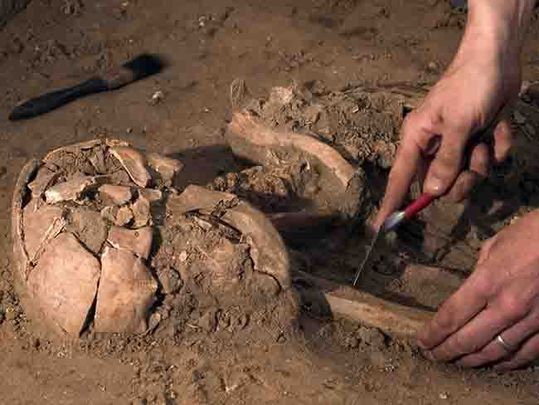
Archaeologists and scientists discovered the remains of up to 1,300 people in an ancient gravesite in County Donegal revealing incredible insights into 800AD doctors.
Irish brain surgeons were operating in the eighth century in a remote area of Ireland. That's according to stunning evidence discovered at an ancient grave in County Donegal. Archaeologists and scientists unearthed the remains of up to 1,300 people after discovering the graves alongside an unknown medieval church on the banks of the River Erne at Ballyhanna.
The scientists said they were able to determine that brain surgery had been carried out on some of the people and they also discovered evidence of TB and cancer. They also said they may have found evidence of cystic fibrosis in the Irish population of some 1,000 years ago.
The findings were made during the 2009 excavation of what would become the Ballyshannon/Bundoran bypass.
Ireland's National Roads Authority is required to maintain an archeological team on every road-building scheme but the team had no idea they would be digging up a medieval church.
Read more
Michael MacDonagh, a senior archaeologist with the National Roads Authority said, "It was an incredible discovery because it was completely unexpected. It is possible that because Ballyshannon suffered so disastrously during the Famine, that these burial grounds just fell out of local memory."
The findings, which were originally discovered in 2003, were revealed during Science Week Ireland.
One fascinating discovery was that of the remains of a young female. Dating back to AD800, her skull showed evidence of brain surgery. "We know that she survived the operation as the skull shows signs of bone growth after the hole was cut into it," MacDonagh said.

Love Irish history? Share your favorite stories with other history buffs in the IrishCentral History Facebook group.
The remains of a disabled man were also discovered. The man's legs had fused together, as a result of multiple exostoses, also known as bumpy bone disease.
“This man lived into his 30s which was a typical lifespan then. He would have had to be carried everywhere and he was obviously buried formally and with respect, which tells us something about how medieval society treated people with disabilities,” MacDonagh added.
* Originally published in 2009, updated in Nov 2024.



Comments