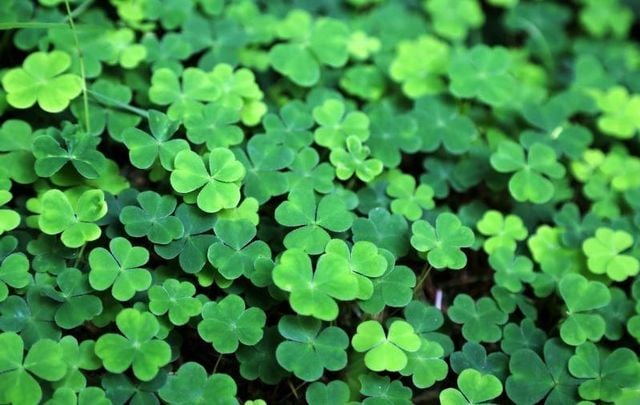
I hope you have a bottle of good, strong Irish whiskey stashed away, all ready to fortify you for the St. Patrick's Day parade and for the ritual drowning of the shamrock through the big day.
If so, my advice is to take a good shot from the bottle here and now before you read the rest of this quite shocking story. You will need it. Okay?
You're back with me and feeling stronger. That's good because this article is as difficult to write as it is to read.
Until I did a little bit of research, you see, I always believed that the beautiful green shamrock only grew in Ireland. That is what I was taught when growing up.
And I was also taught the shamrock is so special to us as a symbol of the Irish because St. Patrick used a fistful of shamrock on the Hill of Tara to explain the mystery of the Holy Trinity to the pagans around him at that historic site. Take another shot from the bottle... The facts are that the first four letters of the word shamrock are brutally and cruelly accurate.
The facts are that there is no evidence at all that St. Patrick used the delicate little plant as a conversion tool at Tara or anywhere else, for that matter.
The facts are that he never mentioned shamrock in his many writings about his conversion campaign at that time. The facts are that any link between the good saint and the shamrock did not appear until English writers and botanists began to mention the myth as hearsay around 1571.
The facts are that the Druids that St. Patrick displaced and shattered did have some respect for the shamrock as an edible and healing herb, but there is no hard evidence at all to substantiate the story. Take another shot from that bottle... There is no such botanical plant as the shamrock. It is wrong to think that the shamrock only grows in the Emerald Isle.
The plant or plants that we call shamrock grow all over Europe and beyond – even in Mother England – and are frequently treated as weeds!
Even Irish botanists of great lore and learning cannot accurately identify a shamrock to this very day! The cruel reality is that the original Gaelic word seamróg, Anglicized to shamrock, means "young clover," and that is where the problem begins.
Even here in Ireland, different species of clover (and even other related plants) are pinned to our breasts on St. Patrick's Day.
As recently as 1988, the learned botanist Charles Jolson, then director of the famed Botanic Gardens in Dublin, attempted to solve the shamrock issue by asking folk from all over the country to send him their shamrocks.
It seemed a good idea at the time, but I'm sad to say that you now need another shot from that bottle! You see, what happened was that not only did he receive totally different species of clovers from all over the land, but he also received alleged shamrocks which were not even clovers.
Rakes of them! I could blind you with botanical names here, but since you are already feeling delicate, I will simply say that a clover called trefolium dubium was the most common shamrock selection across the land, but there was also a strong showing of hardy trefolium repens, trefolium pratense, and various other mutations, and even a strong showing of three-leaved plants which were not clovers at all. A fair percentage of the specimens he received were actually of wood sorrel!
So even when the bands play, and the parades begin through the hometowns and villages of Ireland on St. Patrick's Day, there are many separate species of clovers being paraded. And not a genuine mythical shamrock amongst them.
(At this point, please forgive me because I need to take a healing shot from my own bottle because I fear I've worn sorrel on my bosom more than once in the past. I'll be back with ye in a moment…)
It is customary for our political leaders to travel in numbers over to the US for St. Patrick's Day and to present the President with a basket of luxurious, allegedly shamrock-filled baskets. What will the Taoiseach bring with him to the White House? Will it even be a clover at all?
That 1988 astonishing survey apparently revealed that a good number of Mayo folk actually wear wood sorrel on their hardy breasts.
If it is indeed wood sorrel, which is traditionally presented by the Taoiseach of Ireland to the President of the United States. I hope he will be informed that, though it has a bitter taste, it also has considerable medicinal properties. The old Druids swore by it.
Incidentally, we might have lost the trademark use of the shamrock altogether about 30 years ago were it not for the intervention of another famous Mayo-born leader of the country, none other than the frequently maligned late Charlie Haughey.
The Irish government had long registered the shamrock as a national trademark, but this was successfully challenged in the German courts in the 1980s by a company which, I understand, wished to emblazon our shamrock on their fleet of refuse trucks and bulldozers. Haughey, however – fair play to him – saw to it that the case was powerfully appealed to the German Supreme Court in 1985. We won, and the (alleged) shamrock has been safe as our trademark ever since.
We don't have exclusive rights, though. The shamrock is still the official symbol of the Danish town of Viborg and a range of other towns and cities, which include the German city of Furth. It is also attached to the flags and banners of many sporting clubs, both in the USA and right across the world.
Regiments in many armies march behind images of the shamrock. It is central to leading soccer club Panathinaikos in Greece, has been inscribed on the walls of Buckingham Palace since the Act of Union in 1801 (as a trefolium dubium beside the leek, thistle and rose) in the Royal Coat of Arms, and, in general, English writers down the centuries have been intrigued by the clovery connection between the Irish and the trefoils.
Time to take another swig out of that bottle. We ritually drown whatever species of clover we have worn on the big day, and, as we all know, some of us drown it more thoroughly than others. However, that is only half the story.
The English writers Edmund Spencer and Edmund Campion were amazed to report in the 16th century that the Irish were actually devouring large quantities of shamrocks, especially (they said) poorer Irish living through hard times.
Given the botanical confusion involved, there is a possibility that they were actually seeing folk eating the aforementioned wood sorrel.
That is an interesting point because, forgetting our patron saint's work altogether, the wise old Druids often advised the Irishmen of their time to consume wood sorrel, as it would make them strong and speedy in battle. I kid you not.
Sorry for smashing a few fables, but I know well you will have a mighty day anyway, no matter which species of clover adorns your person during the marching hours in question. In the end, it does not matter at all.
And in conclusion, I would like to send special greetings to all the surviving residents of the small town of Shamrock in Texas and suggest that they consider renaming it Trefoil or Oxalis before this time next year.
* Originally published March 2014, updated in March 2026.



Comments