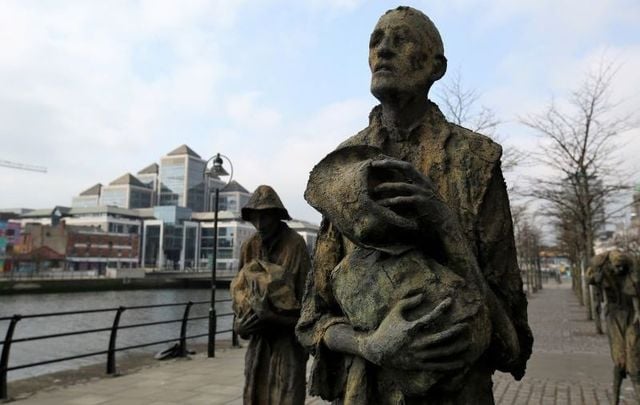
“The Famine emigrations represent one of the greatest population displacements of modern times, an exodus on a stunning scale that has no other nineteenth-century parallel,” writes Dr. Ciarán Ó Murchadha in his 2011 book, "The Great Famine: Ireland’s Agony 1845 – 52."
“Between 1845 and 1855, approximately one-quarter of the inhabitants of an entire European nation, amounting to some 2.1 million persons, were permanently removed from their homeland.”
Over 95 percent of those who left Ireland during the Famine traveled across the Atlantic, and about 70 percent of all emigrants who arrived in the United States settled, typically in cities of over 100,000, in seven northerly states: New York, Connecticut, New Jersey, Pennsylvania, Ohio, Illinois, and Massachusetts.
The total number who died during passage is unknown, but Dr. Ó Murchadha, who teaches history and Irish at St. Flannan’s College, Ennis, Co. Clare, estimates that it may have been more than 80,000. Fever – due both to the condition of those who embarked and the filthy conditions aboard – was the primary cause of death.
"The Great Famine" includes a vivid description of life on these ‘coffin ships’ written by Stephen de Vere, son of a Co. Limerick landlord, who traveled steerage to Quebec in 1847. Passengers were “huddled together without light, without air, wallowing in filth and breathing a fetid atmosphere”. They were “sick in body, dispirited in heart…living without food…dying without the voice of spiritual consolation, and buried in the deep without the rites of the Church."
However, surviving the voyage was not the end of the hardship for Famine emigrants. In fact, for most, it was just the beginning of a new chapter of desolation.
“A great number of these emigrants had never previously ventured outside their own local areas,” says Dr. Ó Murchadha. “Suddenly, they found themselves transported thousands of miles away: from a rural to an urban landscape, to a very alien social environment where the inhabitants didn’t speak the same language and, frequently, showed a deep loathing for their Irishness and their Catholicism. This was bewildering and devastating to them.”
Gullible and unprepared for exile, many Famine emigrants were overwhelmed by their new surroundings and became easy prey for exploitation. In most cases, the book suggests, the predators were not unscrupulous Anglo-Saxons but, instead, fellow Irish who wielded their soothing, familiar tones – in Irish or English – to lull the new arrivals into trusting them.
Most of the Famine Irish struggled to improve their circumstances. “For all but a lucky few,” the author writes, “the lot of the Famine immigrants was grinding poverty, unemployment or backbreaking, dangerous work for little pay. Immigrants’ lives were shortened by work-slavery, psychological alienation, and the alcohol with which many sought to obtain relief from both.”
Chief among the stigmas endured by the Famine Irish and inherited by their children, Dr. Ó Murchadha suggests, was the “brand of their Irishness” and, consequently, their inferiority. But for them – and subsequent generations – this was eased by the succor of Irish neighborhoods, particularly the trinity of the Catholic Church, Irish cultural societies, and major political organizations, until demography, democracy, and economic success enabled the Irish to tentatively assimilate within the majority society.
Those who remained in Ireland grappled with another kind of anguish. “As surviving inhabitants tried to come to terms with a significantly emptier landscape, they were also wrestling with a sense of guilt: that they had survived and a great number of their neighbors had not,” says the author. “In so many cases, their survival had been at their neighbors’ expense. This sense of survivor guilt was something that inevitably became embedded in the Irish psyche.”
Read more
Charting a monumental record of abject suffering, from the destruction of the potato harvests, through to the degradation inflicted by the relief programs, the swell of fever pandemics through the workhouses, the mass clearances by landlords, and the hemorrhaging emigration, The Great Famine climaxes with a sober analysis of the consequences and causes of this seminal event in Irish history.
Approximately 1.1 million died and over a million emigrated during the Famine. The population of Ireland plummeted from almost 8.2 million in 1841 to 6.5 million in 1851. Among its legacies were the physical and psychological disabilities of Famine survivors in Ireland and abroad, a deep-seated hatred of Britain, ruptured social and communal intimacy, rising conservatism in Irish society, and a highly influential Catholic Church that met a gaping spiritual yearning and provided otherwise absent leadership.
The failure of private charity and state relief is central to explaining the extent of the Famine, insists the author. While contributions towards famine relief were received from the US president, the papacy, and, most movingly, from the Choctaw tribe of Native Americans – the Famine resonated with the ‘Trail of Tears’ deaths during their forced population transfer from Mississippi to Oklahoma in 1841 – its impact was tempered by soaring international food prices. While Britain spent £8 million on relief programs in Ireland during the Famine, most of it as loan advances, it spent £69 million on the Crimean War (1854 – 56).
Additionally, Dr. Ó Murchadha argues that the prevalence of providentialism – the belief among the British government that the Famine was an opportunity to reform Ireland – is essential to account for the Famine and, controversially, he believes Britain may have been guilty of genocide.
“If you’re talking about a Jewish-style holocaust, a deliberate attempt such as by the Nazis to annihilate an entire people, then it’s not that kind of genocide,” he explains. “But there is a case for asking if the British deliberately used the Famine to thin out the ranks of the Irish by allowing mass death and emigration after 1847. Of course, it was never admitted at the time so it can’t be proven. But the question is certainly valid.”
"The Great Famine: Ireland's Agony 1845-1852" is published by Continuum, an imprint of Bloomsbury Publishing.
* Originally published in 2013. Updated in September 2025.


Comments