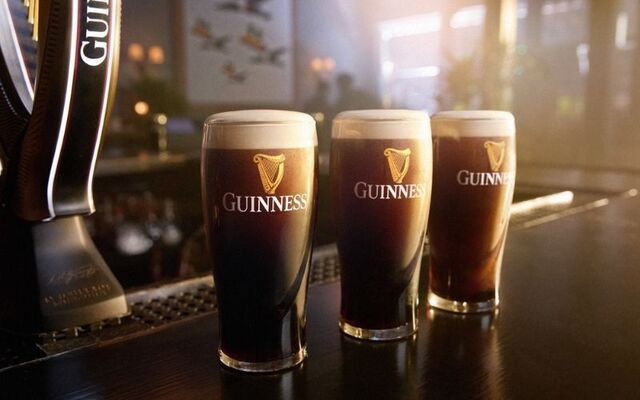
The real reason why bubbles in a pint of Guinness go down instead of up. The bubbles in a stormy pint of stout actually go down instead of rising!
Science has finally figured out just why Guinness is so unlike other brews in that respect. Lucky members of the Royal Society of Chemistry investigated a selection of pints last week in London.
They used a super-fast camera that magnified the bubbles to 1000 percent of their normal size and zoomed in on their behavior.
They found that the bubbles rose rapidly at the center of the glass, pulling the surrounding liquid with them and setting up a circulating current, while the outlying bubbles moved downwards.
Senior researcher Dr Andrew Alexander, a lecturerer in chemical physics at the University of Edinburgh, said he had wanted to do this experiment since drinking Guinness as a student.
"I'd wanted to try and capture the bubbles going down as I had obviously wondered whether it really did happen, having drunk a few Guinness during my time at university, or whether it was an optical illusion created by the waves in the drink that don't contain any bubbles. Nobody had carried out the experiment before.
"To capture the image, we had a camera which uses 4,500 frames a second and a zoom lens of times 10. When we saw the bubbles really were going down, I was immeasurably happy.
Read more
"We then filmed it as a colleague pointed out that people might have said all we did was turn the photos upside down. But it's true. The circulation cells in the glass provide the same effect like you see in a tornado."
A spokesman for the RSC said: ''Guinness is good for this experiment as the bubbles are small, due to being released at high pressure by the widget and therefore easily pushed around.
"The gas in the bubbles is also important. In lager beers, the gas is carbon dioxide which is more easily dissolved into the liquid. The gas in Guinness bubbles is nitrogen - not so easily dissolved and therefore not prone to grow larger.
"Finally, the contrast between the dark liquid and the light cream bubbles makes the bubbles much easier to see."
* Originally published in 2016, updated in Jan 2025.


Comments