RSS
Irish Roots Cafe


Irish Roots Cafe

by Michael O'Laughlin

Posted on Tuesday, July 20, 2010 at 11:21 AM


'Celtic' myth exposed by DNA


Bookmark and Share


Milesians Not Irish Founders

We have been taught for a few generations
that the Irish descend from the Celts.
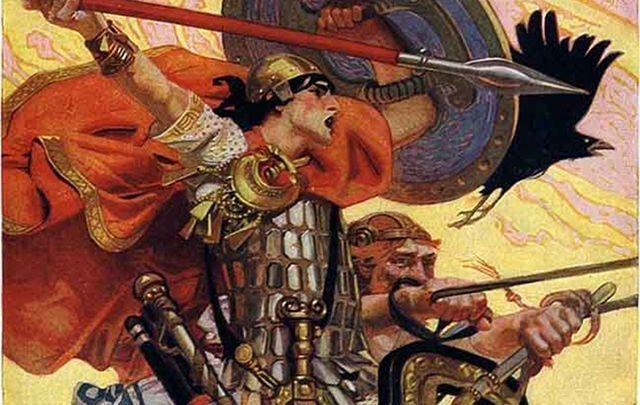
The King of one wave of Celts was Milesius.
Milesius is the most famous Celt in legend
I think. Some call him the founder of
the Irish people - but it looks like it is
mostly a fanciful story.

First Irish Families
DNA studies are now telling us that Ireland
was settled centuries earlier than thought.
It was not first settled by the Celts of legend.

Ice Age Survivors
It was actually those who survived the last
ice age about 10,000 years ago, holding out
in northwest Spain. As things warmed up,
they found their way to Ireland.
In fact, the closest DNA match with the
Irish in all Europe is with the Basque.
Take a look at the film 'Blood of the Irish'
and you'll become a believer.

How They Got Here
Current theory is that they came by boat
to Ireland, which was settled much later
than Britain, which was connected by
land to the continent. They did not come
from Scotland, but from Basque country.
So, at least they came from around Spain like
some of the Milesian legends speak of.

Our New Ancestors
We still have to double check all the findings
but it seems pretty convincing. The Irish and
the Basque are brothers, so to speak. As far
as we can see, our earliest ancestors were
the Basque people. So there is the point to
start your genealogy in Ireland !

Books
If you want to see some of the legend that
came from the story of the Celts and
Milesius there is a book. It is titled
'A Genealogical History of the Milesian
Families of Ireland' that I published
several years ago.

Book of Invasions
If you want to see a real classic, take a
look at the 'Book of Invasions', one of our
oldest written stories about who settled
Ireland. This book gives that the Irish
originally came from Spain. This is the
ancient book that O'Donnell took to the
court of Spain, trying to strengthen the
ties between the two countries. Looks
like there was some truth there.....

All of this should make doing current
day research on your Irish family history
seem a lot easier....
Just remember, Every Day is a holiday....


-Mike O'Laughlin
www.Irishroots.com

About the author of this blog
Mike is the most published author in
his field, and also founded the first audio
show on the internet, on Irish Families
and genealogy.


7 Comments

It may take several minutes for your comment to appear.
The legends themselves say that the Milesians succeeded the Tuatha de Danaan, and that before them in turn were the Fomor, although they are hazy about the origins of these earlier peoples. Possibly successive waves who all immigrated from Spain at different times? We don't know, but the legends do give a Spanish origin for the Milesians, and if the DNA says the original inhabitants (the Fomor, or someone else?) also came from there, there's not necessarily any inconsistency in that. The Milesians are considered to be Gaels, a sub-group of the Celts.
The Celts had an important influence on the English language which is related to that genetic study which shows the Anglo Saxons did no exterminate the Celts they met in England. At least Celt genes are recognized now amongst English people (and not deemed racially inferior), maybe one day too, the Celtic origins of English vocabulary will find similar acceptance.
Identities are language and culture based, not racially or genetically based. Ireland has a strong and distinct Celtic language and culture, some of which survived the English invasion and occupation. Interestingly, when you get away from formal French and learn street French the manner of talk is funny, laced with elaborate metaphors, and playful, a Celtic cultural heritage. My own parents could speak very formal English, even using Victorian periodic sentences, but when they were being Irish their English was another language culturally and psychologically - witty, playful, self-mocking, full of elaborate metaphors and dramatized emotions. Much more fun. But then the old English working class speech was also great fun.
Curious about what this article did not point out from this DNA study, namely that the Irish, Basque AND English are closely related but not that closely related to the rest of Europe. In England there is also a thin overlay of Saxon and Celt, as there is in Ireland, with the Saxon thinner.
But you put "Celtic" in quotation marks as though you had found evidence to disprove something the Irish think about themselves. You had not. The well-known monument Newgrange was built by the people the Celts incorporated into what became two thousand years of Gaelic Ireland.
Many folks researching Irish family history, have not studied early Irish History at all. This is understandable, but it can lead to misunderstandings. I have had several genealogical researchers state that the Celts and Milesius were the first Irish, etc... The point of this brief article is that people were here thousands of years before the 'Milesians', and it has been proven we carry the DNA of those people today. Evidenced of late by the bones found in the Burren, DNA matched to living school children, pre-dating the Milesians, etc... The fact is that DNA is improving our knowledge of the origins of the Irish.
The myth is very clear that the Milesians were not the first invaders. Where has it ever been written that the Celts were Ireland's first inhabitants? Everyone knows the Celts invaded a populated island and subsumed everyone over centuries into a Gaelic Irish identity, with a Celtic language most Irish spoke up until a few generations ago. Your refutation of the Celtic origin of Irish people is unexplained and badly stated.


remember me on this computer
forget your password?     
IrishCentral.com is also home to Irish Voice and Irish America magazine