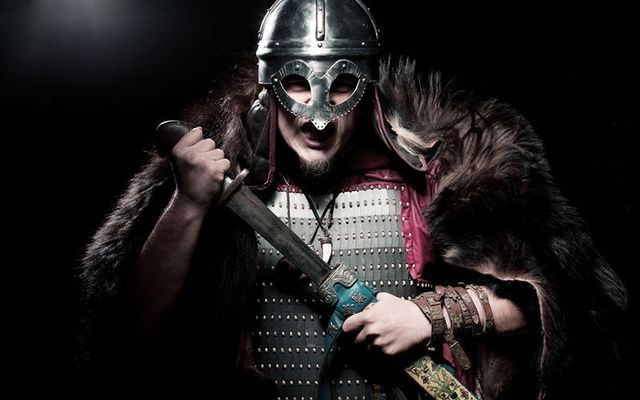
From words we use daily, to leaps in shipbuilding, placenames, cuisine and more, Edythe Preet explores all that the Vikings left behind in Ireland.
One day while searching for I can’t remember what in my foot-thick Webster’s Dictionary, which has been my word go-to since high school, I stumbled upon a most interesting linguistic factoid. Every single question word in the English language (who, what, where, when, which, and why, plus whose, whither, whence, whom and even how) has a Viking origin. It makes sense.
Picture this: a Viking raiding ship has just dropped anchor and hordes of bloodthirsty marauders have come ashore. They chase down one poor fellow and bombard him with questions. Who are you? What place is this? Where is your leader? When did he leave? Which way did he go? Why won’t you tell us where the gold is? And the clincher: How many men are hiding in the forest?
It doesn’t take much to imagine the scene, especially since Hollywood has done us the favor of putting it up on the big screen countless times. Huge, helmeted Viking warriors wreaking havoc on a sleepy pastoral setting provide spectacular action footage and big box office returns. However, it was not so entertaining a scenario some 1,200 ago in Ireland.
The first recorded raid occurred in 795 AD when the church on Lambeg Island was plundered and burned. While the Vikings were Pagans, their assaults were not religion-based. At the time, there were no true towns in Ireland but rather scattered communities near monasteries that served as ‘safe houses’ for valuables, food, and cattle. This made those locations prime targets for Viking raids.
Why Ireland was singled out is not clear, but most historians agree that her lush landscape proved an enticement the Norsemen could not ignore as their own territory lay in such a harsh climate zone that farming was an arduous business at best.
Another factor that played a huge part in the invasions was the Northerners' seafaring knowledge. The Irish had not yet developed any shipbuilding skills, relying on coracles, small willow-framed one or two-man boats covered in animal hides, to ferry people and goods on the island’s network of rivers and streams. The Viking longboat, on the other hand, was an amazing example of advanced maritime technology for the time. It was durable enough to weather the worst storms of the North Atlantic, yet its slender design and minimal draft could easily navigate inland rivers and land on shallow coastal beaches.
Initially, the Vikings were satisfied with seasonal lightning raids on their Southern neighbors. Men headed out to sea after their spring crops had been planted and returned home after a few months of pillaging to reap the meager autumn harvest, their boats heavy with plunder and slaves.
It wasn’t long before Ireland’s mild winters and verdant hills convinced the offshore interlopers it would be wise to emigrate there. In the 9th century, invasions began in earnest. The monastery of Armagh was sacked in 832AD, and Clonmacnoise in 837AD.
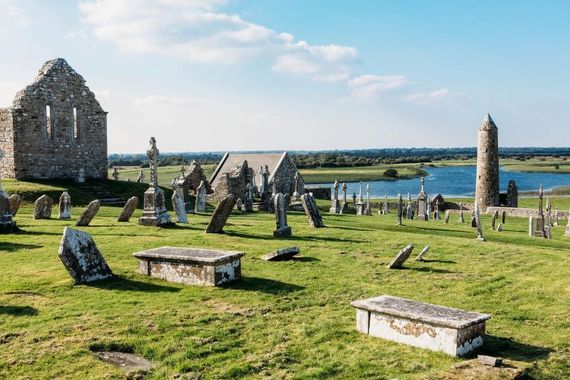

Clonmacnoise graveyard and round towerr, in Roscommon.
At the time, Ireland was divided into numerous ‘kingdoms’ that no one ruled outright, and no unified force defended the territory. The Vikings continued raiding Ireland, pushing ever deeper inland, marrying local women, and making trade alliances with the various chieftains.
One of the earliest Viking settlements established at the mouth of the Liffey survived to become what is now modern Dublin. In 914AD, a fleet of ships established a base at Waterford, followed by a base at Cork. Somewhat later, an invasion up the Shannon estuary laid the foundation for Limerick.
Archaeological digs at these towns and other sites around Ireland have shown that the Vikings assimilated almost seamlessly with Irish life. Like the island’s inhabitants, the newcomers were farmers and herdsmen and ate a wide variety of native vegetables, greens, dairy, grain (oats), game, wild fowl, and beef.

Love Irish history? Share your favorite stories with other history buffs in the IrishCentral History Facebook group.
Unlike the Irish, who although they were island dwellers did not consume much fish, the Viking diet included copious amounts of seafood, much of which was preserved by salting. The invaders also blessed the Irish kitchen with a new dietary staple – chicken – which the long-ranging seafarers had discovered and quickly adopted in China where the birds had their origin.
For nearly two hundred years, the Vikings continued their pattern of invasion, settlement, and assimilation. Dublin developed into a wealthy trading center serving other Western European towns with slaves, commodities and shipbuilding skills.
Meanwhile, the individual Irish kingdoms began banding together, uniting finally under a single High King of Ireland, the great chieftain Brian Boru. His attempts to make everyone swear allegiance to him failed in only one key quarter. Mael Morda, King of Leinster, had cut his own deal with the Viking King of Dublin. Unable to iron out their differences, the opposing forces met at the bloody Battle of Clontarf on April 3, 1014. Despite the fact that Brian Boru was killed, the unified Irish chiefs prevailed, tolling the finale of major Viking influence on Ireland.
While researching this article, I decided to look for more linguistic Viking connections to Ireland. Up popped Waterford and Wexford. Both were built on inlets from the sea that still in Norse are called fjords. The city of Howth comes from hofuth, Old Norse for ‘headlands’: Skerries comes from skjcby, meaning ‘a rock.’ Ulster, Leinster, and Munster all share the ending ‘ster’ which comes from Old Norse stathir, meaning ‘a place.’ Proving how pervasive and permanent the Vikings were on the Emerald Isle, even the word ‘Ireland’ is derived from Old Norse Iraland! For more info see: www.archive.org
There were numerous other fascinating links, but the one that really flabbergasted me was my grandmother’s name: MacCaffrey! It stems from the Norse family name ‘Guthothr.’ I’m guessing here, but it could be an amalgam of gut (good) and Thor (the Norse warrior god whose hammer shook the heavens with thunderclaps) as many names were based on Norse deities. One thing is certain. Viking genes are floating around somewhere in my DNA chanting what has morphed from the warrior’s queries to the modern journalist’s six-word mantra: Who? What? When? Where? Why? How? Sláinte!
* This article was originally published in our sister magazine, Irish America, in 2010. Updated on IrishCentral in Sept 2023.

Comments