
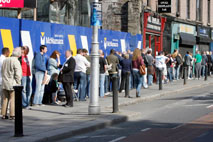
| People line up for unemployment benefits in Dublin last summer. |
As you probably know, last week Ireland passed its most recent review by the IMF-EU-ECB troika of officials -- they visit us every tree months to check the nation's finances.
It's the humiliating part of getting the bailout. They have the right to come in, examine how we're doing and tell us off to smarten up if we're not sticking to the program. Any back sliding and they could turn off the money flow until we came to our senses.
So far that has not been necessary. In fact we have been such good bailout recipients that we've passed every examination, and we're being held up to other EU countries in trouble as the model to emulate.
Once again we passed last week's quarterly exam -- the seventh since the November 2010 bailout -- with flying colors. In fact we've been so good at meeting our targets and keeping the troika happy that it's almost boring. Every three months they come in and tell us we're making great progress and to keep it up.
There is a down side to this, however, because it has generated a false sense of achievement and security among people here. It's true that we have managed to keep more or less on track so far in the program, but the reality is that the toughest part of the process still lies ahead of us.
The minor adjustments we have made so far have been mere trimming rather than cutting. All the low hanging fruit in the garden of state spending has been picked. In the future we are going to have to make cuts where it really hurts.
We're not near the end of our rebalancing of the nation's finances. In fact we're not near even the halfway point.
The fact is that despite the cuts in some state spending and the modest increases in some taxes over the past three years, Ireland still has the highest budget deficit in the eurozone. Not that you would think that listening to the government ministers complacently expressing "satisfaction" after getting the troika's approval again last week.
We may be hitting the targets in the bailout plan, but the fact is we're still broke. And we still can't quite accept the idea.
We go on running a tax system that is porous with avoidance schemes, and we go on insisting on a level of state spending that is way beyond our means. All suggestions of higher taxes and all attempts at making serious cuts in state spending are met with howls of anguish.
The result is that progress in rebalancing our books -- getting rid of the yawning budget deficit -- has been painfully slow.
Under the bailout program we're supposed to have the gap down to a 3% deficit by 2015. If we are to achieve that we need to stop the fiscal baby steps and take a few massive strides in cutting spending.
Even if we manage to get a deal on our bank debt from Europe which will lower the interest payments we have to make (due to reach around €10 billion a year within the next three years), we still have to rein in spending in line with our much reduced revenue.
Maintaining spending at near boom time levels even though tax revenue has collapsed is not a sustainable situation. That's why the markets stopped lending to us and why we had to take the bailout.
The fact is that if we are to regain our economic sovereignty the first thing we have to do is to start living within our means again.
That means we will have to go through at least three more draconian budgets over the next three years, budgets in which we implement real hikes in tax and real cuts in spending.
It's not going to be easy and it's not going to be popular (just wait until they make major cuts in welfare benefits and replace the present token property charge with a real property tax that takes big money from anyone living in a half decent house.) But that's what's ahead of us from next year, and favorable reports from the troika won't make the medicine go down any easier. It's going to be a very rude awakening from our present national torpor.
Rather than scare people with the reality of what lies ahead, the government has been saying little and hoping for a miracle of some kind.
Over the past year they have been clinging to the hope that growth in the economy would start to lift tax revenues and lower the welfare burden as more people found jobs. That would narrow the deficit gap and mean less cutting would be needed.
But it ain't happening. At over 14%, unemployment remains at a catastrophic level. The latest figures from the state's Central Statistics Office, which also were published last week, show that the Irish economy contracted in the first quarter of this year.
So there is not going to be any easy growth-led solution for us in the immediate future, the kind of solution that would allow us to wriggle through this correction process without feeling any real pain.
So let's look at some of the things we have to do here. First on the revenue side, we have to move away from the present tax system which is riddled with reliefs that allow many high earners to avoid much of their tax (dodgy property investment driven by tax reliefs was an example, contributing in a big way to the boom).
We need a simple, fair, progressive system with no get outs. A bonus would be that the army of lawyers and accountants who now get rich by undermining the system would have to get a real job for a change.
We also need a similar approach to the forthcoming property tax next year -- no exceptions, everyone pays, thereby keeping the average as low as possible. Charges for many state services now provided free (water for example) will also have to be introduced, even in taboo areas like health and education. The old adage that you never appreciate something you get for nothing has been proven by the rampant waste in the system at present.
On the spending side, even bigger changes have to be made. The two big untouchables, welfare and health, account for two thirds of all state spending, with the last one third going on everything else.
So to make any real progress in reducing the state spending we can't pay for, we have to start making cuts in these two areas. There's simply no other way.
It's not just a matter of cutting welfare rates. It's also a matter of limiting who is eligible, thereby drastically reducing the numbers who are claiming.
Our unemployment benefit, or jobseekers allowance as we call it these days, is one of the highest in Europe and has no limitation on how long someone can claim. People learn to work the system and develop a powerful sense of entitlement. Work, especially a regular job at or just above the minimum wage, becomes something to be avoided.
For those with children and who qualify for a range of free state services and payments, the cumulative benefits that come with being out of work are so high that it's hard for an employer to better them in pay.
"It wouldn't be worth it for me to take a job," these people say. "I'd lose my rent allowance and my fuel allowance and maybe my medical card. I'd have to pay for transport to a job and I'd have to pay for childcare.
“It wouldn't be worth it. I'd rather stay at home with the kids."
This situation is a real problem here now, although everyone tries to deny it. One economist who used to work for the Economic and Social Research Institute, the main state-backed think tank here, recently let the cat out of the bag by writing a report detailing exactly what was going on. The reaction here from the liberal consensus now running the country was to try to discredit him.
The other area that has to be tackled in a big way is the state sector. There are too many people on the state payroll here (about one-fifth of the national workforce!), they're being paid too much, and when they retire they have guaranteed high pensions we can no longer afford to pay. On top of that, efficiency in delivery of state services is poor.
Instead of instituting major cutbacks and reforms in the state sector, the government has continued with the Croke Park Agreement negotiated by the last government. The state sector is the last bastion of union power in Ireland and the present government, like its predecessor, is terrified of stirring up trouble which could cause strikes and disruption of basic services.
The Croke Park deal, which guarantees no forced job losses and no pay cuts in return for increased flexibility and efficiency, is bogus. It's largely controlled by the state workers themselves, and so change is resisted and takes forever.
Last week, for example, we had more statistics which showed that sick leave in the state sector is now twice as high as in private industry. Why? Because they can get away with it.
And despite all the talk about keeping state pay under control, it turns out that pay among state workers is now higher than it was at the peak of the boom in 2008. This is largely a result of the system of automatic annual increments in pay in the state sector, in contrast with the private sector where pay has been squeezed over the past few years as companies had to fight for survival.
All that has to change in the state sector, with management brought in from the private sector, performance related pay, cutbacks in pay and pensions to mirror what has happened in the private sector, and so on.
Instead, the state workers have been allowed to negotiate a reduction in their numbers, with people taking deals to get out on their golden pensions for life which are guaranteed at close to two thirds of salary.
The immediate savings for the state are very small, although the government is insisting that long-term savings will be substantial, with smaller numbers.
The IMF has watched in mild horror as this has gone on. They even suggested publicly that it might be better to reduce pay and pensions in the state sector rather than cut numbers so that the level of state services for the ordinary citizens could be protected.
Obviously they are right. But instead the state workers have been allowed to protect their pay, pensions and poor efficiency as the bogus Croke Park Agreement carries on and gets nowhere.
The government claims savings are being made and reforms are underway. But no one in the private sector believes them.
In the next budget in December -- assuming we don't need an emergency one before then -- the government has to find another €3.5 billion in savings and extra revenue to meet the bailout targets.
This time, even with a new property tax and other tax changes, major cuts in spending will be needed. The untouchables of the state sector pay and pensions, welfare and health will have to be tackled. There's nowhere else to go to get the budget deficit down by the amount required over the next year.
And if our government hasn't the bottle to do it, the troika will be stepping in to tell them to man up and get on with it.
It's sad but true that we are unlikely to get real reform here until it's shoved down our throats by the EU and the IMF.


Comments