Did Irish leader Daniel O’Connell help make the Famine happen? -- “Graves are Walking” book tells powerful Irish Famine truths
Posted on Friday, September 14, 2012 at 08:19 AM
RSS 
Recent Posts
- President Obama’s visit to North comes at a critical time for peace process - Hopes that he can help stop slow slide into the dark side
- Boston Irish Immigration Center continues to lie about their role in turning woman in to State Department
- Why no effort to repair damage to Irish Famine memorial in New York nearly one year after? - Car slammed into memorial and ugly plywood and metal barricades still mark the site
- How sports helped defeat the 'No Irish Need Apply' racism in America - Top baseball exec Tim Brosnan tells Irish Sports 50 how Irish served as example
- Sandy scourged Rockaways is on the mend with a little help from community spirit and perseverance
Archives
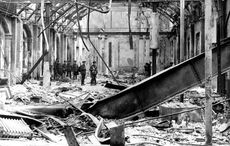
| Famine memorial in Dublin |
Like a wolf in search of prey
Comes the famine on his way”
That poem in “The Nation,” the journal of the Young Irelanders, who were the Irish republicans of 1846 summarizes what was occurring as Ireland headed full tilt for the Famine and disaster.
In his new book “The Graves are Walking” John Kelly gives an extraordinary insider account of the events that led to the Famine and the machinations on high and the suffering of the peasants below.
It is still an insane thought that the most successful country in the world at the time allowed millions to starve in Ireland, its’ closest colonial neighbor.
Imagine the US, the land of plenty, allowing millions of Hawaiians to starve in a Famine there and you get some sense of the absurdity.
This book reveals insights which have rarely been glimpsed and it does not shun controversy.
The role of Daniel O’Connell as liberator of the Catholic masses is well documented.
But also documented here is O’Connell’s disastrous decision to throw in his lot with Whig leader Lord John Russell who became Prime Minister in July 1846 at the beginning of the worst period of the Famine.
O’Connell did so to help gain the repeal of the Act of Union between Britain and Ireland, which was at the source of so many of Ireland’s problems.
But in the process he backed a man who had become a fully-fledged free trader who insisted that market prices must be received and no government intervention made – even when the result was millions of Irish starving because they could not afford to buy the imported corn.
Russell’s predecessor, the Tory leader Sir Robert Peel, as Kelly points out, had adopted a far more humane policy and had been widely praised for ordering and freeing up imported corn for starving Irish the previous year when the worst of the Famine was blunted.
Kelly has made a profound point about O’Connell that it was the biggest mistake of his life as Russell paid no heed to repeal and the Irish starved by the millions.
The book is scathing about the various British viceroys who came over to Ireland during that period, but kind to the many incredible charities, such as the Quakers and many American organizations as well who did their best to alleviate the suffering.
There is a hilarious chapter on Monsieur Alexis Soyer, a French chef who had proclaimed he had the perfect ingredients for a gourmet soup to save the starving Irish and was much praised in The Times of London and elsewhere.
He even demonstrated this for hundreds of aristocrats in Dublin watched by a “large and brilliant assemblage” and no doubt by the starving peasants as well. Even Monty Python could not have done such a scenario justice.
M.Soyer, gourmet soup and all were soon dispatched back to Britain and obscurity.
The fate of the Famine ships is also discussed in great detail, as is the sense of impending doom in cities such as Montréal as the famine increased and the Irish boats kept coming, discharging their wretched cargo.
The scenes at Grosse Ile, the quarantine Island as depicted by Kelly would bring tears from a stone, while the unlikely rise of the Irish in New York from Famine masses to political power is also documented.
A great read if you’re Irish and even if you’re not. "The Graves Are Walking" is already deservedly a best seller in Ireland.
44 Comments
15 - 44 | See all comments
Searlit | Sep 18, 2012, 12:37 AM EDT
@Pittsburghkid, that's quite a good analogy.
Report abuse
ancavker | Sep 17, 2012, 03:53 PM EDT
sirpeter: Do not paint all Irish-Americans with the same brush (apart from whether O Dowd is right or wrong) Any how on a lighter note. A friend of mine here in the U.S. who is Irish born (came here in the late 1980's), just came home from a trip back, and was shocked that someone over there told her she too is now a Plastic Paddy as she has lived in the U.S. too long!!!
Report abuse
IrelandNorth | Sep 17, 2012, 08:55 AM EDT
O Connell's undoing was when he called off one of his highly successul "monster meetings" (ie mass rallies) for a repeal of that constitutional sleigh-of-hand, Act of Union, 1800/'01. Daniel finally bumped up against the reality that democratically-challenged English imperialism will always threaten military action, even against cuddly constitutionalists like Dan "da man" O' Connell. And then will criminalise physical force when it raises its inevitable head.
Report abuse
MichaelSavage | Sep 17, 2012, 06:46 AM EDT
"It is still an insane thought that the most successful country in the world at the time allowed millions to starve in Ireland, its’ closest colonial neighbor."
It is not an insane thought once one properly understands the prevailing depopulation policy of the establishment in control of the British Empire. A famine in one of the most fertile most fishery rich countries in the world? Our best produce was robbed from us at gunpoint and shipped to the mainland UK. It was Genocide by Starvation and can be called nothing less.
Report abuse
seanomelb | Sep 16, 2012, 08:12 PM EDT
Should read "the life of Thomas Mitchell" by Sillard 1889.
Report abuse
dukmarshal@aol.com | Sep 16, 2012, 07:31 PM EDT
If it is to be finger pointing then point at;
1) the English press
2) the English government
3) the English lords
4) most of the landlords, both absent and present.
Report abuse
dukmarshal@aol.com | Sep 16, 2012, 07:16 PM EDT
Though I have not read this book, currently reading Paddy's Lament", I cannot fathom the idea of someone pointing a finger at Daniel O'Connell and blaming him for an Gorta Mor. When he threw in with Russell he was trying to repeal the act of union. He had already gotten nowhere with Peel's party.
Report abuse
WoundedKnee | Sep 16, 2012, 05:06 PM EDT
There's a poignant parallel between Ireland during the Great "Famine" and Ireland today. During the "Famine" Irish food was produced in abundance--corn, wheat, vegetables, beef. It was sent out of the country. Into the country came "food" that was alien to the Irish and had no tradition there--maize or American-style corn. Today, something similar happens. Young Irish men and women, the flower of Ireland, stream thru the Departures area in Dublin Airport. At the same time, aliens with no connection with Ireland are flooding in. The Irish of 1847 couldn't digest maize/corn, and today's Irish are getting sick on Mass Immigration.
Report abuse
Galeforce | Sep 16, 2012, 03:01 PM EDT
Let me tel ya. This is all true in this book and because of travellers like paddy, that mix ad spend time with settle people, country people
We are all starting to understand each other more..
Long may it continue, long live the travelling people.
Report abuse
Pittsburghkid | Sep 16, 2012, 02:24 PM EDT
Ireland's problems never change. Irish Kings invited the English to Ireland, who brought settlers to displace the Irish. Today the Irish are inviting the EU, who are bring settlers to displace the Irish. Ireland should look to the Swizz for a role model.
Report abuse
patsav | Sep 16, 2012, 05:43 AM EDT
The last I knew, Hawaii was in the United States and not its closest neighbor.
Report abuse
Lokelani | Sep 15, 2012, 11:58 PM EDT
Sirpeter: I don't think it is fair for you to put down Irish American's. "There but for the Grace of God" go you. No reason to be so boastful & proud; you had nothing to do with where you were born; you could have been born in England & there's nothing you could do about it & you'd be singing a different tune then. I happen to be one of those Irish American's you are talking trash about and I happen to love both America, where I was born & also Ireland, where my ancestors originated from. Check yourself. Rose O'Connor
Report abuse
seanomelb | Sep 15, 2012, 10:41 PM EDT
Why do you keep referring to it as a "FAMINE" Niall? are you out of touch with the reality of what actually happened. You are correct in saying that peel had a more humane attitude than his opposite number and yet O'Connell slated Peel and would not support his Irish relief programme's(The Life of Mitchell by Sillard 1989).
Report abuse
curtisjohnson | Sep 15, 2012, 10:24 PM EDT
Anything that deflects blame from the british terror state (with a history of worldwide manufactured famines, the other notable example being in India) is automatically considered scholarship. I doubt he mentions the fact that the terror state continued to steal what little funds the Irish people had in the form of forced tithes to the Anglican "Church."
Report abuse
- Good Morning America says Sasha and Malia...
- Michelle Obama and daughters trace their...
- Former church spokesman criticised for using...
- President Obama’s visit to North comes at...
- Sinn Fein deputy leader speaks out against...
- Daily Mail unloads on 'drunken young' Paddys...
- Body of Irish immigrant tossed in medical...
- North’s Minister for Finance accuses Republic...
- Shock as Irish priest praises Prime Minister’s.
- Secret Service agents take to the Fermanagh...
44 Comments
Report abuse