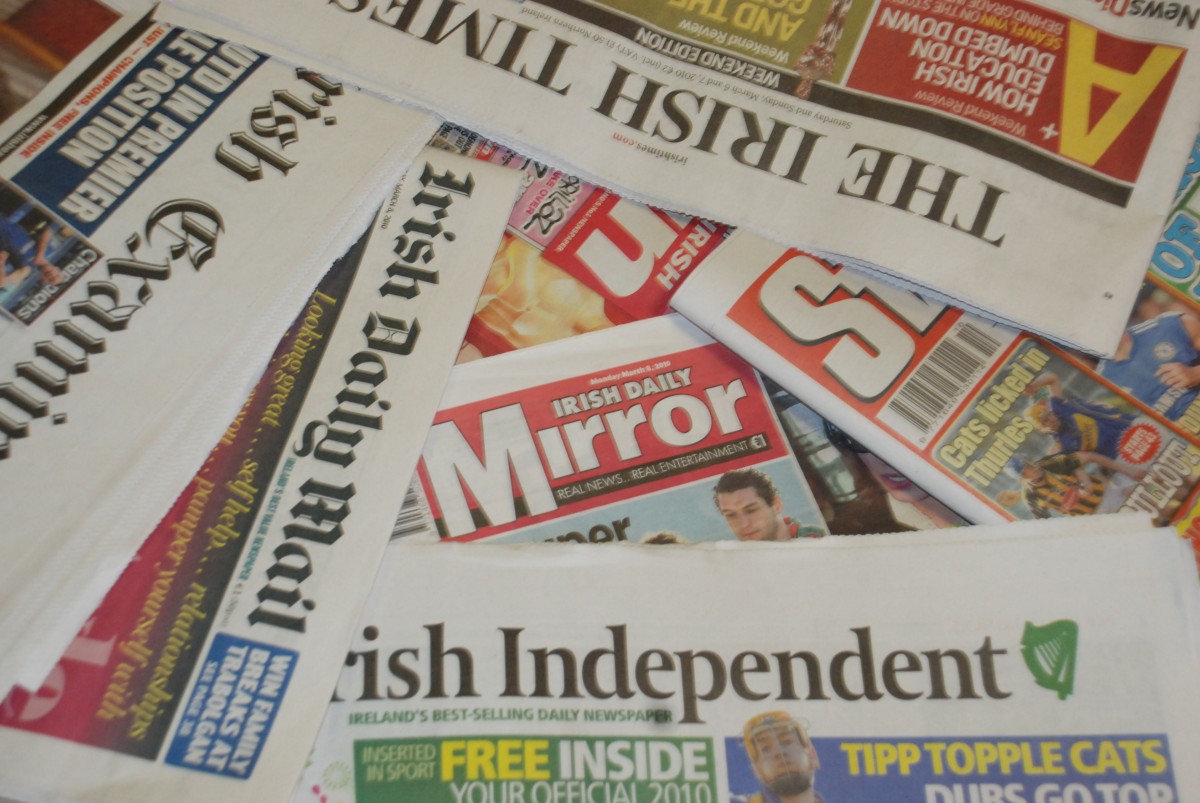
| Irish newspaper headlines make for depressing reads |
“Fears of severe depression mount if EU does not take action.”
“UK body warns of risk of EU defaults.”
“German minister admits to euro zone contagion.” “Small savers will pay if euro goes into meltdown.”
“Young couples told, ‘rent, don’t buy,’ as prices keep falling.”
“Shock as heating oil soars €300.”
“Families facing €340 health bill hike as costs rise again.”
“Jobless rate in Ireland up to 14.5% while euro zone hits new record at 10.3%.”
“75,000 people to leave Ireland next year.”
“Europe’s outlook falls below forecasts.”
“Ross warns Ireland could lose sovereignty for second time.”
“Minister sees Ireland returning to 1950s standards if euro fails.”
“Forecast for 2012 growth slashed over export fears.”
“Household income will fall by €7K over 4 years.”
Reading these fifteen headlines offers a small taste of what is continually on offer as of late in the Irish media. The headlines were selected at random from Ireland’s three broadsheet newspapers: the Irish Times, the Irish Independent and the Irish Examiner. The headlines all appeared on just one day, Wednesday, November 30, 2011.
The headlines provide an insight into just how profound a funk Ireland and all of Europe are in.
At European level, because of the serious, well-known economic difficulties Greece and Italy face at the moment, the future of the euro zone is in crisis. The aim of the euro was to foster greater European integration, but Greece and Italy – not to mention Ireland, Spain and Portugal – have inflicted wounds upon themselves and, in turn, upon the other member states of the European currency union.
---------------------
READ MORE:
More news from Ireland on IrishCentral
Irish town name deemed to be offensive by Facebook
US Irish targeted in British tabloid phone hacking probe
---------------------
Consequently, cracks are beginning to show, particularly in Germany, the financial hub of the European Union. German domestic politics will have a disproportionate impact in determining the future of the euro. Wide swathes of the German electorate are sick and tired of the fiscally irresponsible behaviour of their fellow Europeans and are increasingly saying “enough’s enough.” Moreover, as the Financial Times reports on November 30th, some international corporations are already preparing contingency plans for how they will address the end of the euro.
Irish politicians and economists warn that the end of the euro would be devastating for Ireland on a number of different levels and moot a number of different courses of action that could be taken. Most of these involve dramatic and drastic intervention by the European Central Bank to save the euro. While varied and nuanced proposals are emerging, what is being called for in broad terms is that the bank should print a large amount of new currency – what is euphemistically known as “quantitative easing” in the United States – to solve the immediate crisis in the euro zone.
Yet there are apparent shortcomings to what’s being mooted by Irish politicians and economists. One difficulty is that the calls for European Central Bank action have something of a “band aid solution” feel to them. The second is that it may be impossible to force the bank to print new currency, given the historical experience of and palpable fear about rapid inflation among Germans.
Again, domestic political realities in Germany will play an integral role in how and whether the European Union can emerge from this mess. The latest call by German Chancellor Angela Merkel for a “fiscal union” with rigid budgetary controls to save the common currency is partially an attempt to address the understandable recalcitrance of the German people. The idea of “fiscal union” could also inspire confidence among governments and financial institutions outside of the European Union. It would be painful though.
Domestic realities of all kinds in Ireland are perhaps even more chilling. The country is desperately trying to extricate itself from the place it now finds itself in. The new government is to follow its predecessor and will unveil the details of another more austere budget with a range of tax increases and spending cuts this week.
---------------------
READ MORE:
More news from Ireland on IrishCentral
Irish town name deemed to be offensive by Facebook
US Irish targeted in British tabloid phone hacking probe
---------------------
A 2% rise in VAT (value added tax), a property tax, rises in excise duty, a carbon tax, a fee for medical cards for senior citizens and water charges are all on the horizon. The rate of income tax, which has risen steadily in recent budgets, won't be touched this time, leading advocates for those living in poverty to charge that the upcoming budget will disproportionately hurt those already in dire circumstances.
On the spending side, significant cuts in capital spending have been announced with more to come. And decreases in the rate of child benefit, in the legal aid budget and in funding for non-governmental organizations that provide a wide array of badly needed services to those most in need are also on the way.
At a very human level, tax increases and spending cuts will pose further awful human dilemmas for so many people who are stretched far too thin as it is. Many struggling parents throughout Ireland who might have been able to just about put together a nice Christmas over the past few years are at, this very moment, initiating dreaded conversations with their children about this year’s presents. My heart goes out to them.
I’m afraid that I can’t offer any new solutions for how we here in Ireland and across Europe can extricate ourselves from this malaise. There are plenty of economists for that. And I’m not going to play the “blame game” about how we managed to get here. There are plenty of politicians for that. I can, however, attest to how frightening the reality of living in Ireland in 2011 can sometimes be.
At the same time, I’m a long way from concurring with the view I’ve heard over the years from so many Irish emigrants in Boston who never accepted that the European project could work because of the significant, multifaceted differences between the people who live on the continent and those who inhabit the two islands on its western edge. Nor do I agree with the sentiments of some emigrants who have warned me that Ireland’s boom was a temporary mirage and that there was no future for a country where the shots would always be called by, as one Galway man living in Boston for decades once memorably put it to me, “gombeens and gobsh*tes.”
I still believe that the European Union is a worthy and, even more importantly, a necessary venture. And I still believe that Ireland is a great country whose boom was not a temporary mirage and whose people – including its global diaspora – are its greatest asset.
But just like everyone else I know living in Ireland in late 2011, I am scared.


Comments