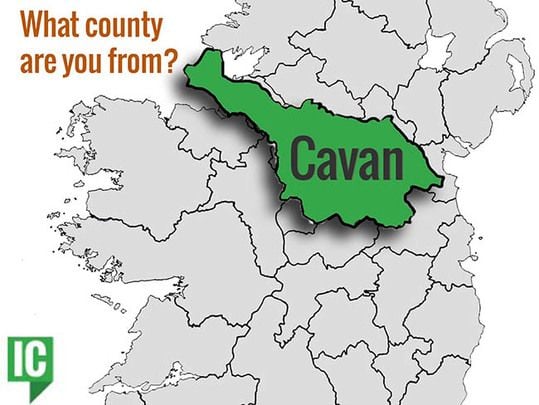
All about County Cavan.
Irish Name: An Cabhán – "The hollow"
Nickname: The Breffni County – if heaven existed on earth, it would be Cavan.
Population: 76,176 (as of 2016)
Area: 745 square miles
Province: Ulster
County town: Cavan
GAA colors: Blue and white
Common surnames: Reilly, Smith, Brady, Lynch, McCabe, Clarke, Farrelly, Maguire, Quinn, Sheridan, and Galligan.


Beara-Breifne Way, County Cavan.
Famous people with Cavan roots: Francis Sheehy Skeffington, John Charles McQuaid – Archbishop of Dublin, General Philip Sheridan – General in the US Civil War, Matthew Brady (early pioneer of portrait photography), Songwriter W. Percy French, Erik Dorman-Smith – General in the British Army, Marcus Daly, the Copper King of Montana, and actor TP McKenna.
Jonathan Swift often stayed at Quilca House, the home of classical scholar Thomas Sheridan, and was godfather to his children.
Ed Reavy, the renowned fiddle player, immigrated to Philadelphia from Cavan when he was fourteen. In the 1920s, he made some of the first recordings of traditional music.
Shane Connaughton, the author of the novels "A Border Station" and The Country Boy, grew up in Redhills. He also wrote the screenplay for the Oscar-winning film "My Left Foot."
The American novelist Henry James' grandfather William was born in Bailieborough. He emigrated to New York and at the time of his death was thought to be the third richest man in America.

Are you planning a vacation in Ireland? Looking for advice or want to share some great memories? Join our Irish travel Facebook group.
And more recently: Tony Award Winner Briain F. O’Byrne, New England Patriots QB Tom Brady, Bill O’Reilly, Irish Celebrity Chef Nevin Maguire, and Kingspan CEO Gene Murtagh.
Famous Cavan women include Charlotte Brooke the daughter of Henry Brooke of Rantavan, near Mullagh. Henry was a lover of words and passed on his passion to his daughter. Charlotte silently saved the Irish language from extinction and laid the foundations for its more recent revival. She was particularly interested in Irish epics and sagas and began collecting and translating them. This resulted in "The Reliques of Irish Poetry," published in 1789, today seen as a seminal publication in Irish history.
Perhaps inspired by Charlotte Brooke’s work Professor Agnes Farrelly also of Mullagh wrote widely about the Irish language and succeeded Douglas Hyde (first President of Ireland) as Professor of Irish Poetry in the National University of Ireland in 1934.

Brackley Lough near Bawnboy, Cuilcagh Mountain, County Cavan.
A brief history of County Cavan
Cavan is one of the three counties of the province of Ulster that are not part of Northern Ireland. The translation of Cavan in Gaelic is "The Hollow." The town of Cavan is the county seat and lies in the northeast of the county, relatively close to the border with Northern Ireland.
The O'Reilly family (still the most common surname in the area) established a castle in the town in the late 13th century. A Franciscan monastery was also established at around the same time. King James I of England granted the town a charter in 1610. The phrase 'Life of Reilly' was credited to the O'Reilly clans due to their great wealth and power, having created and issued their own currency during the 1600s.
In the late 19th century, Cavan became an important rail junction between the midland and western lines and those of the Northern Railways. The Town Hall was built in 1909. In 1938, work began on the Roman Catholic Cathedral of Saints Patrick and Felim.
Three miles west of Cavan Town is the Church of Ireland Kilmore Cathedral, which contains a Romanesque doorway dating from the 12th century. Farnham House, to the northwest of Cavan, is one of the largest houses in the county. It is believed to have been built for the Maxwell family – who holds the title of Baron Farnham – in 1810. It was sold by the widowed Lady Mairead Smith and the house and estate has now been converted to a luxury hotel.
A little-known fact about Cavan is that the famous classic Gulliver’s Travels was reputedly penned by Dean Jonathan Swift while vacationing in Mullagh, a beautiful village in East Cavan. The main character in the book Gulliver was loosely based on a local giant of a man, Big John Doughty, who was so strong he could carry a pony on his shoulders.
For more in-depth information on Cavan, visit ThisIsCavan.
Top attractions in County Cavan
Situated on an island in the middle of the lake, Lough Oughter Castle was built by the Anglo-Normans in the early 13th century when they tried to conquer the Cavan area. It was soon captured by the O'Reilly family, the Irish rulers of east Breifne, who used it as a prison for the rest of the Middle Ages. Owen Roe O'Neill, leader of the anti-English revolt of the 1640s, died here in November 1649.
There you will also find Killykeen Forest Park, which is full of walking trails and wildlife.
Lough Sheelin if fishing is what you are interested in.
Dun a Ri, the forest of the kings in Kingscourt is worth a visit.
Ballyhaise College – one of the finest examples of Georgian architecture in Ireland. Now an agricultural training college.
Shannon Pot – the source of the River Shannon, Ireland's longest river. The longest river in Ireland, the River Shannon has its source in Cavan in the Shannon Pot. Cavan is known for its rolling hills and lakes shaped by the last Ice Age. There are 365 lakes in Cavan, one for every day of the year. With all the lakes fishing is a very popular attraction for locals and visitors.
Comments