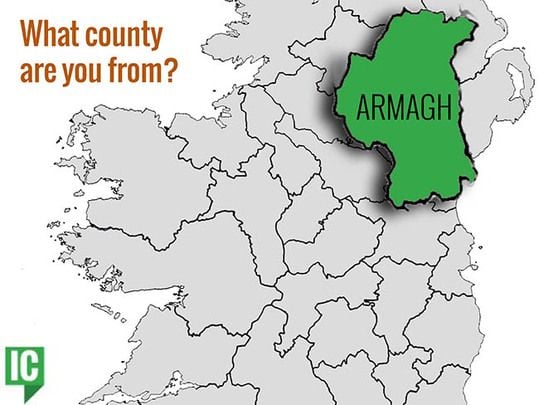
Irish Name: Ard Mhacha - "Macha's height"
County Town: Armagh
Nickname: The Orchard County
GAA Colors: Orange and White
Famous People with Armagh roots: Singer Tommy Makem, William McCrum (inventor of Penalty kick in soccer), Arthur Hunter Palmer (Premier of Queensland), Field Marshal John Dill, Frank Aiken, Andrew Trew Wood, John Stephenson (built world's first street car)
Armagh is a large settlement in Northern Ireland, and the county town of County Armagh. It is an ancient site of worship for both Celtic paganism and Christianity. Although classed as a medium-sized town,[1] Armagh was granted city status by Queen Elizabeth II in 1994. Its population of 14,590 (2001 Census) makes it the least-populated city in both Northern Ireland and the island of Ireland.
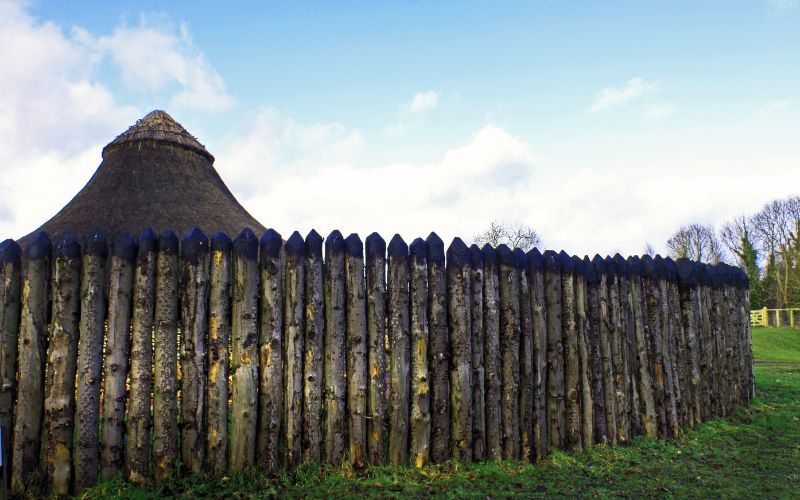
Emain Macha (or Navan Fort) at the city's edge, is believed to have been used as an ancient pagan ritual or ceremonial site.
According to Irish mythology it was once the capital of Ulster, until it was abandoned during the 1st century. The site was named after the goddess Macha, and as the settlement grew on the hills nearby, it was also named after the goddess — Ard Mhacha means "The Height of Macha".
When Christianity spread to Ireland during the mid-400s, Armagh became the island's "ecclesiastical capital", as Saint Patrick established his principal church there. Saint Patrick decreed that only those educated in Armagh could spread the gospel. According to the Annals of the Four Masters, in the year 457: “
Ard Mhacha was founded by Saint Patrick, it having been granted to him by Daire, son of Finnchadh, son of Eoghan, son of Niallan. Twelve men were appointed by him for building the town. He ordered them, in the first place, to erect an archbishop's city there, and a church for monks, for nuns, and for the other orders in general, for he perceived that it would be the head and chief of the churches of Ireland in general.
In 839 and 869, the monastery in Armagh was raided by Vikings. As with similar raids, their objective was simply to acquire valuables such as silver, which the churches and monasteries often kept.
The Book of Armagh came from the monastery. It is a 9th century Irish manuscript now held by the Library of Trinity College, Dublin (ms 52). It contains some of the oldest surviving specimens of Old Irish.
Brian Boru is believed to be buried in the cemetery of the St. Patrick's Church of Ireland cathedral. After having conquered the island during the 990s, he became High King of Ireland in 1002, until his death in 1014.
In 1189, John de Courcy, a Norman knight who had invaded Ulster in 1177, plundered Armagh.
Three brother from Armagh died at the Somme during World War One. Andrew, 38, David and Robert Hobbs, all of 9th (Service) Battalion the Royal Irish Fusiliers. None of the three has a known grave and all are commemorated on the Thiepval Memorial to the Missing. A fourth brother, Herbert, was wounded in the same attack.
Armagh has been an educational centre since the time of Saint Patrick, and thus it has been referred to as "the city of saints and scholars". The educational tradition continued with the foundation of the Royal School in 1608 and the Armagh Observatory in 1790. This was part of the Archbishop's plan to have a university founded in the city. This ambition was finally fulfilled, albeit briefly, in the 1990s when Queen's University of Belfast opened an outreach centre in the former hospital building.
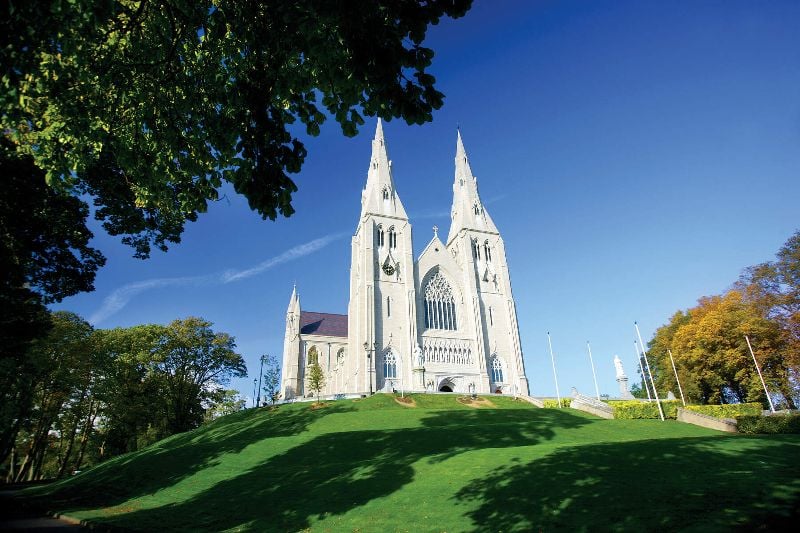
Armagh is the site of two cathedrals, both on hills and both named after Saint Patrick. The Church of Ireland cathedral dates back to around 445. The present-day, post-Reformation, Roman Catholic cathedral was constructed during the latter half of the 1800s and features twin 64m spires, making it the tallest such structure in the county. Armagh is the only city in the world which is home to two cathedrals of the same name.
The city is home to the Armagh Observatory, founded in 1790, and to the Armagh Planetarium, established in 1968 to complement the research work of the Observatory. It has a Georgian area of heritage importance.
The palace of the Archbishop of Armagh is now the local council offices and, along with the archbishop's private chapel, is open to the public. The Palace Stables heritage centre is a reconstructed stable block dating from the 1700s, which was once part of the Archbishop's estate.
Among the city's chief glories is the public library on Abbey Street. Founded in 1771 by Archbishop Richard Robinson (later Lord Rokeby), using his own library as its nucleus, it is especially rich in 17th and 18th century English books, including Dean Jonathan Swift's own copy of the first edition of his Gulliver's Travels with his manuscript corrections.
Armagh Market House was built in 1815 as a two-storey five-bay building, and is currently used as a library.
Gaelic football is popular in Armagh, its two major clubs being Armagh Harps and Pearse Ógs.
Common Surnames in Armagh: Murphy, Hughes, Wilson, Campbell, O'Hare, Smith, McCann, Donnelly, Watson and Quinn
5 Comments
-
-
-
-
-
Switch to the desktop site to post a comment.Seanmor | Jun 20, 2012, 09:27 PM EDT
Armagh is the Christian capital of Ireland and it is where The R.C. Peimate of All-Ireland and the Church of Ireland (Anglican) Primate of All-Ireland reside. There are no ecclesiastical partitions in in Christian Ireland; all denominations of that faith regar Ireland as a single national entuity. Four Catholic diocese and the same number of Church of Ireland dioceses have territory on both sised of the artificial partition.
MegK311 | Jan 14, 2012, 01:41 PM EST
Josephpatrick, my grandfather had a brother who immigrated to the US. I have often wondered what happened to him and does he have any children or grandchildren. I am sure he is no longer alive.
MegK311 | Jan 14, 2012, 01:32 PM EST
I love Armagh. My mother was born there and my grandfather owned a farm about a mile outside the city. I spent many wonderful summers there as a child. I paid a visit to Armagh about 18 months ago and so much has changed. Homes have been built where my grandfather lived but I have a lot of happy memories of my time spent there.
josephpatrick | Dec 09, 2010, 04:39 PM EST
My Grandfather came from Armagh. He never returned to his home after moving to America. God Bless all who live in Armagh.
McGivern10 | Apr 14, 2010, 12:29 PM EDT
In the ???? and where is the end of the sentence? (see below) Why do it this way? In 2004, The Royal School, Armagh became only the second team in history to win both the schools' rugby and hockey cups in the