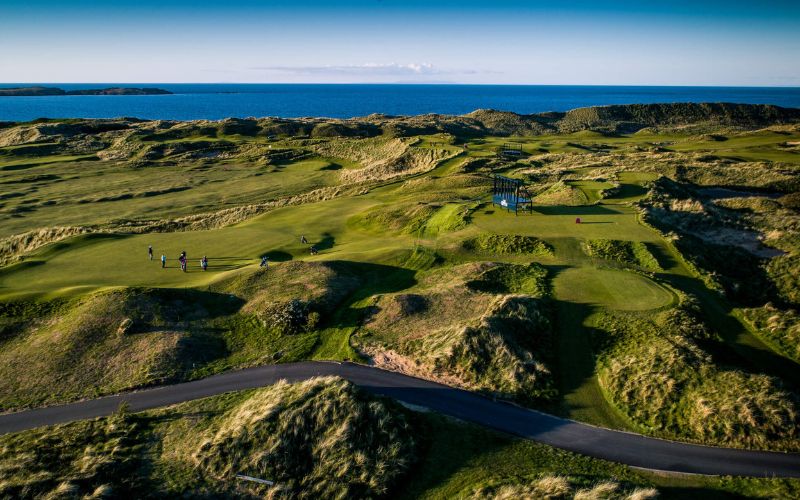
A mean Atlantic southwesterly howls up the sand dunes, blasting a wintry chill across the grassy headland. Out on the exposed hills a slow procession catches my eye. Leaning into the gale is a hardy knot of Arctic adventurers, pressing on and pausing, driving forward for all their worth. They're buttoned from head to toe in woolens and waterproofs yet they're out enjoying themselves, chasing after a small white ball. There's no doubt golfers are a breed apart.
Do they ever look excited at the first tee? Oh Jesus, yeah, replies Martin Shorter, director of golf at the recently-opened Doonbeg club in Co. Clare. Shannon airport is in close proximity to us so American visitors will get off the plane and want to play here or Lahinch on the first day they arrive. It's 8:30 in the morning and there they are, dead tired but they can't wait to tee off. You see the sleep in their eyes but the adrenaline is kicking in and they can't wait to go.
While Mark Twain famously observed that golf is one sure way to spoil a good walk, a growing number of strollers will risk dragging a set of clubs along with them. There has been an upsurge in the number of golf courses in Ireland, but aside from local interest, the game's growing appeal has generated a new form of business golf tourism.
According to Damien Ryan, director of golf at Bord Failte, about 58,000 visitors played the game in Ireland in 1988. Last year we put that figure at 250,000 and our plans are built around 2006, by which stage we aim to bring 400,000 golfers a year to Ireland.
It's an ambitious target but the figures tell their own story. At present there are about 440 golf courses in Ireland with quite a number of high-profile courses such as the K-Club, Mount Juliet, Doonbeg, Carton House, Druid's Glen and Fota Island developed in recent years.
Those who care little for the small ball game might feel we have more than enough courses thank-you-very-much but the demand is such that it's not so easy getting out to play. Even with so many new courses springing up, the waiting lists for club membership are getting longer, not shorter. Private membership can cost over $20,000 what's more, you'd be lucky to get it, especially anywhere within driving range of Dublin.
We have a private members' club here but visitors are welcome, explains Alan Reardon, club secretary at the famous Lahinch Golf Club in Co. Clare. We're full all the time I mean between 23-24,000 visitors go through here but we have to turn away over 8,000 more every year. The demand simply outstrips supply.
If all their birthdays have come together it has taken quite a while for clubs in Ireland to grasp that potential. There was never a shortage of courses as such, agrees Bórd Fáilte spokesman John Brown. But one of the problems was that 99 percent of the clubs were run by their own members and obviously member-run clubs weren't so open to the idea of tourists.
Golfing holidays began to boom in Spain and Portugal while renowned venues in Ireland, Scotland and England lost out. They had something to sell but weren't willing to sell it or didn't know how.
To their credit however, administrators of the game got together to review the situation and sort out a cohesive marketing plan. They saw how they could accommodate visitors by
opening off-peak playing hours to non-members. The income from green tees would defray running costs and visitors got to play. Whether the move was prompted by goodwill or business acumen it has certainly paid off. In a game notoriously unforgiving on close calls, it was a win-win situation.
Local clubs set up regional associations to promote their interests abroad. It was Denis Brosnan's idea modeled on the way the Kerry Group was formed, explains Paddy O'Looney, chief-executive of Southwest Ireland Golf Ltd. (SWING). When he brought the milk co-ops in Kerry under one umbrella they became a force to be reckoned with. He applied the same principle to golf tourism.
SWING was formed in 1988, incorporating nine clubs Lahinch, Ballybunion, Waterville, Dromoland, Dooks, Killarney, Shannon, Tralee and Dingle and pooling resources to cultivate a growing overseas market. Clubs around the country formed similar marketing groups such as West Coast Links, IGTOA, Green Isle Golf, Shannon Golf Partnership and others to make their own pitch for business in an increasingly competitive and profitable arena.
But there was no point luring tourists if facilities weren't here for them. At national level Bórd Fáilte's Operational Program for Tourism (1989) provided £9 million in funds to develop new pay-and-play' clubs as well as encourage established clubs to open up for tourists. A second tranche (1994-99) completed the agency's structural development of golf tourism.
We're putting Ireland up there to make us the Number One destination in Europe, contends Damien Ryan. One of the biggest pluses for us now is we have a lot of commercial courses here, which makes it more accessible than with member clubs.
The profile of visitors has changed dramatically, confirms Alan Reardon at Lahinch. At the start of the 90's Irish visitors made up about 48 percent of our business; that's now down to eight percent. The market spread is now 80 percent American.
The same shift is reflected nationally. Golfers from Britain make up about half of those who come to Ireland to play but the American share has grown to almost 35 percent, many of whom play premium courses. In tourism-speak they are valued as high-yield guests.' A high ratio of repeat business suggests the visitors get exactly what they come for.
It's a game where tradition runs deep. Golfers everywhere love to try the famous old courses and in Ireland they go for Royal Dublin (est. 1885), Lahinch, Royal Portrush, Portmarnock, Royal County Down, Old Head of Kinsale, Balmoral and Woodbrook.
Lahinch itself dates back to 1892 when Limerick businessman Alexander Shaw deemed the coastal sand hills an ideal site to set up a course. He then built with the assistance of Scottish officers from the Black Watch Regiment, and the first game was played on Good Friday, April 15 that same year. To commemorate the occasion the West Clare Railway put on a special train in order to give persons an opportunity to view the game and enjoy the sea air.
The course was originally divided by a road but in 1927 six extra holes were added on the beach side to bring the entire course by the sea. Some 36 years later the club developed land on the other side of the roadway to make up a second course, the Castle Course, for which green fees of 50 euro are less than half the fee to play the Old Course.
Of course the newly-built courses can't compete in terms of history and tradition. To win immediate profile and prestige the current trend is to hire an international golfing figure to design the course. Many of the new courses in Ireland have a famous stamp on them, such as Jack Nicklaus' design at Mount Juliet, Arnold Palmer's at the K-Club or Bernhardt Langer's design of the newer links course at Portmarnock.
In fact, links golf seaside courses is one of the biggest draws in the Irish game. You don't get true links courses in America, reasons Martin Shorter, himself a native of Raleigh, North Carolina. The difference is the wind, and the firmness of the turf is something American golfers are not accustomed to. Americans are used to hitting the ball in the air, landing it on the green where it stops. Here, you have to allow for the bounce. It's the shot you roll and the shot you have to chase. And it's about patience. If you come to Ireland to play matchplay golf you'll have a great time. If you come to medal play you'll be a beaten and broken man!
There are about 151 links courses in the world and one third of them are in Ireland. Not surprisingly, there was huge interest when Australian champion Greg Norman was invited to design the course on coastal farmland at Doonbeg, Co. Clare. The opportunities for building new links courses are obviously diminishing Doonbeg runs for a sprawling 385 acres but Norman was overwhelmed by the potential of the site.
When I first looked at this site I thought I was the luckiest designer in the world, enthused the man known as the Great White Shark. It's spectacular land made by God, one of the most beautiful places on earth. This is the course I want to be identified with.
Designers are known to complete their work after a few visits to a course but Norman's involvement at Doonbeg, saw him visit the site on an unprecedented 23 occasions. Under strict conservation guidelines to protect the 100-foot dunes in Doonbeg he sought to work around existing features on a minimum disturbance' philosophy. The Great White Shark also came up against a most unlikely foe. The site turned out to be a habitat of a rare species of snail, the Vertigo Angustior, so additional directives were issued to protect it.
After resolving various difficulties including access to the beach for locals the $25 million development is now in business. Plans include a 90-room hotel on site as well as holiday chalets in what Brendan Lynch of Shannon Development Tourism described as the most significant project to be developed in the West of Ireland over the last 25 years.
We knew going in there's always give-and-take, explains Shorter. If you don't plan with the environment in mind you won't be successful. We knew we had to work around the configuration of dunes but basically Greg routed the course around the 15th hole. When he saw the land there he thought it would be one of the greatest golfing holes in the world and wanted to work around that.
The 15th is indeed a magnificent par-four, running along an ocean ridge with the green nestling in the natural bowl of a dune amphitheater. Greg didn't want to Americanize' the course, continues Shorter. By that, he meant he didn't want to move earth. The site was so natural we just started mowing fairways. Twelve of the fairways are meadow grass and that's very unusual.
Doonbeg is managed by Kiawah Development Partners, and the importance of the American dimension is underlined by the preponderance of major figures from U.S. political and commercial life on its advisory board. Former Senate Majority Leader George Mitchell (who chaired the Northern Ireland peace talks), Wayne Huizenga (formerly of Blockbuster Entertainment), Kerry Packer (chairman of Consolidated Press Holdings) are just three of 19 influential board members.
In 2006 Ireland will host the Ryder Cup for the very first time. The tournament, which pits the best of Europe against the best of America, will take place at the K-Club in Straffan, Co. Kildare for what ranks as a highlight of any sporting calendar.
The Ryder Cup will be one of the biggest sporting events Ireland has ever had and one of the biggest events in general ever staged here, feels Bord Failte's Damien Ryan. We have another four years to market it.
Earlier this year Bord Failte invested $1 million on the American Express World Golf Championship. The four-day event brought 49 of the top 50 players in the world to Mount Juliet in Kilkenny. The $5.5 million tournament was televised in 140 countries and brought crowds of over 120,174, a gallery record for a WGC event. You couldn't ask for a better showcase for golf here, said Irish champion Padraig Harrington. All the players have loved it here; the course, the facilities. Everything about it.
Tiger Woods won the tournament by a single stroke, and the world champion added his voice to the promotion effort. It's great to play in front of galleries that are knowledgeable, and Irish fans certainly know the game, he remarked. I was telling Paddy [Harrington] they're not only gracious but they understand the game of golf. They were fantastic. And I think the course is playing absolutely gorgeous. The fairways are perfect. The greens are the best we have putted on all year, including the U.S. majors.
In the wake of the September 11 tragedy there were widespread fears that Americans would not travel in numbers this year. Tourist business in Ireland is certainly down, but golf, it seems, is impervious to everything. Golfers are war-proof, recession-proof and waterproof, suggests Paddy O'Looney. If Irish golf tourism remains a quality product offering value for money, he and others are confident that the future is bright.
The indications suggest the same. While I was speaking to Alan Reardon at Lahinch, the fax machine continued to hum behind us. It's no time for complacency but business is brisk. The last fax put in a reservation for a group of eight to tee off at 10 a.m. on August 8, 2003. A whole year in advance and eight adventurers already planning to spoil a good walk! Golfers are indeed a strange breed.
Comments