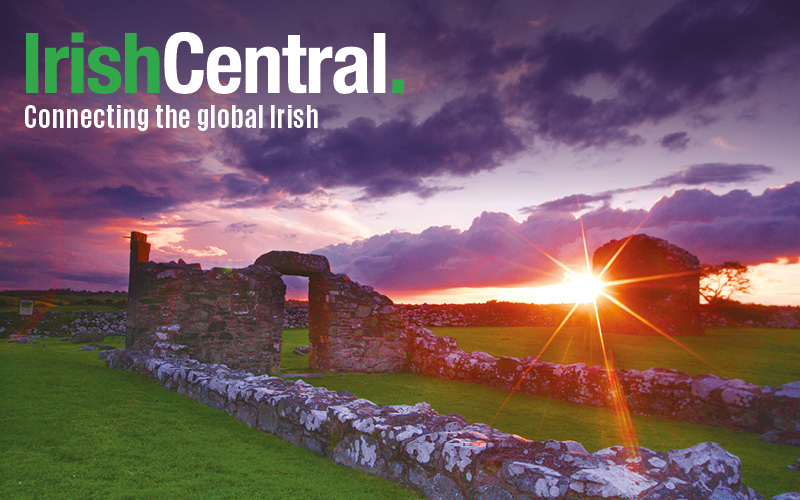
They say you can never go home. Even so, while Ireland’s Minister for Tourism tries to lure the secretive Irish out of their silence, we diaspora hope against all odds to be found, to be brought into the fold, home.
As children, my siblings and I had been told our grandmother was from County Cork. We knew her name, and her father’s name. As it was explained, she was an orphan who came to America as a young woman. Soon after her arrival, our grandmother married a young American, had three children, divorced and then died an untimely death from tuberculosis. My father was twelve years old when he lost his mother. By then, the Great Depression was taking its toll. He and his sisters were farmed out to the Catholic orphanage until their age of majority. That was the whole story, no more, no less.
Many years later, finding record of my grandmother on a ship manifest bound for Boston opened new worlds for me. There was a lot to be learned from that one historical record. She was seventeen years old when she arrived in 1922. World War I had just ended, and Irish home rule had been won. It was an optimistic time, with the roaring twenties in full swing. From the manifest I learned the name of the town where my grandmother had lived in Ireland. I was surprised to learn her mother paid her passage and was meeting her at the Boston docks. I was curious about the uncle my grandmother left behind. I was puzzled by the unfamiliar surnames. I was pleased to learn that my grandmother’s coloring matched my own – brown hair, grey eyes, fair complexion, and that her tiny stature matched my sister’s.
Chasing one clue after another, I learned more and more of my grandmother’s story. She was the product of an assault. When she was born in Cork, she was boldly given her father’s last name. It must have been scandalous as he was a man of some means in the community. A big battle likely ensued with the local church - de rigueur placement for wayward girls at the time was in asylums, adoption for their babies. But her family, my family, did not succumb to the pressure. (I have seen this stubborn, righteous determination reveal itself in my father, my aunts, my sister, myself, my son). Their decision was not without consequence. As I have been told, a younger family member was refused confirmation due to the “sins” of my great grandmother, who soon left for Haverhill, Massachusetts, a small factory town filled with Irish immigrants. Perhaps the chatter in the village had been too much for her to bear. Or was the opportunity in America too great to resist?
My grandmother was left behind in the care of her own grandmother. Growing up motherless in that small Irish village was not the sad childhood I had long imagined for her. In addition to her grandmother, many uncles, aunts, and cousins surrounded her. According to one distant cousin, there was always “an open door and a warm cup of tea” for the asking. The beautiful village countryside, even today filled with hills and grass and trees, was there for roaming, dreaming, exploring.
My best guess is that her mother always intended to reunite, but the weeks became months, and the months stretched to years. Only after her precious girl was nearly grown into a beautiful young woman would their reunion occur. By then the bond was badly frayed, and the reunion was not the joyful experience long anticipated. Throughout the rest of their days, while both women were members of the same Irish Catholic Parish in Haverhill, their relationship remained strained and distant.
Yet, in spite of her tragic beginnings, my grandmother was a joyful woman, a lover of life and life’s small pleasures. As I have learned, she was vivacious, loved to dress up, keep a nice home, set a fancy table, go dancing. Her glass was half full, her lemons made into lemonade.
In recent years I had the privilege of getting to know my grandmother’s last living child, an elderly aunt. A few weeks before she died, this aunt, my only living relation of my father’s generation, a wise woman and a psychologist, gently asked me why the search for my grandmother’s history was so important to me. “That is the question you must answer, my dear”. I cried, as I do now, when I think of that moment.
Since that profound meeting one year ago, my genealogical research has ground to a halt. Instead, I have been turning my aunt’s question over and over in my mind, trying to find an answer. I realize, more than anything, a need to connect to the tree that eventually brought me into this disconnected world. Having been removed from my own mother’s home at a tender young age, I identify closely with my grandmother, a woman I never met, yet think of often.
So for me, this is where The Gathering begins. We diaspora do not want to embarrass or to pester our families. We do not want to take advantage of frail, elderly cousins. We want connection. We want an open door and a cup of tea. We want to understand more of where we come from, why we are who we are. We want to hear your stories, share your memories, learn your traditions. We want to come home.
*Carr-Ramirez lives in Los Angeles, California, is married with three grown children, and is a hobbyist genealogist. She hopes one day to travel to Ireland to meet family and to explore the countryside.


Comments