What better way to explore Ireland than journeying through the sites associated with Irish myths and legends?
Ireland is a land rich with mystery and myth, intriguing sites, and Irish stories - and we're not just talking leprechauns and pots of gold!
From the ancient seat of the Celtic High Kings to the Mountain of the Witch; from the Celtic severed head ritual to the warrior Queen Maeve’s tomb, there are countless Irish mystical sites waiting to be explored, all of which have tales of pagan Celtic warriors, fairies, and magic associated with them.
Here, we take you through a tour of some of Ireland’s most magical mythological sites:
Ireland's Best Mythological Sites Tour Stop 1: The Boyne Valley: Newgrange, Knowth, Dowth, Hill of Tara & Hill of Slane, Co. Meath
Brú na Bóinne (the Boyne Palace) spreads over Counties Meath and Louth. The Boyne Palace contains some of the most important historic sites and monuments in Ireland, including the massive, ancient passage tombs of Newgrange, Knowth, and Dowth, the pagan headquarters of the Hill of Tara and the legendary Hill of Slane.
The Main Attraction: Newgrange
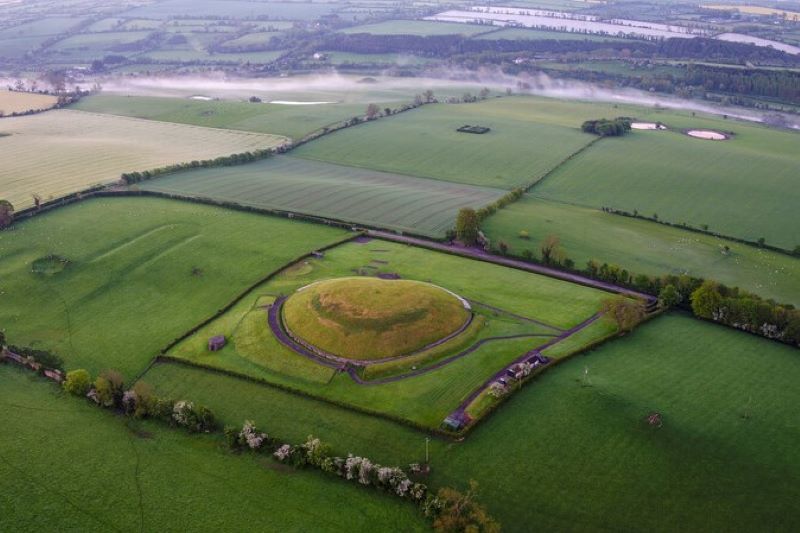

Sunrise over Newgrange (Ireland's Content Pool)
Newgrange is Ireland's most famous prehistoric site. As with most of the passage tombs in Ireland, archeologists believe that it was built around 3200 B.C., which means that Newgrange predates the construction of Stonehenge in England and the Pyramids of Egypt.
Newgrange was built so that during the winter solstice (dawn on the shortest day of the year), a narrow beam of sunlight illuminates the floor of the chamber at the end of the long passageway for about 17 minutes.
The Celtic myth says that Newgrange is a fairy mound or a sidh. A group of ancient people, the Tuatha Dé Danann, or “people of the goddess Danu,” dwelled there. Newgrange was built by the god Dagda and named for the goddess Boann.
Some say that the famous Irish mythological hero Cuchulainn was conceived in Newgrange.
Access to Newgrange begins at a visitors' center, from where you can take a guided tour of the site. The center hosts a re-enactment of the winter solstice at Newgrange through the use of electric lights situated within the tomb. A lottery is held annually for tickets to be allowed into the tomb during the actual event.
Knowth
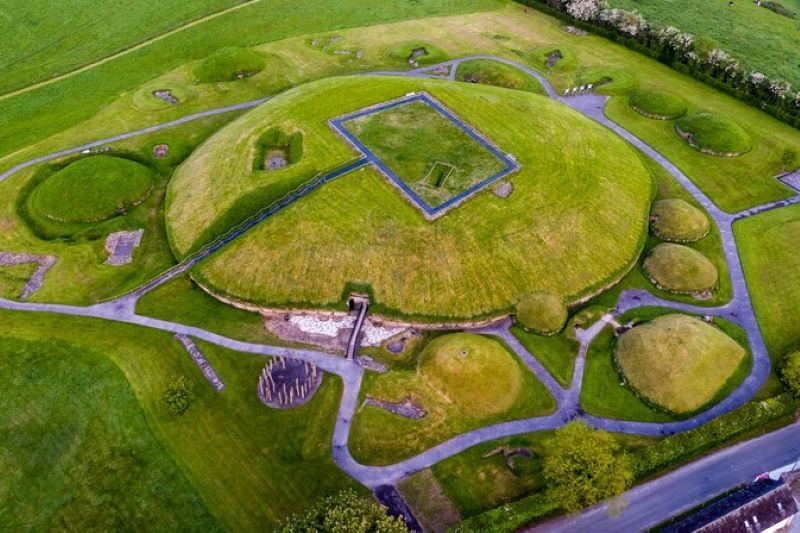
Knowth (Ireland's Content Pool)
The Great Mound at Knowth is the second of the three major passage tombs in the Boyne Valley. Built over 5,000 years ago, the mound is younger than Newgrange but older than Dowth. Knowth is similar in size to Newgrange.
The mound has two passages (unlike Newgrange, which has one), with entrances on the east and west sides. Recent scientific data suggests Knowth had a lunar function when it came to ancient rituals.
Knowth is best known for its impressively large collection of stones carved with Neolithic art, which comprises a quarter of all known Neolithic art in Europe.
It is said that a noblewoman named Bua is buried at Knowth, and a “great hill” was built up over her, creating the Great Mound at Knowth.
You can access the Knowth site through a guided tour from the Brú na Bóinne Center.
Dowth
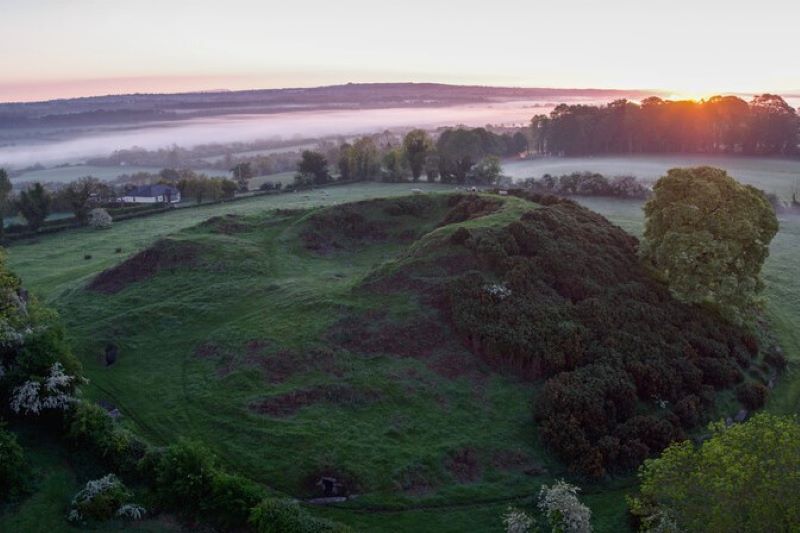
Dowth (Ireland's Content Pool)
The third passage tomb site in the Boyne Valley is Dowth, or the “Fairy Mound of Darkness” (sounds appealing, eh?). It is similar in size to Newgrange and Knowth, and like the two complexes was built 5,000 years ago.
The Dowth mound has two small passages, both located on the western side. Like Newgrange, the southernmost passage of Dowth is aligned to the setting sun of the winter solstice.
Dowth is not included in the Brú na Bóinne Visitors Center tour, and you cannot enter inside the tomb, but you can directly access it (it’s a short way from the Slane to Drogheda road) and meander around the peaceful site.

Are you planning a vacation in Ireland? Looking for advice or want to share some great memories? Join our Irish travel Facebook group.
Hill of Tara
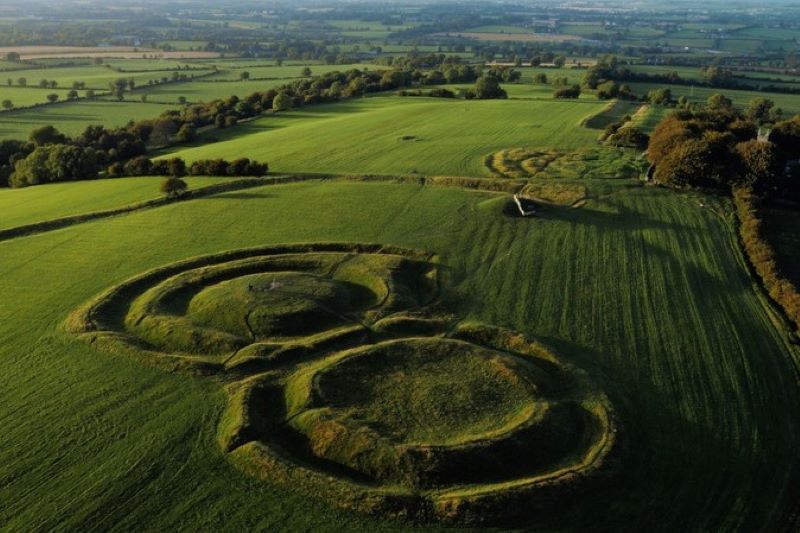
Hill of Tara (Ireland's Content Pool)
The Hill of Tara, also in the Boyne Valley, is the ancient seat of power in Ireland and contains over 30 visible ancient monuments, including the Stone of Destiny and the Mound of the Hostages.
The Hill is said to be the actual seat of the High Kings of Celtic Ireland and the sacred dwelling place of the gods.
It is believed that St. Patrick went to Tara - the most powerful Celtic pagan site - in order to confront the religion of the Celtic pagans.
One of the most famous monuments at Tara, the Stone of Destiny, is known as the Lia Fáil. The stone, which is thought to be a symbol of fertility, once stood in front of the passage tomb at Tara, the Mound of the Hostages. High King legend says the Stone of Destiny would sing and roar in praise if it approved the inauguration of a worthy high king.
The megalithic passage tomb at Tara, the Mound of the Hostages, is the oldest monument on the site. Evidence of at least 200 individual cremations has been uncovered at the mound.
Engravings within the tomb are thought to represent the sun, moon, or stars as religious symbols and one of the stones may have been used as a prehistoric calendar.
Access to the Hill of Tara is free, but if you want to hear a bit more background on the site, take a guided tour through the visitor center.
Hill Of Slane
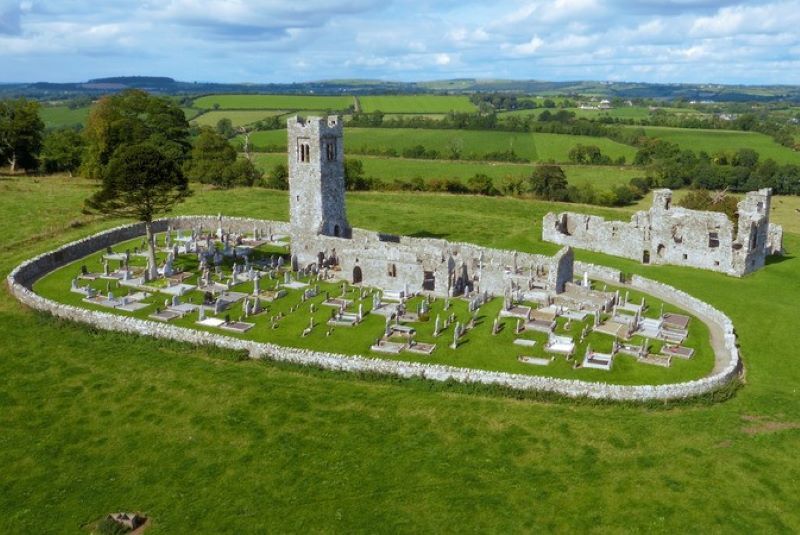
Hill of Slane (Ireland's Content Pool)
According to the myth, the impressive Hill of Slane is the burial place of King Sláine, the king of the Fir Bolg (an ancient people of Ireland).
In more recent Christian history, the hill is also the site where Patrick lit the divine Paschal Fire in defiance of the pagan kings at Tara. Church ruins lie atop the hill, and the site remains a popular destination for Christians.
The Hill of Slane is accessible at all times, and there is no entry fee.
Ireland's Best Mythological Sites Tour Stop 2: Loughcrew, Oldcastle, Co. Meath
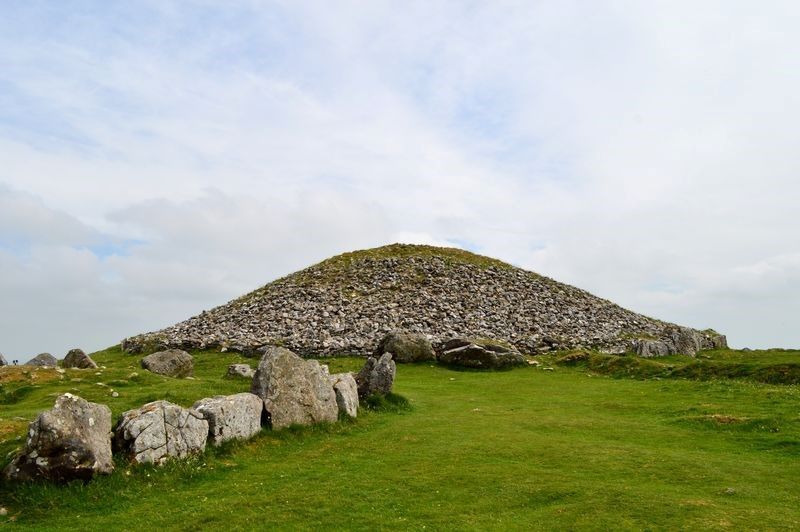
Loughcrew Cairns (Ireland's Content Pool)
Loughcrew, also called “The Storied Hills” or “Mountain of the Witch,” is one of Ireland’s major passage tomb sites (the others are Bru na Boinne, Carrowkeel, and Carrowmore), all believed to date back to around 3200 B.C. The site is made up of clusters of cairns (manmade, pyramid-like stone piles) around hills.
The winter solstice at Newgrange is well known, but the lesser-known Equinox illumination at sunrise occurs at Loughcrew. The backstone of the chamber is illuminated by a beam of light at sunrise on the Spring and autumn equinoxes.
The myth says that the monuments of Loughcrew were created by a witch flying overhead who dropped large stones from her apron.
Admission to the site is free, but be aware that the climb to Loughcrew is quite steep.
Ireland's Best Mythological Sites Tour Stop 3: Navan Fort & The King’s Stables Armagh, Co. Armagh
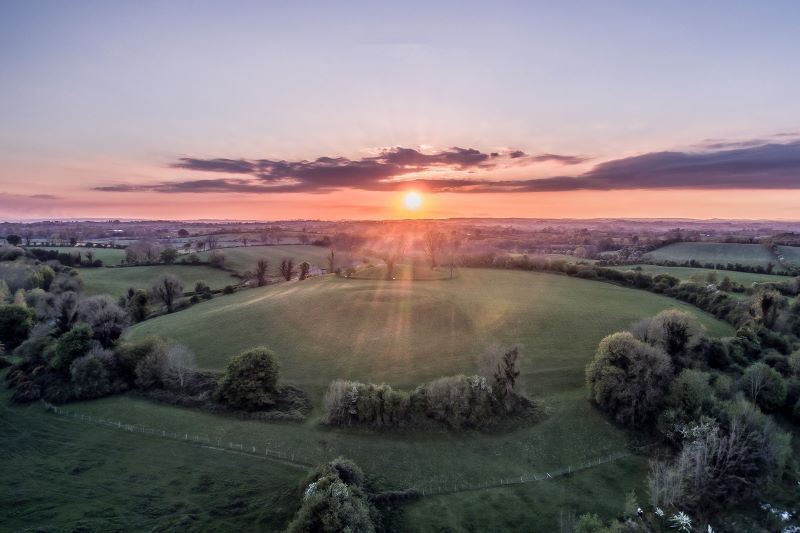
Navan Fort (Navan Centre & Fort, Facebook)
Navan Fort is a historical royal fortress on Killylea Road in Co. Armagh. The ancient monument was a stronghold of the kings of Ulster around 700 B.C. The Fort was the center of King Conchobar mac Nessa and his Red Branch Knights.
Navan Fort is surrounded by a bank with a ditch inside, suggesting that it was a ceremonial, rather than defensive, site.
It is said that the great Irish mythical hero Cuchulainn spent much of his youth in Navan Fort before single-handedly facing the army of the mythical Queen Maeve.
The Fort was eventually abandoned, which probably was a result of the creation of St. Patrick’s church two miles away. But in 1005, the Irish king Brian Boru camped there, and in 1387, Niall O’Neill chose Navan Fort as the location for a house.
One mile west of Navan Fort lies another myth site, the mysterious King’s Stables which is thought to have played a role in water rituals in the area.
King's Stables, which was built around 1000 B.C, is a 10-foot-deep man-made pool surrounded by a bank. It is believed that its significance had to do with water because the prehistoric Celts are known to have practiced water cult ceremonies.
A brief excavation of the site in 1975 uncovered the front of a human skull that was severed from the back part, perhaps related to another famous Celtic cult ritual – the severed head, a large-scale beheading as a human sacrifice to the Celtic gods.
You can take a tour of the sites through the Navan Center.
Are you planning a vacation in Ireland? Looking for advice or want to share some great memories? Join our Irish travel Facebook group.
Ireland's Best Mythological Sites Tour Stop 4: Beaghmore Stones, Cookstown, Co. Tyrone
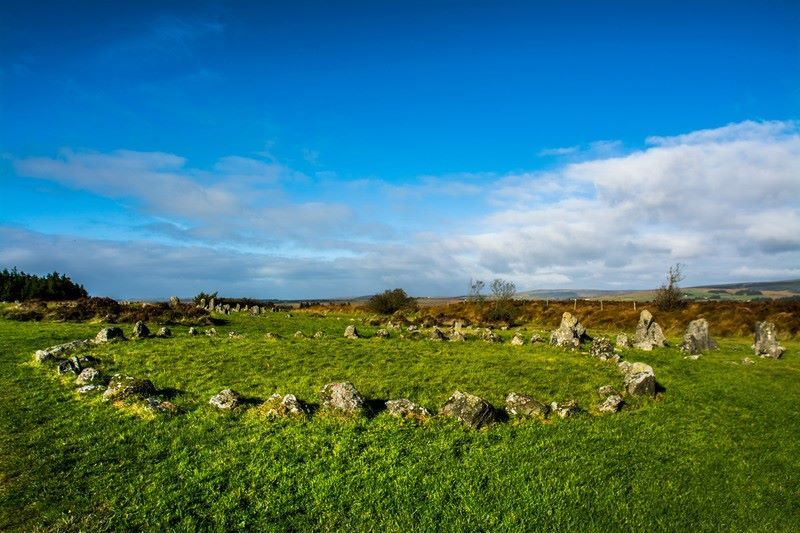
Beaghmore Stones (Ireland's Content Pool)
Stone circles in Ireland span across the Sperrins Mountains in Counties Tyrone, Derry, and Fermanagh. In each area, there is a concentration of sites made up of multiple stone circles. The circles have relatively small diameters and are comprised of 40 or so stones each.
The circles are typically misshapen and occur in pairs or multiples in one place.
Tyrone has the most stone circles; there are 61 known rings there. The most famous stone circle complex is at Beaghmore (“the moor of the birches”) in Co. Tyrone. The complex was accidentally uncovered in the 1940s while men were peat cutting. It took four years of excavation to remove a thick layer of protective peat and to uncover the 1269 stones of the seven-circle complex.
Thus far, seven stone circles, 13 cairns and several rows of standing stones that make up the Beaghmore complex have been uncovered, but it is assumed that even more are still hidden in the surrounding peat.
It is believed that the stone circles date back to 1600 B.C., but field walls, fireplaces, and flint tools discovered at the site suggest that it was in use since 2900 B.C.
It seems that the builders of the complex wanted to point the stone rows at the midwinter sunset, so some archaeologists believe that the circles were constructed to record the movements of the sun and moon in order to mark lunar and solar events.
Alternatively, the stone rows are thought by many to have been used for ancient rituals, either religious or social.
The Beaghmore Stones lie 10 miles west of Cookstown and can be accessed for free at any time.
Ireland's Best Mythological Sites Tour Stop 5: Grianan Ailigh Letterkenny, Co. Donegal
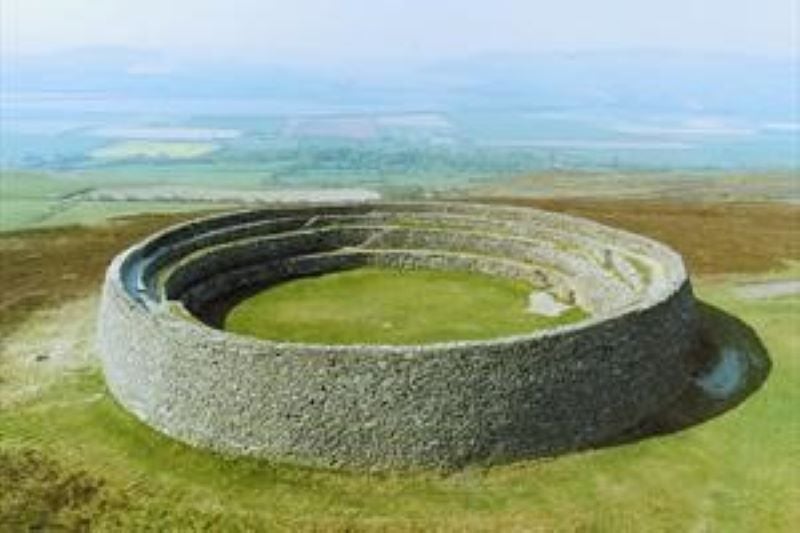
Grianan Ailigh (DiscoverIreland.ie)
An Grianan Ailigh is a mysterious circular stone fort which is thought to date back to 1700 B.C. The fort sits on the hill of Grianan, 750 feet above sea level, so the views from the surrounding Donegal countryside are amazing.
According to myth, the fort was built 4,000 years ago by the god of the people called Tuatha De Danann in order to house the grave of his son. The fort then became the seat of the Kingdom of Ailigh and was a center of culture and politics during the rule of early Irish chieftains.
The road that leads to Grianan Ailigh can be accessed from the main Letterkenny to Derry road.
Ireland's Best Mythological Sites Tour Stop 6: Carrowmore and Carrowkeel Co Sligo
Carrowmore and Carrowkeel are two megalithic sites in Co Sligo and once held over 200 tombs.
The two sites are joined by the Uinshin River, which flows from Lough Arrow to Ballisodare Bay – the main road during the Stone Age. This makes the Carrowmore/Carrowkeel area one of the most important centers of ancient mythological Ireland.
The location of the monuments, along with their breadth and majesty, shows the significance of the area, and the ancient Celtic people’s reverence for the dead.
Carrowmore
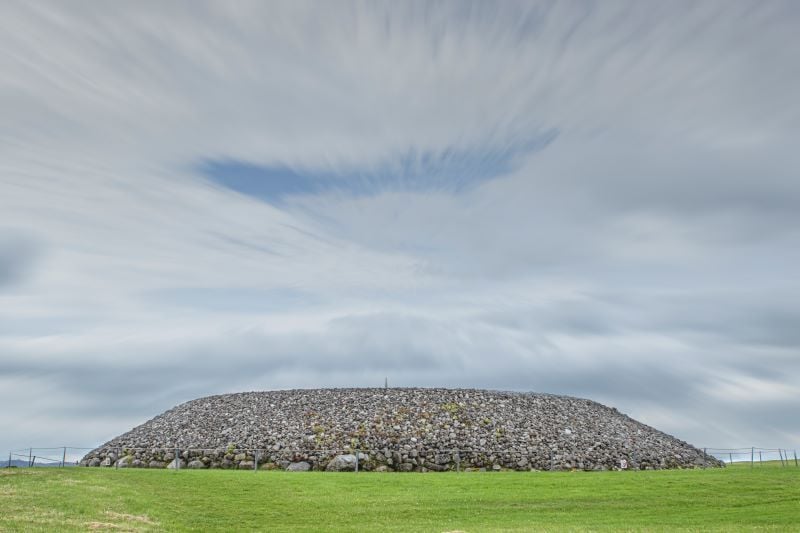
Carrowmore (Getty Images)
The most extensive megalithic complex in Ireland, about 30 tombs can be viewed at the sacred lands of Carrowmore (though it is thought that up to 100 existed at one time).
The tombs are mostly “dolmen” circles or a single tomb made of three or so upright stones supporting a large, flat, horizontal stone, surrounded by a circle of boulders. There is an average of 30-35 stones in each boulder circle, set side by side. Most circles are around 40 feet in diameter, but a few span up to 165 feet.
Carrowmore is classified alongside Newgrange and Loughcrew as part of the Irish Passage Tomb Tradition.
Within Carrowmore lies the Great Cairn of Knocknarea – also known as Queen Maeve’s Tomb.
The monument, 197 feet in diameter, was built about 6,000 years ago and is situated on the highest part of the flat top of Knocknarea mountain, 327 meters above the sea.
The cairn is one of the most impressive and well-preserved ancient monuments in all of Ireland and stands in one of the most beautiful and visible locations of any passage tomb.
According to legend, the site is the resting place of Queen Maeve of Connaught in the Ulster Cycle of Irish mythology, and an iconic Irish mythological warrior (this may help to explain why her tomb is so well preserved).
Queen Maeve is notorious for inciting the Tain Bo Culainge (“The Cattle Raid of Cooley”), where she led her province to war against Ulster to steal their prized bull.
Maeve’s choice to be buried in Knocknarea speaks volumes of its importance in Irish mythological history.
Carrowkeel
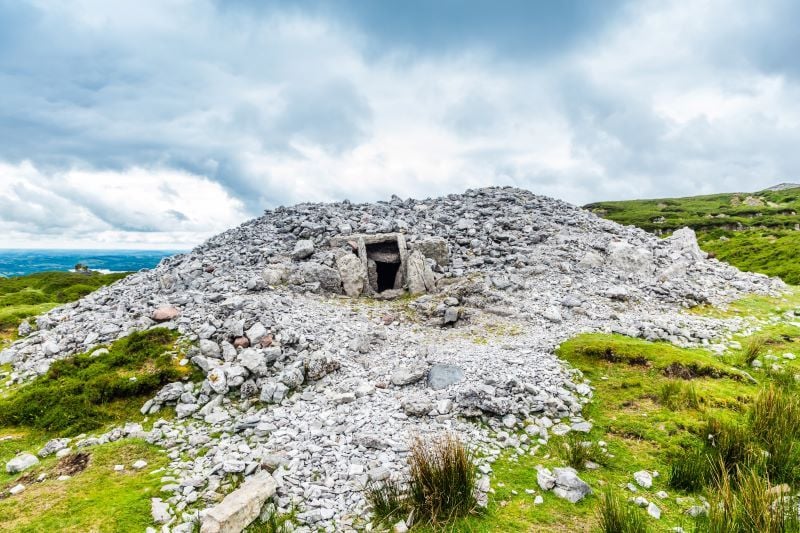
Carrowkeel (Getty Images)
Carrowkeel, which lies atop the Bricklieve Mountains, is a collection of some of the most mysterious mounds in all of Ireland. It is a lesser-known ancient site than Carrowmore but is equally significant in Ireland’s mythical past and has one of the most beautiful locations of any megalithic site. Carrowkeel is the fourth major passage tomb cemetery in Ireland (the others being Newgrange, Loughcrew, and Carrowmore).
Today, 14 passage tombs can be seen at Carrowkeel. One of the tombs is a “classic” Irish passage tomb – one that consists of a short passage you can crawl through, which leads to a central chamber with three equally spaced side chambers. What’s unique about the tomb is the roof box above the entrance. The only other known roof box exists at Newgrange, but while Newgrange is aligned to the Winter solstice, the Carrowkeel roof box is aligned to the midsummer sunset, signaling two different types of rituals that must have taken place in the locations.
Both Carrowmore and Carrowkeel are very accessible from the main roads in South Sligo.
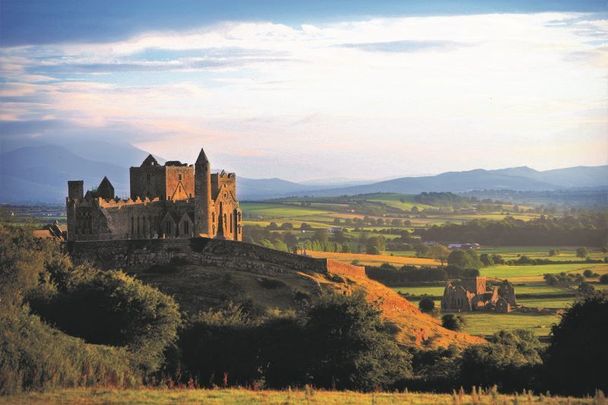
Ireland's Best Mythological Sites Tour Stop 7: The Rock of Cashel, Cashel, Co. Tipperary
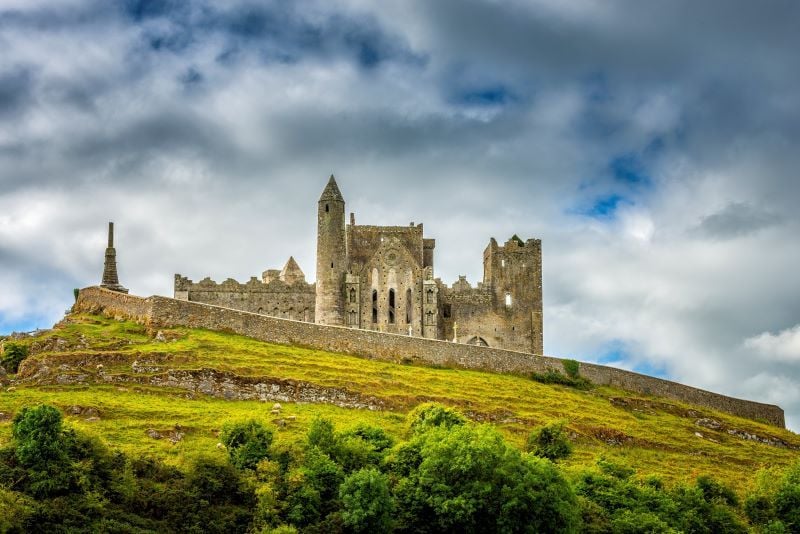
Rock of Cashel (Getty Images)
Legend has it that the Devil took a bit out of a side of a mountain in North Tipperary – now known as the Devil’s Bit – and then spat out a rock, which landed at Cashel. That rock is now known as the Rock of Cashel.
The Rock was the traditional seat of the High Kings of Munster prior to the Norman invasion.
Numerous buildings are perched on the site, the majority of which date back to the 12th and 13th centuries, and today hold some of the most extraordinary collections of Celtic art in Europe.
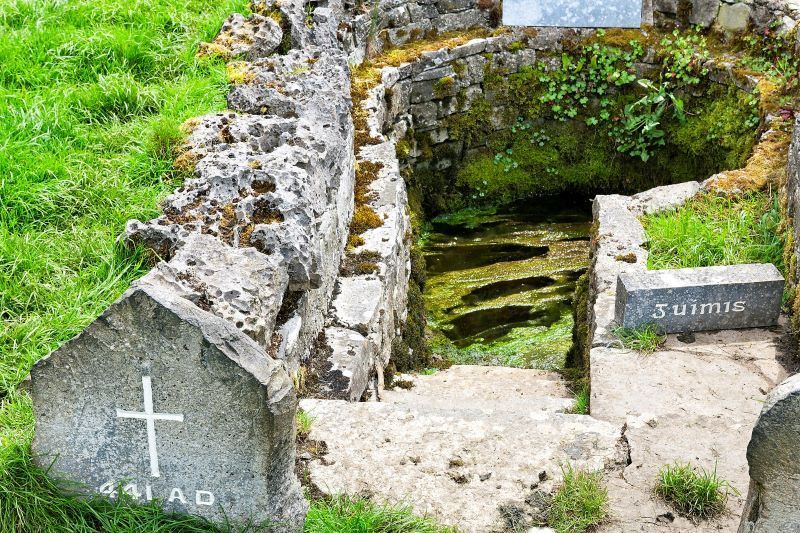
The Rock of Cashel is also known as St. Patrick’s Rock because Cashel is the presumed site of the conversion of the King of Munster by St. Patrick in the 5th century.
The site has a small admission fee, and guided tours are available upon request.
*Originally published in 2010, updated in Dec 2023.
Comments