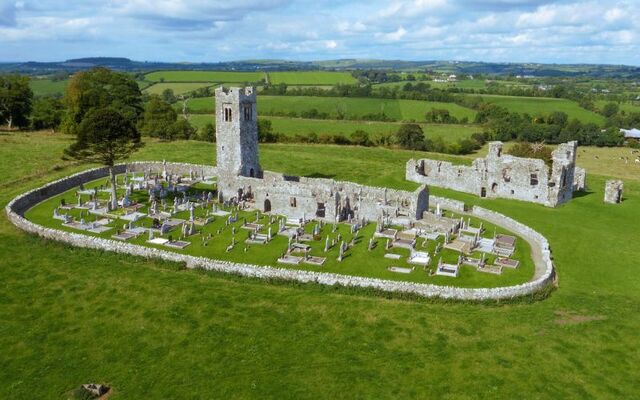
Take a tour of the many Irish spots visited by our national patron saint this St Patrick's Day.
What better way to spend the Irish national holiday and Catholic feast day than in the footsteps of the man himself, tracing the path he made throughout Ireland and visiting the many places he's left his name.
Although this happy day is celebrated all around the world, many people do not even know who Saint Patrick was or why we honor him. Believe me, it has nothing to do with green beer or corned beef and cabbage.
St. Patrick
For starters, Patrick was a 5th-century Christian missionary who did his greatest work in Ireland. As he sought to convert the pagan natives to Christianity, this roving cleric left his mark (and his name) in many places, such as Ardpatrick, Downpatrick, Croagh Patrick, Patrick’s Well, Patrickstown Hill, and a Patrick Street in every city, not to mention hundreds of churches and cathedrals. If there were travel agents in early Ireland, Patrick must have been a star customer.
It’s all quite remarkable, considering that he traversed the length and breadth of the land without benefit of the Internet, airplanes, trains, cars, buses, or even a few friendly pubs. No wonder the best itineraries of Ireland today still follow in Patrick’s footsteps.
As he evangelized, Patrick seems to have sought scenic locales. His adventurous visits to County Meath are legendary, first ascending the Hill of Slane to light the paschal flame, and then climbing the Hill of Tara to convert the High King of Ireland, as thousands of local folk gathered in the surrounding valleys.
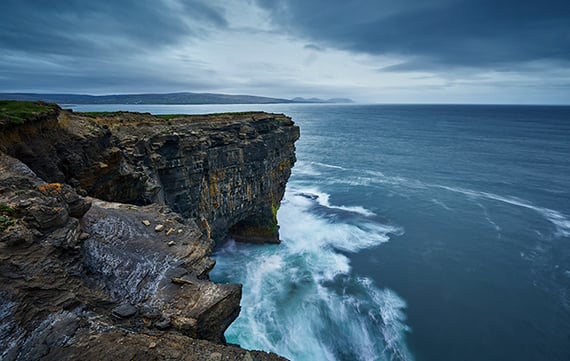

Downpatrick Head. Image: iStock.
Life of the saint
Plucking a shamrock from the ground to illustrate the doctrine of the Trinity, Patrick not only won over the king and the crowd, but he also gave that simple three-leaf clover eternal life as the universal symbol of Ireland and the Irish.
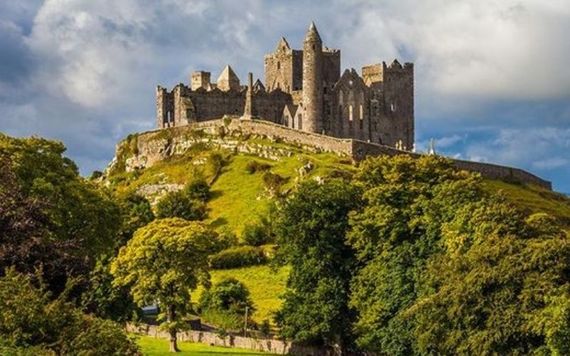
The Rock of Cashel, in Tipperary.
Patrick’s appearance at the Rock of Cashel in County Tipperary further attests to his fondness for panoramic heights. He seemed equally happy on the water as he paddled out to spend 40 days doing penance on an island in Lough Derg in County Donegal, a custom that is imitated to this day by visitors and locals seeking religious solitude.

Holy Island, in Lough Derg.
Decidedly at home amidst the bustle of Ireland’s cities as well, Patrick is said to have preached widely in Dublin in 448 AD, especially in the area where St. Patrick’s Cathedral stands today, beside a holy well said to have been used by Patrick to baptize. Two souvenirs from his travels – a small hand bell and an ancient reliquary – are on display at the National Museum.
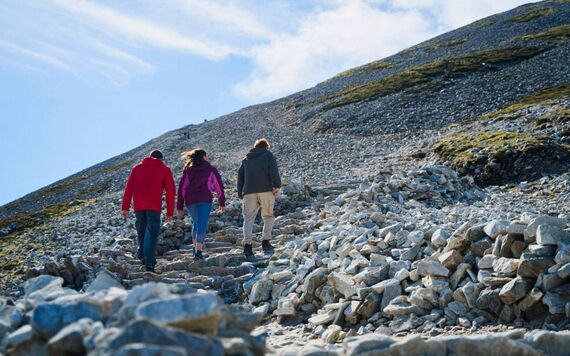
Hiking up Croagh Patrick, in County Mayo.
Croagh Patrick
Records show that Patrick favored Ireland’s west coast, particularly Galway and Mayo. Watching the sun go down on Galway Bay must have been a delight for Patrick, judging from the extent of his work in the county of Galway. Not only did he settle for a while at Moycullen, but he also built a church at Tuam. Nearby, in County Mayo, Patrick blazed a trail up atop a mountain overlooking Clew Bay near Westport. This site, now known as Croagh Patrick (Patrick’s Mountain), has become a primary place of pilgrimage for Christians. Each July thousands of participants climb “Patrick’s Path” to the summit of this beautiful quartzite ridge to pray.
As much as he loved the West, Patrick is most remembered for his travels around Ulster in Northern Ireland. It was at Armagh that he erected his principal church, giving the city a lasting prominence as the ecclesiastical capital of Ireland. This fact is graphically illustrated today by Armagh’s two St. Patrick’s Cathedrals, one Protestant and the other Catholic, standing on adjoining hills. St. Patrick’s Trian, a visitor center in the heart of the city, brings all the history to life via walk-through exhibits and high-tech audio-visuals.
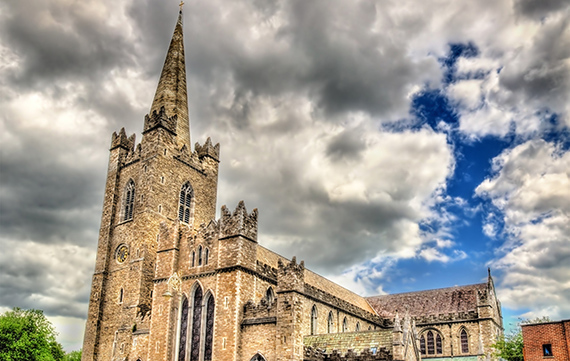
St. Patrick's Cathedral in Dublin. Image: iStock.
To round off a Patrick-inspired tour, all roads lead to County Down. It was here – amid the rolling hills, winding seacoast, and legendary Mountains of Mourne – that Ireland’s patron saint started his ministry and later spent his declining days. At Downpatrick, the quiet marketing town named in his honor, the cathedral churchyard reveals the journey’s end for the tireless traveler. Wedged among the elaborate graves, high crosses, effigies and monuments, stands a lone granite boulder – etched simply with a cross and the name "Patric" in Irish-language lettering. Follow the pathway down from the churchyard to the St. Patrick Centre, a contemporary gathering place that presents an in-depth review of Patrick’s life and legends.
So, next time you travel to Ireland, do walk in the footsteps of St. Patrick – and you will surely have a trip worth celebrating for many St. Patrick’s Days to come.
* Originally published in 2016, updated in March 2025.


Comments