American in Ireland


John Barry - Irish hero of the United States

Posted on Tuesday, November 01, 2011 at 03:11 PM

RSS


Recent Posts

Archives

submit to reddit

John Barry,
Philadelphia

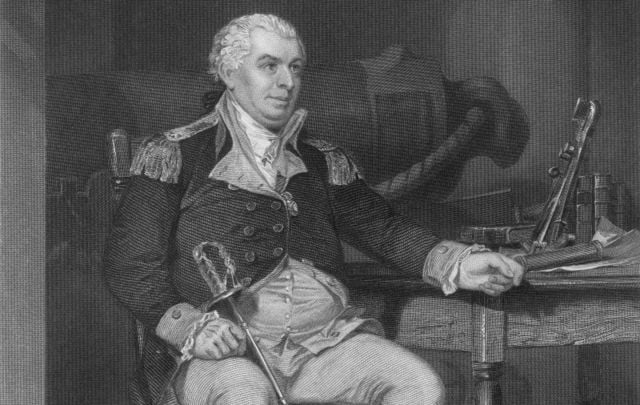
John Barry, Irishman and "father of the American navy" seems to be finally getting some of the recognition he's long past due. The most important development is the decision of the United States Naval Academy to erect a memorial to Barry, thanks to the efforts of members of the local branch of the Ancient Order of Hibernians. In addition, a recently published biography of Barry is the first in 72 years. I'd love to imagine that Barry will also receive some national attention in Ireland, where he is mostly known in his native Wexford.

I have visited Philadelphia many times and each time I've taken a moment to look at the statue of Barry. It's not hard to find. It's in Independence Square, right in front of Independence Hall.
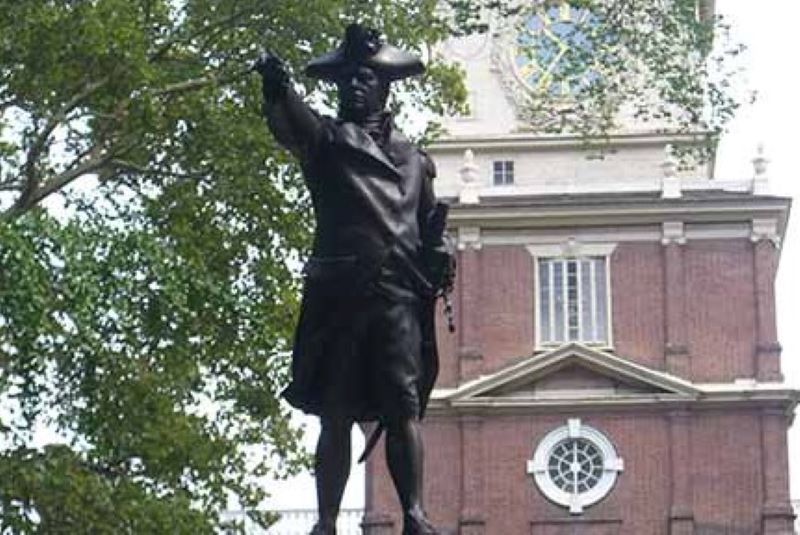
You can't miss it, but from what I've seen on my visits very few people actually pay any attention to the man whose statue greets them on exiting the building. During my visit there this summer the thought crossed my mind that many tourists from Ireland probably go on the Independence Hall tour and leave the area without ever realizing that the man who greets them in this quintessentially American location is an Irishman.
____________
Read More:

His Brother's Keeper: Commodore John Barry, Father of the American Navy

A Voyage of Rediscovery: the Irish America Hall of Fame at the Dunbrody Emigration History Centre

Notre Dame vs Navy will be security nightmare for Ireland
_____________
It's a shame that Barry is not better known - in America and Ireland - because Barry's story, while hardly unique, is fantastic. He grew up a poor kid in Ireland. His family was forced to leave their farm, supposedly by the landlord, and move to the coastal town of Rosslare. He was drawn to the sea, began working on merchant ships as a young boy and eventually sailed into Philadelphia, where he settled.

When the Revolutionary War broke out Barry, who was then captaining merchant ships, volunteered for and was given the task of outfitting fighting ships. He had a successful war as commander of a of a number of ships and even fought as a marine with Washington at Trenton and Princeton, while his ship was in dry dock. Barry's success during the war was rewarded later by President Washington, who made Barry the first head of the new United States Navy.
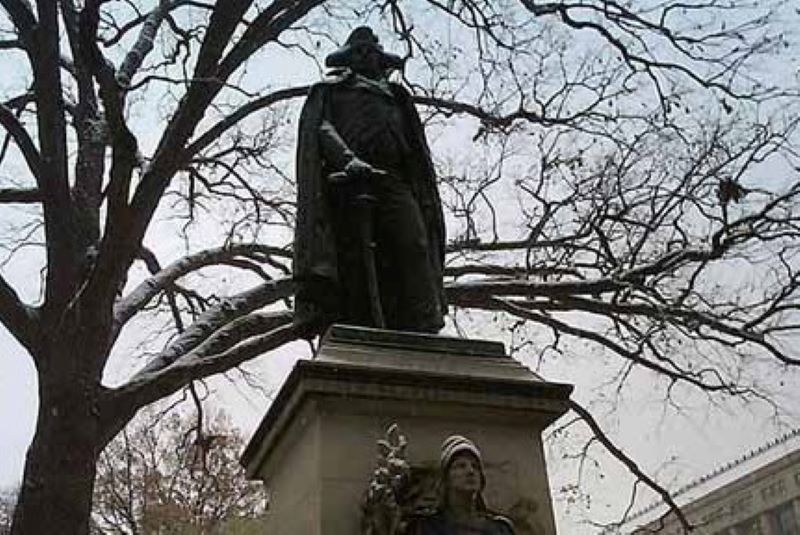
John Barry, Wexford
(photo: Paddy Donovan)

Philadelphia is not the only city with a Barry statue. There is one in Franklin Square in Washington, which I have not seen, and one in a prominent place in Wexford, which was a gift from "his grateful countrymen to the people of the land from which he sprung."
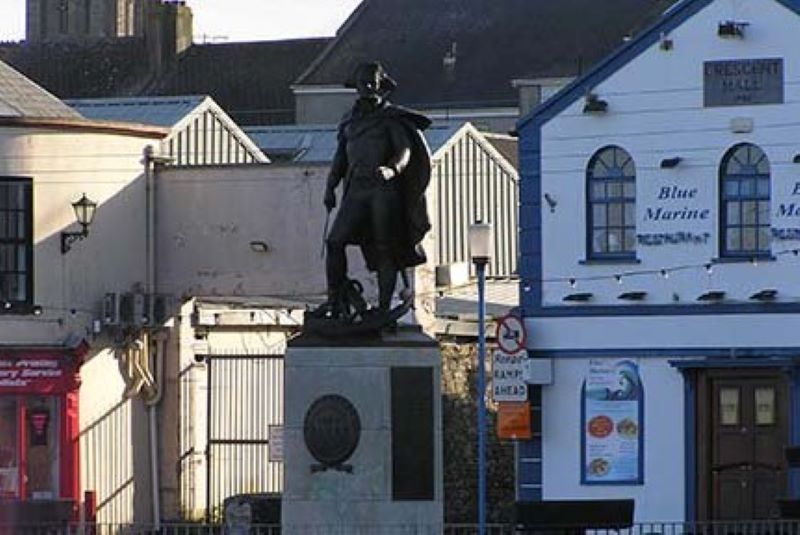
{Maybe it's my combative nature, but I prefer the Wexford statue that depicts Barry with the sword in his hand. In the Philadelphia statue he's pointing his hand and his sword is in its scabbard.}

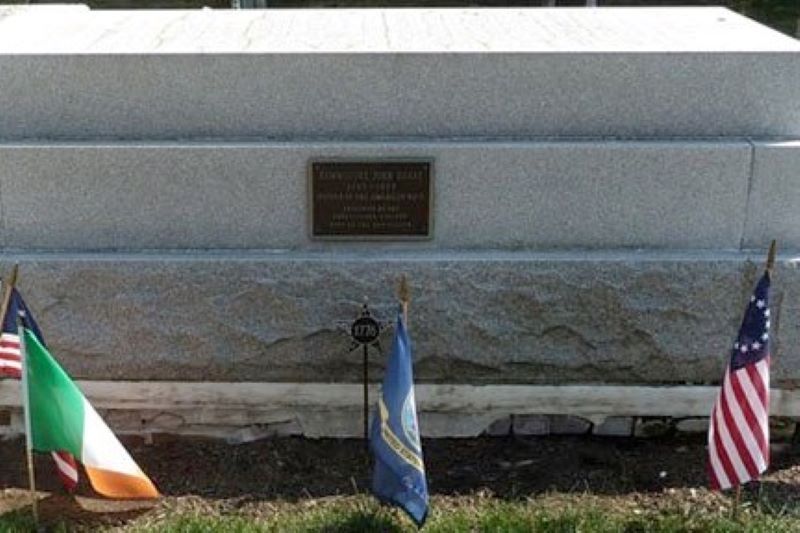
While you can't miss Barry's statue if you visit Philadelphia, you can miss his grave. I know because I did every time I visited until this year. His grave is well worth visiting, however, and it's only three blocks away from the statue. {Although on the day I visited this summer - July 23 - it was over 100F and those three blocks seemed an awfully long way.}

Barry's grave is in a beautiful setting and well maintained in Old St. Mary's Church yard. The epitaph on his tomb, restored in the 1870s, is poetic. It begins with:

Let the Christian, Patriot and soldier
Who visits these mansions of the dead
View this monument with respect.
Beneath it are interred the remains of
COMMODORE JOHN BARRY
Father of the American Navy.
He was born in the County Wexford in Ireland
But America was the object of his patriotism
And the theatre of his usefulness.


Barry is not the only prominent Irishman buried at Old St. Mary's. Thomas Fitzsimons from Wicklow, who signed the Declaration of Independence, and General Stephen Moylan from Cork, who during the Revolution was Quartermaster General, Aide to General Washington and finished the war as a Brigadier General, are both buried there. These two, along with Barry, put Old St Mary's high on the list of important places in Irish-American history.

John Barry's grave
Old St. Mary's Church, Philadelphia


15 comments

Page 1 of 2 pages
I found this very interesting, particularly as an Irish-American former sailor.
paulquigley,

Gift from the people of Philadelphia? If that's true - and it's been a good while since I was in Wexford and I can't remember now - I'm sorry. I thought it was a gift from all Americans. The link above - where I mention the "gift" - is to an article referring back to the statue's unveiling and the quote is from President Eisenhower.
I am a life long resident of Philadelphia and it's suburbs and we were taught in Catholic school that John Barry was the "father of the American Navy". While in Wexford I saw the statue and I believe the inscription states that it was a gift from the people of Philadelphia.
An other little known fact is, the masked freedom fighter of colonial Mexico ZORRO was an Irish gentleman of noble birth named William Lamport, born in 1615 in County Wexford. After an amazing life he was burnt at the stake as a heretic in Mexico City in the year 1659.
In elementary school, I was taught that Commodore Barry was the Father of the American Navy. friends dismissed it as Irish propaganda.thank you Sister Regina. From Wikepdia: John Barry was once offered $100,000 British pounds and command of any Frigate in the entire British navy if he would desert the American Navy. Outraged at the offer, Captain Barry responded that not all the money in the British treasury or command of its entire fleet could tempt him to desert his adopted country.[1] He was still in command of the Alliance when it participated in the last battle of the Revolutionary War.[2] Appointed senior captain upon the establishment of the U.S. Navy, he commanded the frigate United States in the Quasi-War with France. Barry authored a Signal Book published in 1780 to improve communications at sea among vessels traveling in formation.[3] On February 22, 1797, he was issued Commission Number 1 by President George Washington, backdated to June 4, 1794. His title was thereafter "Commodore." He is recognized as not only the first American commissioned naval officer but also as its first flag officer.[4] Barry's last day of active duty was March 6, 1801, when he brought the USS United States into port, but he remained head of the Navy until his death on September 12, 1803, from asthma.
My husband is a Navy vet and this is a cool bit of history to know. Thanks!
Thank you for the article, as a U.S. Navy vet, I had not heard of John Barry. Nor, as JamieLM mentioned, not even in our history books here in the Midwest.
peaceuniteeire

I didn't know that. I guess I assumed the Navy was paying. Uggh.

Contributions it is, tax deductible if you pay tax in the United States.
The AOH in America must raise the funds to complete the construction of the long awaited Commodore John Barry Gate and Memorial at the United States Naval Academy in Annapolis MD. Please go to www.hiberniancharity.com to make your tax deductible donation.
He's buried when it comes to his contribution in founding the Amer Navy. No mention of his Capt brother Patrick also, one who was lost early in his sea battle, early into the struggle from Merry O.
He's buried when it comes to his contribution in founding the Amer Navy. No mention of his Capt brother Patrick neither who was lost in battle early into the struggle from Merry O.
I remember passing the Barry monument in Wexford on my 1999 bird watch tour. Now can you name the people with Irish origins who signed the founding documents of the USA? Henry Knox, the first Secretary of War (now Defense)for the USA, was born in Ulster and served in the American Revolution. Knox was likely the largest person of Irish heritage to serve as a General during the American Revolution.
@The Yank, very interesting article. I hate to admit that I'd never heard of Barry. He wasn't mentioned in my history books, that I remember. It's too bad Barry hasn't had more press. People in the Philadelphia area are sure to be more knowledgeable than I am, living in the Midwest, about Barry's role in Am. history. Thanks for bringing Barry to the attention of IC readers.
Rebelforce,

I didn't forget that bridge because I didn't know about it. Thanks for that.
Don't forget the Commodore John Barry Bridge which spans the Delaware River from Chester, Pennsylvania to Bridgeport, in Logan Township, New Jersey, USA. It is named after the American Revolutionary War hero and Philadelphia resident John Barry. Along with the Betsy Ross Bridge, the Benjamin Franklin Bridge and the Walt Whitman Bridge, the Commodore Barry Bridge is one of the four toll bridges connecting the metropolitan Philadelphia region with southern New Jersey. Construction of the bridge began on April 14, 1969, and it opened to traffic on February 1, 1974. It has a total length of 13,912 feet and a main span of 1,644 feet, making the bridge the fourth longest cantilever bridge in the world, and the longest in the United States.
Page 1 of 2 pages


Log into IrishCentral with your Facebook account


or sign-in directly

E-Mail:
Password:
 Remember me Forgot my password
Not a member? Register Now!
print this article Print
email this articleE-mail