
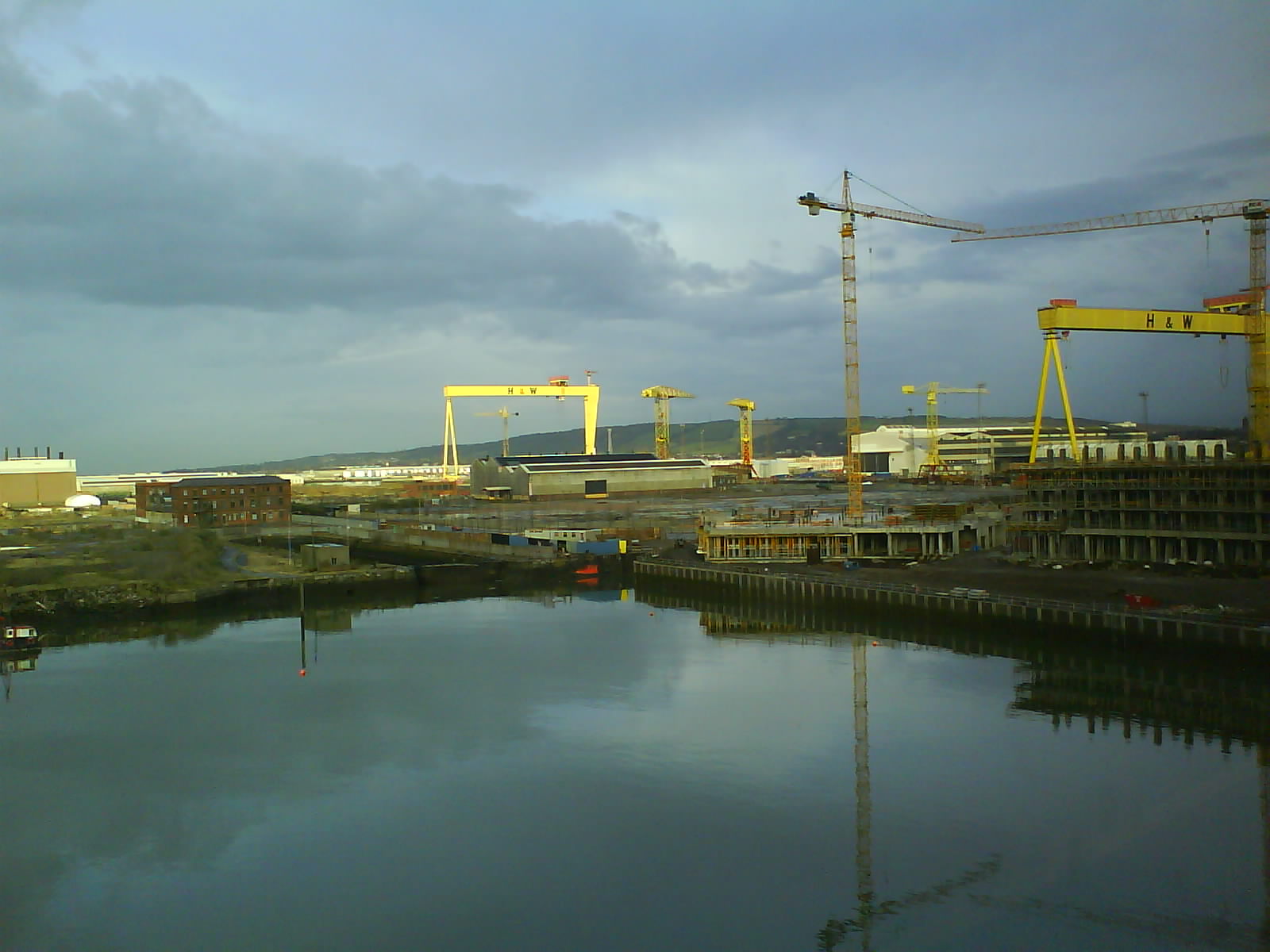
Harland & Wolff is a name you will certainly know if you're an aficionado of the Titanic story. However, even if you are only familiar with Belfast you will recognize the two massive yellow cranes that loom over the Harland & Wolff shipyard.
I was in Belfast a few years ago and drove over to East Belfast to see what the Harland & Wolff site looked like. 'Desolate wasteland' sums up pretty much what I saw as I stared through the rusted iron gates. Broken glass, broken concrete, broken dreams were all that was visible.
However, on a later visit I toured the site and two things struck me. First, that although it's a modern day ruin, the dry dock where the Titanic was built is still there as is the building where the plans for the great ship were first drawn.
It didn't take me long to realize that the site had great potential as a tourist attraction. I'm not the only one – there are plans to transform the area from a derelict site into one that tourists will flock to. Whether it's all going to be ready for the 2012 100th anniversary of the Titanic's maiden (& only) voyage is hard to say.
The second thing that caught my eye was a strange red tower just off to the side of the yellow cranes. I knew that H & W were still doing some shipbuilding or repairs, but I knew it was nothing like the old days. However, this red tower was not a ship, but a wave power generator.
As I learned, H & W have diversified into ocean based renewable energy engineering projects. Wave power generators are only part of the project because H & W are also building wind turbines and in July they won a contract to build a tidal turbine, which will produce electricity from the tidal flows.
Harland & Wolff is at the cutting edge of 21st century technology, just as it was at the cutting edge of 20th century technology at the time of the Titanic.
I was in Belfast a few years ago and drove over to East Belfast to see what the Harland & Wolff site looked like. 'Desolate wasteland' sums up pretty much what I saw as I stared through the rusted iron gates. Broken glass, broken concrete, broken dreams were all that was visible.
However, on a later visit I toured the site and two things struck me. First, that although it's a modern day ruin, the dry dock where the Titanic was built is still there as is the building where the plans for the great ship were first drawn.
It didn't take me long to realize that the site had great potential as a tourist attraction. I'm not the only one – there are plans to transform the area from a derelict site into one that tourists will flock to. Whether it's all going to be ready for the 2012 100th anniversary of the Titanic's maiden (& only) voyage is hard to say.
The second thing that caught my eye was a strange red tower just off to the side of the yellow cranes. I knew that H & W were still doing some shipbuilding or repairs, but I knew it was nothing like the old days. However, this red tower was not a ship, but a wave power generator.
As I learned, H & W have diversified into ocean based renewable energy engineering projects. Wave power generators are only part of the project because H & W are also building wind turbines and in July they won a contract to build a tidal turbine, which will produce electricity from the tidal flows.
Harland & Wolff is at the cutting edge of 21st century technology, just as it was at the cutting edge of 20th century technology at the time of the Titanic.



Comments