![]() |
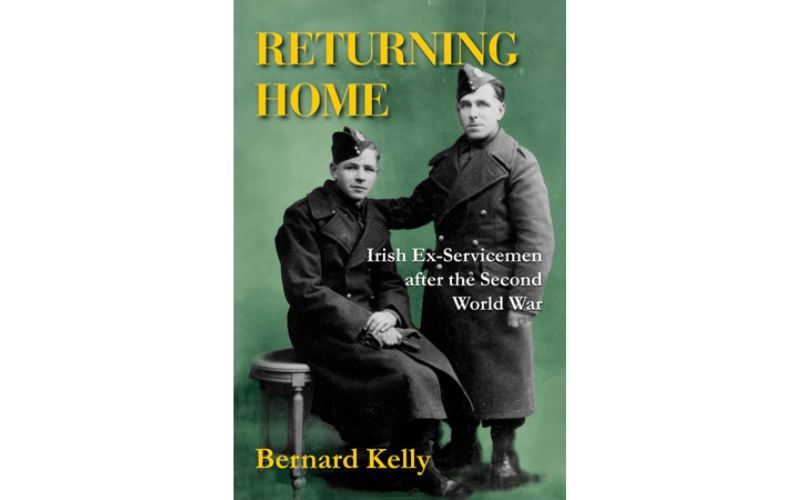
| Bernard Kelly's new book: Returning Home |
This week we're going to give you a break from the mind-numbing economics and politics of the euro crisis and the referendum here on the Fiscal Compact Treaty. It will be unavoidable next week in the run up to the vote in Ireland on May 31, so make the most of your time off!
So this week we will ignore all that euro stuff. There also happens to be a good reason for switching the focus this week because it gives us the chance to take a look at an important new book which was published in Dublin on Tuesday, May 22.
The book, Returning Home, is by the young Galway historian Bernard Kelly, and it investigates the shameful way the estimated 12,000 Irish veterans who returned to Ireland after the end of the Second World War were treated.
Let's put it like this -- it's a long way from Saving Private Ryan.
You would think that after fighting Hitler's armies the returning ex-servicemen would have got a hero's welcome home. But they didn't.
Instead they came back to a country that was scornful of, ignorant of and indifferent about what they had been through. In many cases they faced open hostility. Their service in the British forces was seen by many at home as anti-national, almost traitorous.
The book tells the stories of many of these Irish servicemen and women who fought in the war, but I particularly liked the one about a guy called John Kelly who left rural Kilkenny to join the British Army and ended up fighting the Germans in North Africa.
In 1943, after the heat of the battle to liberate Tunis, the capital of Tunisia, he was sitting in a bar in the city center having a drink. Also there celebrating the liberation of the city were some American conscript soldiers.
Hearing his Irish accent, the Americans said, “Say, you guys are neutral, you’re not in the war at all!” Kelly explained that he was a volunteer. The reaction of the Americans was, “Are you goddamn mad or something?”
It was a fair question. Kelly, and thousands of other Irishmen like him, had left the safety of neutral Ireland and risked death or injury to fight in the Second World War. They played their part in defeating Hitler.
But they got no thanks for it when they came home. It's a disgraceful and shameful part of recent Irish history. It shows how small minded and inward looking Ireland was at the time.
De Valera had kept Ireland neutral during the war while the British and the Americans fought the most brutal and evil regime the world had ever seen.
Whether that decision was morally justifiable given the murder and mayhem unleashed across Europe by Hitler is arguable. One can take the view that as a weak, newly independent country we had other priorities.
But at the very least the sacrifice made by thousands of Irish people who volunteered to fight Hitler should have been recognized when they came back. After fighting the Nazis the 12,000 Irish veterans deserved that much.
Instead they came back to a country where the attitude to them was so poisonous they quickly learned to keep their war service secret.
Even worse, of the 12,000 Irish veterans an estimated 5,000 had deserted from the Irish Army to join the British and fight Hitler and they faced potentially severe punishment when they returned home. All of the veterans also had a practical reason for keeping their mouths shut -- they came back to a country that was severely depressed, and being an ex-serviceman did not help in the search for a job.
There was a lot of ignorance in Ireland about the war. Unlike in Britain, where the entire country had been caught up in the war effort and as a result had great admiration for the returning soldiers, the Irish public had little understanding of the veteran's experiences.
All the Irish public had been through were the minor inconveniences of what de Valera called "the Emergency," which involved keeping the country on alert and putting up with some shortages and rationing.
Even the terminology says a lot about Ireland at the time. The rest of the world had a world war. In Ireland we had "the Emergency."
Despite the ignorance here, however, by 1945/’46 many Irish people were aware that details of Nazi atrocities were emerging. You would think that this might have changed attitudes. But it didn't.
"Word of Nazi atrocities were filtering back to Ireland, partly through the media and partly through people like Dubliner Albert Sutton, who visited Belsen soon after it was liberated and saw harrowing scenes there," Kelly said at the launch of his book.
"But the whole experience of neutrality had opened an emotional breach between the Irish population and the U.K. Censorship, isolation and neutrality meant that while many people in Ireland were well aware of the war, they had no attachment to it. There was a genuine sense of pride and satisfaction that Ireland had avoided the war, despite pressure from London and Washington.
"When ex-servicemen returned their friends and family were delighted to see them, but they encountered indifference from the government and much of the population. There were no bands out to meet them because most people did not see the Second World War as Ireland's war; it wasn't something to be celebrated.
"From the government's point of view, they had not fought for Ireland, so they were not Dublin's responsibility. As for the bulk of the public, they simply didn't understand what the veterans had been through," Kelly said.
One writer quoted by Kelly recalls that in his home city of Cork they "were more concerned with the horrors of rationing than with anything that was happening in Europe.” Which sums up Irish attitudes at the time.
The whole business is still a very sensitive subject, even today. When Kelly was doing interviews for the book many of the surviving veterans and the families of deceased veterans asked him not to use their surnames or addresses. For that reason the servicemen and women are referred to in the book on a first name only basis.
A man called George returned to Dublin from service with the Royal Navy, and he said it felt "as if you didn’t exist -- nobody wanted us."
Another man called William, who left Dublin to join the RAF, was dumbfounded by the ignorance of the war in Ireland. He was told by his neighbors that stories about German concentration camps were simply "British propaganda."
Another man called Larry, who left Wicklow to join the Royal Navy, was absolutely "shattered" by people’s attitudes when he returned home. He says that his fellow countrymen were interested only in "drinking themselves into oblivion, not a single thought about what was going on beyond the horizon. And they didn’t care a damn either."
One can understand the anger of many Irish ex-servicemen who had been though a lot during the war, in ways that changed their lives forever. Back home, however, people did not want to know or just didn't care.
John Kelly, the guy in the bar in Tunis, is an example. He was aboard the Polish ship Chobry when it was sunk off the Norwegian coast in April 1940, and barely escaped with his life. He fought his way through North Africa and stormed ashore at Anzio in Italy in 1944, where he was severely wounded and almost died.
He says he was rescued by a Kerryman, but then was further wounded by an RAF airstrike. He was evacuated and was invalided out of the army afterwards.
His brother fought in the Far East. John died in 2009 and there are pictures of him in the book.
But my favorite picture is the one on the cover of the book, which you see here. The two young men are Michael and Paddy Devlin, both from Longford Town.
Like many Irish from the south, they crossed the border to join the British army in Enniskillen in 1939 at the start of the war. They were posted to different units and fought in France.
Their units were smashed by the German attack in May 1940. Both were evacuated from French beaches. The men survived the ordeal but are now deceased.
Based on interviews with surviving veterans and drawing on a wide array of archival sources, Returning Home explores how the Irish ex-servicemen coped with the frosty welcome they got when they came back to Ireland, with the difficult task of re-integration, their economic difficulties and psychological problems.
The treatment of deserters from the Irish Army who joined the British to fight in the war is only now being addressed, nearly 67 years after they came home. The minister for defense here made a statement in February indicating that official steps are being taken to issue a formal pardon to all such veterans, alive or dead.
It's been a long time coming. It's disgraceful that it has taken so long.
But of course the delay did not stop people here getting all misty-eyed over movies like The Longest Day or Saving Private Ryan over the years.
Overall, Returning Home makes an important contribution to how we view Ireland's connection to the Second World War and Irish participation in it.
The book is published by Merrion, the new history imprint of the Irish Academic Press. Kelly is currently working as a post-doctoral research fellow at the University of Edinburgh.
72 Comments
-
-
-
-
-
-
-
-
-
-
-
-
-
-
-
-
-
-
-
-
-
-
-
-
-
-
-
-
-
-
-
-
-
-
-
-
-
-
-
-
-
-
-
-
-
-
-
-
-
-
-
-
-
-
-
-
-
-
-
-
-
-
-
-
-
-
-
-
-
-
-
-
Switch to the desktop site to post a comment.ancavker | May 30, 2012, 12:09 PM EDT
dublinborn: Churchill would not guarantee Irish unity at the end of WW 2. He only offered to encourage the north to consider it. had he been serious, he could have at least turned over Fermanagh and Tyrone to Free State jurisdiction as a good faith gesture, as the population was predominantly Nationalist?Catholic.
ancavker | May 30, 2012, 12:05 PM EDT
Tom: Thank You. I think we can also say that De Valera made it known as well, that although he remained neutral, he was neutral in favor of the Allies cause. Churchill came to appreciate this too later on. And the Americans acknowledged the help they received from neutral Ireland.
IrelandNorth | May 30, 2012, 07:45 AM EDT
DanOLoingsigh! Point taken. Might I counterclaim as to whether Ireland as a whole wanted to be a collateral member of the United Kingdom of Great Britain in the first place, (i.e 1800/'01), as to be subsequently partitioned at all 120 years later. The inherent integrity of Ireland is acknowledged by many diverse institutions from the Church of IRELAND to the the Grand Orange Lodge of IRELAND. Which appears to support my contention that geography predicates politics. As an Good Friday Agreement aficionado like myself, I'm sure we'll agree that the proviso for simultaneous referenda in both jurisdictions on the Island for unification is probably as good as it gets contemporaenously.
MerleAZ | May 26, 2012, 10:57 PM EDT
I did not know about this story until a few years ago. My Dad served in the US Navy, in WWII. He still has the paper fliers they passed out to sailors when they came into Londonderry/Derry on leave. The fliers tell the sailors they had to wear civilian clothes if they are going into Ireland. I did not understand this. My Dad had to explain this to me. Like a sailor would be part of the invasion of North Africa or Sicily and keep an set of civilian clothes for a leave in Derry. Let me guess - there is a clothesline in Derry with nothing hanging on it.
Seanmor | May 26, 2012, 07:48 PM EDT
Not only did Dev keep the Free State out of the war, he also discouraged G.B. from imposing conscription in the North of Ireland. If given the option, any sensible leader would choose peace over war for the benefit of his country and its people.
Stiofain | May 26, 2012, 01:44 PM EDT
Ironic? One group fights fascism in Spain are hero's,others in WWII and are scorned.
Stiofain | May 25, 2012, 07:25 PM EDT
ancavker, I appreciate your comments - they are fair and reasonable. Yes, some joined up because they needed a paycheck, others for the sheer excitement. Most, I think, must surely have considered the possibility that they would not survive. Yet, they volunteered. To me, the supreme irony here is that these men, regarded later as traitors, were in brutal reality, fighting for Ireland's survival in the uniform of the ancient enemy. Had Britain been defeated, at the very least, Ireland would have become a puppet of the Third Reich, with a collaborationist government under the Nazi jackboot. God knows, we had enough willing collaborators who would have happily answered the call. Your point re. other neutrals is well taken. I do not excuse them - Spain and Portugal were dictatorships, sympathico with Der Fuhrer, if not outright allies. Sweden is more troubling but, in truth, made little effort to hide its support for Britain and the U.S. The others don't matter.
barneyjo | May 25, 2012, 06:02 PM EDT
@GeorgeDillon - George.. I am wounded to the core that you think me a racist and bigot!! (or should that be a badge of honour awarded by your good self :)- Anyways; Cleric led anti jewish pogroms in southern cities in the early 20th century. Low admissions of Jewish Refugees in the years immediately before WWII. Cleric led boycotts of Protestant businesses and communities (Fethard on Sea and the like). Despite the best efforts of bullys and bigots, George, victims dont lie down to their fate. No George, just as the world turns,so too does the WORM!!!
RedBranch | May 25, 2012, 05:59 PM EDT
Citizen69 Thanks for that, I love the theatrics and proving yet again that the republican movement just does not do irony!
DanOLoingsigh | May 25, 2012, 04:07 PM EDT
Dillon - Wake up man, there's a bunch up north who said no...and meant it...nothing's resolved till the fat lady (probably your longsuffering wife)sings!!!
Nicoletta | May 25, 2012, 03:35 PM EDT
Perhaps this is why so many Irishmen servicemen settled in England after WW2. We had a lovely ex-RAF man in our rural parish. Rode his bike to Mass every morning until shortly before his death. RIP Nick.
GeorgeDillon | May 25, 2012, 01:55 PM EDT
Oloingsigh--you're living in the past. Get over your bigotry. The question of independence from the UK was resolved almost 100 years ago. Grow up. You might as well ask if the United States wants "to have independence from the UK". You're an obsessive bigot.
GeorgeDillon | May 25, 2012, 01:50 PM EDT
Dublinborn: "he could have traded our neutrality for a united Ireland." Just like John Redmond "traded" Irish participation in attacking Germany and Turkey in the First World War for Irish Home Rule! What stupid nonsense you come out with, Dublinborn.
Dublinborn | May 25, 2012, 01:16 PM EDT
Sad to hear all the apologists for Neutrality during WW2. If Dev had any political skills at all he could have traded our neutrality for a united Ireland.
citizen69 | May 25, 2012, 12:47 PM EDT
...Furthermore, on Easter Saturday 1943 the IRA took over a cinema on the Falls road, Belfast, stopped the film, and went on stage and read a statement from the IRA Army Council. The statement denounced the AMERICAN military presence in Northern Ireland and warned that they would target American servicemen. Hugh McAteer, the IRA Chief of Staff at the time read the statement.
citizen69 | May 25, 2012, 12:44 PM EDT
@Ancavker: A group doesn't have to be that well organized to provide intelligence. Some of the information they provided was as simple as informing the Nazis of what buildings still remained intact after the first raids so that they could destroy them in the next wave of bombing, and the morale of the people. The confessions of an IRA veteran were revealed in a TV Documentary in the late nineties. He felt ashamed of what he had done. It's thought a few hundred IRA activists were involved in the intelligence gathering...
DanOLoingsigh | May 25, 2012, 12:23 PM EDT
De Valera's myopia was understandable, given the circumstances...there is far less excuse today...Irishmen were far more effective in any allied uniform, than sitting in the Tom Swinford described position...but US-based posters should remember that American airmen who fought in the RAF had similar treatment...right up until Pearl Harbour
DanOLoingsigh | May 25, 2012, 12:14 PM EDT
Ireland North - Is not the real question is: Does the whole of Ireland want to have independence from the UK or does it not?
ancavker | May 25, 2012, 11:34 AM EDT
Tom: Agreed it is an emotional subject, But you are assuming that all the Irish who joined the British Army did it to fight the evil of Hitler. Lets remember the Holocaust was not common knowledge at the time. One could also argue reasonably that it was just the big Europe and powers slaughtering each other again in another blood bath. As far as Hitler enslaving Ireland, doubtful he did not care one way or the other, but yes did consider them to be inferior to the English. He wanted Britain out of the war nothing more. Once defeated he planned to let them keep their empire, and would not have cared if they invaded the south. And again lets remember the other countries that stayed neutral, why do they get a pass?
ancavker | May 25, 2012, 11:29 AM EDT
citizen: I will attempt and verify, but I highly doubt the IRA provided intelligence to the Nazi's. The IRA at the time could not find their way out of a paper bag.
citizen69 | May 25, 2012, 10:15 AM EDT
Volunteers from Ireland who helped the allies fight the Nazis were barred from attaining any government jobs or state welfare in Ireland upon their return, yet Sinn Fein & IRA internees who has aligned themselves with the Nazis suffered no such bans. The IRA had provided Nazis with intelligence for bombing raids on Belfast. Raids which killed over 1000 Irishmen, Protestant & Catholic and destroyed half of the buildings in the city.
citizen69 | May 25, 2012, 10:12 AM EDT
This is a topic we've covered before in these pages - with strong opinions on both sides. My position is clear and will never change. The Irishmen who fought in the British military in WW ll are heroes of the first order. They were not content to sit on their arses in shamefully neutral Ireland while the greatest evil the world has ever known was rampaging through Europe. These brave men fought that evil - and many died. If England had been defeated Ireland would have been enslaved, yes, enslaved - for, while Hitler had great admiration for the English, whom he regarded as Germanic in racial stock, he had very little regard for the Irish. These men were fighting for the survival of Western Civilization and democracy. If ever there was 'the good fight,' this was it and they chose to be in it - rather than take the easy way out, which their country did.
GeorgeDillon | May 25, 2012, 08:55 AM EDT
Ciaradexy: Your latest extraordinary diatribe confirms that you're psychotic.
IrelandNorth | May 25, 2012, 07:27 AM EDT
The subtitle of this book is misleading. They were ex-British military servicemen, since neither Ireland nor its 40,000 strong army were belligerants in WWII. The estimated 12,000 were British military veterans (even if Irish citizens), not Irish veterans who were British subjects. They would have gotten a heros welcome if they had been fighting for the Irish Army. Their British Army (BA) service was seen as anti-national because it was. Deserters from the Irish Army to the BA were seen as treacherous because they were. The Americans or British don't decorate deserters. Might American conscripts' perception of Kelly/Ó Céallaigh in Tunis/ia have been accurate? Ireland wasn't a newly independent country, it was a recently partitioned one, which goes a long away to explaining De Valera's anti-British sentiment, having escaped a British firing squad for his part in 1916 due to American citizenship. Volunteering for another army whilst serving in one already is desertion, even if to assist Mother Theresa in Calcutta. You can't run an army with a bunch of interloping carpet-baggers. Exposing ones recently partitioned proto-national state to invasion by Germany wasn't helpful to the Allied cause. (How did the British Army deal with their deserters to the Wermacht/German Army?) Do Mr Kelly's aliases represent real subjects or fictious characters. Is his book historical fact or fiction? Did "a man called George" return to Dublin or to Ireland from the RAF? Did William from Dublin and Larry from Wicklow to the RAF/RN respectively go to GB or UK? There is a lot of ignorance in Ireland still, not lease inspired by historically illiteracy and political dyslectic inspired by an unresolved post-colonial inferiority complex which supports a revisionist agenda. The real question is: Does the whole of Ireland have a right to independence from the UK or does it not? Seems political partition inspired a schzoid nationalism.
Baggie68 | May 25, 2012, 07:06 AM EDT
Which war was this - the 1939-45 one or the 1941-45 one?
ciaradexy | May 25, 2012, 05:57 AM EDT
Joan1954, you hit the nail on the head. These men needed money to feed their families. Why wouldnt they get out there and fight the nazi's?
ciaradexy | May 25, 2012, 05:56 AM EDT
George, everyone on this site knows that its you who are racist. You dont want any non Irish people in Ireland so it suits you that an poor black man was murdered. It was probably a member of your family who did it after being brain washed into the white power frame of mind that you have.
GeorgeDillon | May 25, 2012, 03:12 AM EDT
A year or two back a black kid was murdered in Dublin by two Irish thugs. According to our resident racist barneyjo this proves that all 4 million or so Irish are racists. What an amadan.
GeorgeDillon | May 25, 2012, 03:10 AM EDT
More stupidity from barneyjo. He lists two people shot in Dublin in 1923. Presumably he lists these because they were Jewish. He uses the murder of two people to slander an entire community. I bet there were hundreds of Jews murdered in New York in that same year SO that proves that all of the US was anti-Semetic? And of course there were hundreds of Catholics shot in Dublin that Civil War year too. So the Irish were anti-Catholic? What imbecilic nonsense from barneyjo.
MarkRichey | May 25, 2012, 01:52 AM EDT
I'm not Irish, just Irish American, but I also feel serving in the British Army was a questionable decision and I can't see the veterans as any sort of heroes. I can certainly understand they were not given such a warm welcome.
clevelander | May 24, 2012, 09:16 PM EDT
Insanity. Most of the comments below are insane. I am stunned. The ignorance is astounding. If they for for liberty,God Bless them, if they fought for england and deserted Ireland to Hell with them. @breandankearns you state "THANK YOU FIGHTING IRISHMEN FOR FIGHTING AGAINST EVIL, WHEREVER IT IS.-BECOUSE EVIL TRIUMPS, WHEN GOOD MEN DO NOTHING." I agree. God Bless the Freedom Fighters of Ireland Yesterday and Today. @Rebelforce You are correct.
89west | May 24, 2012, 08:42 PM EDT
From what I recollect, most deserters left for NI to join the British Army because the pay was double what the Irish Gov't paid. Rations were bad as were living conditions and the duties very labor intense (cutting turf, etc.) Last summer, I recall petitions were being circulated to provide amnesty to all of those who deserted for a better pair of brogues and a wool sweater. It appears to be working its way through the system and maybe before the last of them are gone, something may be done. Someone on here tried to insinuate, the Stahlhelm (WWI German Helmet) was used to make a political statement. This is rather far fetched, as the helmet was manufactured by Vickers Ltd. in England in 1927, which was only a few years after the Anglo-Irish Treaty and some seven years before the nazis came to power. Originally, it was planned to have a French helmet made for the Army, however, it was unsuitable and the German pattern was more feasible and this pattern is still in use today by the many Europeans Countries. These helmets were taken out of service during the Emergency and painted white and used by the civil defense. Ireland didn't do too bad for itself during the war. Aside for the bombing of North Dublin in retaliation for sending the Dublin Fire Brigade to Belfast and the sinking of a coastwise freighter and the bombing of a factory in Wicklow, Ireland's leaders kept the destruction of the war away from their shores. This came at a price, Ireland was excluded from the aid provided by the Marshal Plan and it took them many years to get a seat in the UN.
Rebelforce | May 24, 2012, 08:39 PM EDT
Why on earth would an Irish soldier be considered a "hero" for fighting to get German troops out of Poland? The real Irish heroes were the Irish men and women who fought to get British troops out of Ireland.
aloistmartin | May 24, 2012, 08:31 PM EDT
Problem was, many People really didn`t see that much difference between London and Berlin with regards to Trusting Ol Willy. Fascism might seem a bit extreme from the comforts of Cape Cod, or Buckingham Palace; But not from the Dusk Hour streets of Northern Ireland.
KevinKehoe | May 24, 2012, 07:57 PM EDT
[1] Leaving aside all the greedy International Bankers, munitions manufactures and oil barons who love wars and made an absolute fortune on the death and misery of millions of people manly Europeans in both world wars, providing funding for all sides involved, and still are to this day funding wars across the globe ?. Ireland pre WW2 had deep suspicions of the British Empire, France and later even America after there treatment during the Treaty of Versailles after WW1. To put it in a nut shell none of the above would even give the Irish delegation a hearing during the talks or one that counts anyway. They didn't want to know the 800 year old plight of the suffering of a small nation. With all there lies and Bull before the war about the plight of the small nation of Belgium. Yet Belgium had lots of blood on it hands a few years before WW1 with the mass murder & torture of people of the Congo. These atrocities were exposed by an Irishman “Roger Casement”. So the freedom loving people of the small island of Ireland had to go it alone and finally get there liberty they justly deserved. They did however get financial aid from “ Irish America” and guns from Germany in that struggle, less that 20 years later WW2 broke out. So people passing judgment today should bear that in mind.
KevinKehoe | May 24, 2012, 07:56 PM EDT
[2] Ponder this, imagine 18 years after WW2 ended and lets say China was causing havoc in some part of the world and Germany was a power again and they wanted other nations to help defeat them, would Jewish people join there side after there history. Don't think so, and you would have to understand there reason for not, its takes a long time for such wounds to heal and us Irish are no different. To imply as one poster suggests that Britain would implement Home Rule in Ireland is utter nonsense.There were some in Britain who through the centuries would have pressed for better conditions in Ireland but they two few. At that time in history Britain concord nations with swords and guns and the only way to get free from them was with there type of brutality. Thats the history of it.
joan1954 | May 24, 2012, 07:12 PM EDT
A friend of mine from Galway once told em about going to Britain during WW II to help with the sugar beet industry among other things. He told me that it ws the only way to make some money and later he legally immigrated to America. I asked about the Irish who joined the British Army to fight and his comment was it was for the same reasons as he, money to help feed their families. Perhaps it is time for peace?
barneyjo | May 24, 2012, 06:55 PM EDT
@GeorgeDillon - The families of Bernard Goldberg, shot by three unknown assailants on St Stephens Green on 31st October 1923, and Emmanuel "Ernest" Kahn, gunned down in Stamer St also in Dublin on 14th November 1923, might beg to differ!!
seanomelbourne | May 24, 2012, 06:04 PM EDT
Having worked with ex-British soldiers in Dublin I never saw any animosity toward them.pilib04 writes an honest appraisal of the Irish psyche at that time.It would behold the 5000 deserters from the Irish army to apologise for their action as part of "closure" in this affair. As one who lived in Dublin in the fifties most people over forty remembered the treatment of Irish civilians by the BA and the black and tans and they were not about to forget who the enemy was. For Spain to say the Irish were ignorant is an ignorant statement in its self.
pilib04 | May 24, 2012, 05:02 PM EDT
This is a very sensitive and difficult subject. There are clearly two sides to this story. One side reflects on a country that had just experienced its own war for independence against an imperialist monster. This monster was led by Churchill. This struggle took place half a century after British Genocide in Ireland, An Ghorta Mhoir. The other side is the anti-fascist fight that many Irish participated in whether in the International Brigade or in the Brit Army. I can certainly see both sides. I don't think revisionist history helps at this point in time. There were very good reasons why there was such negativity about Irishmen fighting in the army of the British imperialists. Today we might be able to see the struggle against British Imperialism in the light of the new Millenium. But in 1945, the wounds of the War for Independence and the Black and Tans and the aforementioned An Ghorta Mhoir were still too vibrant in the national psyche. Those who would judge the Irish, should first judge the English!
Sparklet | May 24, 2012, 05:01 PM EDT
I think a lot of Irish will be offended on behalf of their ancestors, by the suggestion that they weren't fighting for Ireland. They fought because they had the foresight to know that Hitler's madness had to be defeated - admittedly, in some cases they could have been influenced by the fact they had family in Britain. I doubt there were many who actually fought 'for Britain'. They fought for what was right, because Hitler was evil.
GeorgeDillon | May 24, 2012, 03:52 PM EDT
On 1 January 1938 when the 1937 Irish Constituion came into effect a senior Irish rabbi, Dr A. Gudansky, said: ‘We Jews have indeed good cause to rejoice in the happiness and well-being of the Irish people--a people that may justly take pride in the fact that not a drop of innocent Jewish blood has ever been shed on its soil." So much for the mad fanatics that are posting lies and hatred on this site.
GeorgeDillon | May 24, 2012, 03:44 PM EDT
Wow, it looks like the loonies have all left the asylum to get in on this thread! Where to start? OK, Dublinborn, your reference to the Swastika laundry is stupid nonsense. That laundry was in existence decades before the Nazi Party was founded. You know nothing about Dublin history--learn something before posting drivel here. And you condemn the Irish Army for using a particular helmet--why shouldn't they pick any helmet they liked? What the hell is it to you? What a dope. But even you are not as dopey as bythebay. Tell us, bythebay, how many people were killed in that "pogrom" in Limerick? 500? 50? 5? 1? The answer is NONE. Some pogrom. Grow up and get some sense. And what's with your utterly imbecilic reference to " Maria Doc"? What the hell is "Maria Doc"?
chicksooze | May 24, 2012, 03:37 PM EDT
Sparklet, I don't take responsibility for peoples interpretations, they are what they are. ..... italiangirl, those men and women didn't die for Ireland, they were fighting for the british army. I also have a tremendous respect for the US military, they on the other hand ARE fighting for THEIR country, not somebody elses.
Sparklet | May 24, 2012, 03:19 PM EDT
With respect chicksooze, you can't disagree with the possibility that talking about the two issues in the same breath can be misinterpreted. I misinterpreted it, which proves my point. ;) I doubt I'm unique, much as I like to think I am. :)
italiangirl | May 24, 2012, 03:19 PM EDT
I don't care whether these men were from a neutral Ireland or not. They served and died for what they believed in. As an American, I am very proud of our men and women who serve. I might not agree with the war itself, but I support these men and women who die for our country everyday. May God bless these men and women who died for Ireland. And as far as Jews killing Christ, it does not matter who did it. What matters is that he died for mine and your sins.
ancavker | May 24, 2012, 03:10 PM EDT
oldboreen: It is well known that Hitler had no regard for the Irish, and he had no desire to conquer Britain, he wanted then out of the war. He was a great admirer of the British Empire, and was prepared to let them keep their empire. He would of course have had no problem the British reoccupying the south if they desired. All I am saying is I believe De Valera gets a bad rap for the neutrality issue, and that Churchill later acknowledged that he aided the Allied cause immensely during the war, while still maintaining neutrality, something also acknowledged by the Americans. In fact Churchill and De Valera became close in the 1950's. So it is not as black and white as some people make it out to be.
Sparklet | May 24, 2012, 03:07 PM EDT
I should qualify my last comment. I don't mean that killing Jesus shouldn't be remembered - it's the basis of Christianity.
chicksooze | May 24, 2012, 03:04 PM EDT
That's your opinion. I happen to disagree.
Sparklet | May 24, 2012, 02:53 PM EDT
The holocaust is still in living memory, and 2000 years ago isn't? I didn't say you shouldn't talk about Jews killing Jesus. I said that talking about it in the same breath as the holocaust leaves it open to misinterpretation.
chicksooze | May 24, 2012, 02:34 PM EDT
Sparklet, its facts, not opinions. Why is it that talking about jews killing Jesus is not on but the holocaust is not to be forgotten? I don't get it.
Sparklet | May 24, 2012, 02:28 PM EDT
chicksooze, I appreciate what you say. The holocaust is still a very emotive subject and referring to it at the same time as talking about the crucifixion can be easily misinterpreted.
barneyjo | May 24, 2012, 02:23 PM EDT
I think the records will show that well in excess of 12000 Irish Citizens enlisted in the British Forces during WWII. It is well known that for most of latter part of the 20th Century the 2nd most successful fund raising branch of the Royal British Legion behind London was Dublin. It is also documented that many inner city Dublin Families during the period were wholly dependent on the Army pay sent home to Ireland by family members serving in the British Forces. You will find that this is true of many Irish Cities during the period.
chicksooze | May 24, 2012, 02:09 PM EDT
Sparklet, I didn't bring up the topic, I was responding to comments about it. Facts don't change, they are what they are? Why is it that when bringing up the FACT that the jews killed Jesus is one accused of being either anti semitic or supportive of the holocaust??
oldboreen | May 24, 2012, 02:03 PM EDT
Bythebay-Noted your comment with interest.It is documented fact that Jewish children in the 'Kindertransport' rescued from Nazi Germany immediately before the outbreak of WW2,were refused entry to Ireland even though Irish Jews, and non Jews, offered them sanctuary. A mere 200 kids,hardly a threat to Catholic Ireland! Dev was not prepared to stand up to the then Archbishop of Dublin!
oldboreen | May 24, 2012, 01:48 PM EDT
It beggers belief, but there were more than a few naive people in Ireland during WW2 ('The Emergency'-the ultimate euphemism?)who seriously believed that had Britain been occupied, the Nazis would have respected Irish neutrality! I know what I'm talking about-as a child,I was sent to stay with relations in Dublin and later, in Co Limerick.The main grouse there I remember, was the shortage of tea, paraffin and candles!Refugees from Hitler's bombs, all from Irish families incidentally, were not always welcome! My mother, all her life a proud Irishwoman, gave up in digust and brought us back to London to endure another 3 years of bombing and severe rationing! My father and uncle were in the Royal Air Force. Traitors to Ireland?? I don't think so!
Sparklet | May 24, 2012, 01:25 PM EDT
chicsooze, apologies if I misinterpreted your comment, tho I don't think it's a good idea to talk about what the Jews did to Christ in a discussion about WW2. Anti-Semitism based on the actions of the Jews 2000 years ago surely can't be justified though?
Scrivner | May 24, 2012, 01:15 PM EDT
Those who returned to the US from southeast Asia 20-30 years later, can well empathize with those Irish soldiers.
ancavker | May 24, 2012, 12:54 PM EDT
And Churchill knew about the Holocaust by at least 1943, and apparently kept quiet about it. In addition lets not forget Mr. Churchill's little tea party with Stalin regarding splitting up eastern Europe, whereby there would be Russian and British spheres of influence. Even at that late date, there was Britain dabbling in her imperialist ways again. Of course when the Americans found out about this they were furious. So lets blame Ireland, and of course lave out the other neutral countries, like Spain, Portugal, Sweden, Switzerland, and Finland who openly collaborated with the Nazi's, and pin it all on De Valera. I am no fan of him, but neutrality was the best course of action, for the country at the time. The fact that some Irish fought for the British in WWII I wont condemn them for that and for whatever reasons they may have done it, but I would think that they should have realized that upon returning home the reception they received would be less than enthusiastic. As far as the deserters from the Irish army, they were deserters, plain and simple. It is just amazing to me that the British, French, and Germans get into their bloodletting war part 2, and shame on the Irish for not joining in.
chicksooze | May 24, 2012, 12:51 PM EDT
Sparklet, what part of my comment is justifying the holocaust? Please point it out to me.
ancavker | May 24, 2012, 12:45 PM EDT
bythebay: Please political process!!!! The Irish had tried the political process, for 50 years or more prior to the war of independence. And it did not work, that so called Home Rule that they were supposedly prepared to offer the Irish after WW1 of course, was nothing more than a talk shop, with no real powers. And why exactly should the Irish have followed this so called process!!!! Why are the rules different for the Irish vs. every other country that unfortunately had to fight for their Independence. Let me spell it out for you again. To repeat, the independence achieved in 1922 was far greater than the Home Rule offered in 1914, and it took a violent war of independence to achieve it. That its ideals were not achieved is the fault of the generations that followed, including this one. It seems the Irish will blame anyone but themselves for their problems, including the dead.
Sparklet | May 24, 2012, 12:44 PM EDT
Because the present at the time was a greater threat than the past, perhaps? Does anyone ever really consider what would have happened if Hitler hadn't been defeated. And chicksooze, I do hope you're not actually justifying the holocaust.
chicksooze | May 24, 2012, 12:37 PM EDT
Why would any Irish person join the brit army? When someone tortures and murders your people you don't join forces with them EVER. Also, didn't the JEWS in fact kill Jesus Christ? Stating that in a catechism book is not anti semitic, it's fact.
Bythebay | May 24, 2012, 11:55 AM EDT
Irish Government papers from WWII show there was huge concern in Ireland about an attack and invasion by the Germans. Dublin was bombed in WWII by the Germans. Belfast was also bombed during WWII by the Germans and the Dublin Fire Brigade went to Belfast to assist put out the fires.
Bythebay | May 24, 2012, 11:46 AM EDT
There most certainly was persecution of the Jews in Ireland. They were villfied from the pulpits, their businesses. There was a Pogrom against the Jews in Limerick led by Father John Creagh early in the Twentieth Century. Maria Doc another anti-Jewish Movement in Ireland was led by Fr. Denis Fahy during WWII and continued into the 1960's. Ireland also didn't open its doors to Jewish refugees from Europe during WWII as England did.
Sparklet | May 24, 2012, 11:35 AM EDT
Dont use WW2 as an excuse to rehash the old troubles between Ireland and UK. The clue is in the name - World War. No-one with a brain cell would have wanted Hitler to remain in power - or alive. The holocaust is enough to justify the war, and I'm a pacifist.
Bythebay | May 24, 2012, 11:33 AM EDT
Murders twenty years before were taking place by those who orchestrated an Uprising against the British rather than followiung the political process and waiting for the imminent implementation of Home Rule for Ireland proposed by the British Government. The British responded of course to those involved in the Uprising. They didn't initiate it.
ReturnedYank | May 24, 2012, 11:28 AM EDT
There are some important points: 1. The War of Independence had ended less than a generation before the outbreak of WW II. 2. America was happy being neutral too and saw the war as none of its business. 3. The prime threat of invasion in Ireland came not from Germany but from Britain. 4. Deserters left to join the British army and could have found themselves back here shooting their own countrymen.
Tooreenagrena | May 24, 2012, 11:17 AM EDT
Its hardly suprising. A mixture of deserters and adventrr seekers who joined an army which was murdering irish men and women only 20 years before. Did they really join to fight Hitler specfically? Another nonsensical article.
SeamusMor | May 24, 2012, 10:28 AM EDT
Dublinborn forgets that Ireland is the only country in Europe that never persecuted Jews. Dev's message to the Reichstag was a routine diplomatic communication between nations not at war expressing condolences over the death of a head of state. A similar message was sent to the U.S. when FDR died. It is understandable that Irish people would be disappointed with those among their countrymen put on the uniform of a former colonial occupier. After hearing that 12 million people were killed in Nazi concentration camps, one might have hoped that those who fought against Hitler would have earned some respect for their courage.
Dublinborn | May 24, 2012, 09:58 AM EDT
People forget how anti semitic Ireland was in the 40s,50s and 60s. Between Dev offering condolences to the Reichstag on the Death of Hitler. The Irish Army adopting the Stahlhelm helmet in the 30s, not to mention all those vans driving around with Swastikas from the Swastika laundry in Dublin. The best example is in the old green Catechism where it stated " Our Lord Jesus Christ put to death on the cross BY THE JEWS"
ancavker | May 24, 2012, 09:55 AM EDT
John: Fair enough on the men who joined of their own volition, but what of the men who deserted from the Irish army? They did desert after all, they had a choice. Should that not at least be recognized?