
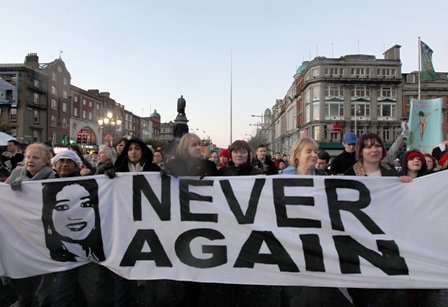
| Thousands of people marched in Dublin’s city center on Saturday calling for legislation on abortion, following the death of Savita Halappanavar. |
The feeling is a mixture of shame, disgust, humiliation and rage. Over the past week it has been felt by most people across the country here, following the death of the young Indian woman, Savita Halappanavar, who was allowed to die in Galway University Hospital last month not just by the inaction of staff there, but by the hypocritical attitude of Ireland to abortion.
As you will undoubtedly know, there has been an outpouring of disgust and anger here over what happened to Savita. And there has been international condemnation as well.
There were protests and vigils not just in Dublin and in towns around Ireland, but in India, the U.K., the U.S. and other countries as well. In India, the government called in the Irish ambassador for an explanation.
We have been shamed and humiliated before the civilized world. Savita's story has been carried in newspapers and on TV around the globe. These stories reported what happened, based largely on what Savita's husband has said ... and there is no reason to doubt his account.
Thirty one year-old Savita, who was 17 weeks pregnant with her first baby, developed pain at home in Galway and showed signs of starting a possible miscarriage. Her husband rushed her to hospital where a doctor told them that her cervix was fully dilated, that amniotic fluid was leaking, that the fetus would not survive and that it would be over in a few hours. She was admitted into the hospital.
But it did not end in a few hours, and by the following day Savita was in "agony" and distressed. Because of the pain and because she accepted that the fetus was non-viable, she requested a termination that day and on the following two days in the hospital.
Her requests were made each morning when the hospital consultant doctor was doing the rounds and at other times. Yet despite her pain and her weakening condition, the request was refused each time; the reason given was that although the fetus was non-viable, a fetal heartbeat was still detectable.
According to Savita's husband, they were told both by the doctor and other staff that a termination was not possible in these circumstances. The consultant doctor said it was not possible because "it is against the law" and "because this is a Catholic country."
This position was maintained by the medical staff even though there was an acceptance that the fetus would not survive anyway.
Checks were done each day by medical staff on the fetal heartbeat. The delay continued for another two and a half days, as Savita's condition worsened and despite her pleas for a termination.
According to her husband, Savita had told the hospital consultant on the first morning that she was a Hindu and for that reason, Catholic-based rules should not apply to her and she should be allowed a termination. But she was told that it's a Catholic country and abortion is not allowed while the fetus is alive.
It took two and a half days for the fetal heartbeat to stop, during which time she became sicker and weaker. On the evening of her second full day in hospital Savita began to shake and shiver, classic signs of septicemia (blood poisoning).
She collapsed in the bathroom, was returned to bed and given antibiotics. The next morning, now much weaker, she again pleaded for a termination and was again refused.
Later that day, the fetal heartbeat stopped and she was taken to the operating theater for an evacuation (emptying of the womb). But by then it was too late to save her.
The septicemia may have been developing for two days (starting from her open cervix where infection can be a danger) and seems to have pervaded her system. By then, even though she had been moved into the intensive care unit in the hospital, some of her organs were closing down, her heart rate was low and she was critical. Hours later she died.
The medieval barbarity of the situation was what struck most of the international media which carried the story. As an educated young woman with some medical knowledge (she was a dentist), Savita was probably aware of the possible dangers of her situation and the possible consequences.
One can imagine her growing fear, despair and disorientation. Yet she and her husband were powerless because of the religious-inspired framework which was dictating how she would be treated.
Comparisons were made in the international media between Ireland and countries with fundamentalist regimes, even with the Taliban. In Ireland a woman had been allowed to die because of the influence of religious beliefs on the health service.
In other countries women have been stoned to death by fundamentalists because of religious beliefs about "crimes" like adultery. Was there really much difference?
Much of the international coverage raised the question of how something so barbaric could have been allowed to happen in a western nation which presents itself to the rest of the world as a modern liberal country. The same question was being asked by the thousands of Irish people who marched and held vigils outside the Dail (Parliament) in Dublin and in other Irish cities as well.
Is this really the kind of country we live in? Is this really what we are?
If this had happened to an Irish woman there would have been an outcry here, but perhaps the story would not have attracted so much attention around the world.
Because Savita was a middle class Indian woman (she lived in Galway with her husband who is an engineer in the local Boston Scientific plant) the story quickly went global.
There was an angry and horrified fascination with the plight of this unfortunate woman, trapped in an almost medieval situation in Ireland (in the middle of a high tech hospital). A situation which had allowed her to die.
But whatever about international reaction, anger in Ireland over what happened is far greater, and in addition to that there is guilt. There is a feeling here that Ireland let Savita down, that Ireland imposed its hypocritical beliefs on her, that she died as a result and that we are all culpable.
There is absolute outrage here as people struggle with the image of Savita repeatedly pleading for a termination and being repeatedly refused. There is horror as people think about the confusion and terror that must have engulfed her as she began to realize that she was dealing with a system with undefined, opaque rules that could have deadly consequences.
In the wake of this appalling case, there is now some hope that at last something may be done to end the present legal vacuum on abortion in Ireland, making it clear in future in what circumstances a termination will be permissible here.
But already there are worrying signs. Both the hospital and the Health Service Executive (HSE), the national health authority, are setting up investigations. The HSE investigation is likely to take months, we are told.
It's the usual stuff -- set up an inquiry and allow it to sit for months while the heat of the situation evaporates. Meanwhile, our gutless politicians can continue to play safe. Even the Taoiseach (Prime Minister) Enda Kenny was at it a few days ago.
As though the public outrage and demand for immediate action was somehow suspect, Kenny said he "will not be rushed." The abortion issue has been left on the shelf here by politicians for over 20 years and Kenny does not want to be rushed?
It's the same with the Expert Group report on possible abortion legislation which has been in preparation for the government for the past year. The Expert Group, mainly doctors and lawyers, was set up over a year ago following a call from the European Court of Human Rights for action here after several women brought cases to Europe. Coincidentally, this report was delivered to the government last week. In the wake of Savita's death, there were calls for its immediate publication.
Now we are told it has to go to the Cabinet first and that it may be next year before there are government proposals for legislation on the issue.
It's always been like this, of course, because our politicians have always been terrified of the pro-life lobby here. As a once strongly Catholic country, we had great difficulty coming to terms with "evils" like contraception and divorce.
Abortion, however, has always been a much more difficult issue, as our attempts to deal with it have shown.
The only law which is in place actually dates back to British times, to 1861, and is an absolute prohibition on abortion. In 1922 the new Irish state adopted this law (and many others) and it is still in force today.
In the meantime, particularly in the last 40 years, Irish society has been changing. Similar laws in other countries were modified to take account of changing attitudes and circumstances in which people might feel abortion was acceptable. But here nothing changed.
It was easy for Irish politicians to do nothing, of course, because we simply exported the problem to Britain where abortion was available. And that's what we have been doing over the years, in a breathtaking display of national hypocrisy.
We could pretend that "Catholic" Ireland did not accept abortion. But the reality was that an estimated 7,000 Irish women every year made the lonely and expensive journey to clinics in the U.K. to have their abortions there. And that miserable trail is still going on.
In the 1980s, worried by the changing attitudes here, Catholic fundamentalists in Ireland were concerned that at some point the Dail might change the 1861 law to allow abortion here in some circumstances. To stop this happening they decided to get a prohibition on abortion written into our Constitution.
They put pressure on the politicians to hold a referendum. And our gutless politicians, afraid to refuse because it might give the impression that they were pro-abortion, went along with it.
The 1983 referendum was passed after a bitter debate. It inserted wording into the Constitution which acknowledged the right to life of the unborn and the equal right to life of the mother.
This lacked definition, although it seemed to mean that any abortion from the moment of conception was unacceptable, even in cases of rape or incest or severe fetal abnormality. It also failed to define what would happen if there was a conflict between the life of the fetus and of the mother.
This might have been cleared up to some degree if legislation had followed, but none did.
Nine years later, in 1992, we had the X case. X was a 14 year old girl who became pregnant after statutory rape and was suicidal. Her parents made preparations to take her to Britain for an abortion, which she wanted, but the attorney general in Ireland got an injunction in the High Court to stop her traveling. The case caused uproar, and Ireland was compared to a police state like East Germany.
After an appeal, the Supreme Court decided that the girl could travel because evidence showed her to be suicidal and therefore she had a right to an abortion under the 1983 referendum wording which guaranteed "the equal right to life of the mother." In its decision, the Supreme Court said that the girl could have an abortion because there was a real and substantial risk to her life, instead of just to her health.
In fact the girl had a miscarriage shortly after the Supreme Court judgment. But the phrase "a real and substantial risk to the life of a woman, as opposed to her health" became the test by which medical staff would work to from then on.
But again, there was no legislation to give clarity to what the Supreme Court finding would mean in medical situations.
Another referendum was quickly held and passed. It gave women the right to travel and to information about abortion. A third part of that referendum to remove possible suicide as grounds for an abortion was rejected by the people. A further attempt 10 years later, in 2002, to do that also failed.
Over all this time -- it's now 20 years since the X case -- there has been no legislation to bring clarity to the grounds for abortion in Ireland. Twenty years ago the Supreme Court produced a broad principle based on the Constitution, but we need detailed legislation to make clear what medical staff are allowed to do in our hospitals.
The failure to do so was what killed Savita. We must await the outcome of the investigation to learn exactly what happened. But there seems to be no doubt that some of the medical staff in the hospital felt that the existing guidelines prevented them from acting.
Savita's case is a perfect example of the grey area our cowardly failure to legislate has produced. At what point in Savita's situation did her condition change from being a threat to her health to a threat to her life, which would have allowed the evacuation of her womb even though there was still a heartbeat of the non-viable fetus?
Was it the point when she collapsed on the bathroom floor, shaking and shivering? Was it the third morning when her husband believed she was seriously ill and she again pleaded for a termination?
Or was it on the first morning when she asked for a termination because the fetus was non-viable and she was in pain and distress?
How much risk must there be? Even if in most delayed miscarriages the risk of septicemia never develops into a life threatening situation, what is a reasonable amount of risk to allow before a decision on intervention is taken?
And who gives anyone the right to take that decision away from a woman? In a situation like that, how can a woman's right to choose be wrong?
Of course Holy Catholic Ireland is a long way from accepting the general principle of a woman's right to choose. But even without going that far, any sensible, humane health system would have helped Savita instead of taking a risk, however small that risk was perceived to be, with her life.


Comments