
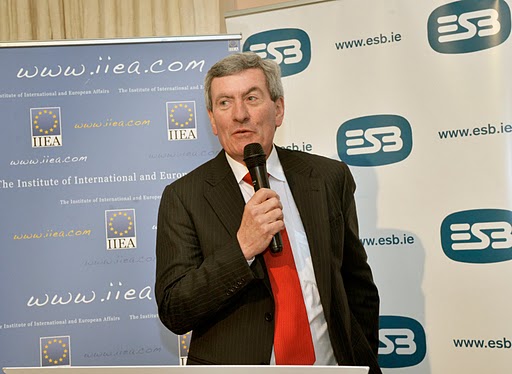
| ESB chief executive Padraig McManus. |
You can understand why he was at pains to emphasize the difference. Greece is a basket case. It's completely insolvent as a country. It has little or no hope of sorting out the mess it is in.
And it's not just a country in massive debt. It's a country in massive denial as well.
The Greeks just don't get it. They don't seem to be able to grasp the concept that a country has to pay its way.
They seem to think it's someone else's fault. They seem to think that if they hold enough marches and fill the TV news with enough mass protests, then somehow the problem will be solved. That they won't have to cut their spending to match their revenue.
Maybe they think that the rest of Europe will keep saying okay, give them another few billion to keep them quiet.
Sadly, life is not as simple as that, even in Europe where billions gets thrown around in the name of holding the EU together. There's a limit, and Greece is way over the line.
The fact is that it's not anybody else's fault that the Greeks are going down the plug hole. It's their own fault.
Greece is a country where not paying your tax is a national pastime. It's a country where the black economy is widespread so that huge numbers of people avoid paying tax and at the same time many of them claim all kinds of state benefits. The inefficiency, everyday corruption and waste is legendary.
There are vast numbers of people on the state payroll, but no one seems to know what a lot of them do. One (Greek) economist I heard recently suggested that the government should lock all the state offices without warning some day and do a head count. He said that this would show that at least a quarter of those being paid were actually at home most of the time.
In Greece a lot of state workers have been able to retire in their fifties and get a full pension. And when they die, the system is so lax that their kids go on collecting the pension (or so a recent investigation uncovered in many cases). The same lack of checks means there is wholesale fraud across the welfare system in Greece.
And the rot starts at the top, with politicians who get big grants and expenses, senior civil servants who get dubious bonuses and gifts of holidays, and middle-rank state officials who refuse to make anything happen unless there's a kickback for them.
One of the best examples of the madness is the pension deal for 25,000 power workers in Greece, which puts even the feather-bedding of workers in the ESB, the Irish electricity company, in the ha'penny place.
In Greece, the state has paid ****8 billion (that's over $11 billion) into the pension fund of these 25,000 lucky workers over the past 12 years. And before you ask, the power supply in Greece is pretty dodgy.
Some of the stuff that goes on over there, you couldn't make up. Yet it's been like this for so long that it's now considered by people there to be normal, even justifiable.
To be blunt about it, the home of democracy is corrupt. Too many people there are on the fiddle and those who are not fiddling themselves are implicated every time they hire a plumber or a painter who is part of the black economy.
And who's going to turn this mess around? All hope rests on the shoulders of the Prime Minister George Papandreou, whose father was Andreas Papandreou, also a prime minister 20 years ago and corrupt, and whose grandfather was Georgios Papandreou who was (you guessed it!) prime minister several times before him.
The current George, like his dad, is a socialist, and cutting back on state spending is not what he's good at. Dishing it out comes more naturally to him.
Anyway, the current George is doing his best, mainly because he doesn't have a choice. But the Greek public is in revolt. There is a two day national strike happening this week over the massive cutbacks demanded by the EU and the IMF before any more billions are handed over.
All of which explains why Noonan can assure everyone that "Ireland is not Greece, you know."
We have huge fiscal problems also and we need to cut back drastically. But the public here understand, they are taking the bitter medicine and Irish society is holding together.
And of course there is no similarity between the inefficiency and fiddling that goes on over there and what happens here. And no similarity between having such high numbers on the state payroll in a small country, or the number of those on big salaries and big guaranteed pensions.
No similarity at all, right?
Well, it's at this point that Noonan's dismissive "Ireland is not Greece, you know " assertion becomes less convincing.
It's at this point that we call in Declan Collier, chief executive of the Dublin Airport Authority (DAA), which runs the airports here. His total package in 2010 totaled €612,500.
That's not bad, considering that in 2009 passenger numbers fell by 13% and last year they fell by another 10%, just as the white elephant that is Terminal 2 opened at Dublin Airport. It's a vast cavern of emptiness, with only a handful of the retail units occupied.
DAA profits plunged over the past couple of years but hey, so what, he jacked up the airport charges by nearly half, so they're back in the black. The ordinary Joe can pay, right?
Or we might want to call in Padraig McManus, chief exec of the previously mentioned ESB, the semi-state which has supplied us with power over the years. He had a package of around €750,000 in 2009.
It was reduced a bit in 2010 but it's still huge. No doubt the Greek power workers would applaud, but the rest of us, facing electricity prices that are among the highest in Europe, might not.
Not that the cost of electricity would bother Padraig since he gets a 50% discount on his own bill, like all the other ESB workers, who have average pay of around €76,000 a year.
And that's average pay, so it covers everyone including the guys with the shovels who put up the poles and the guys with the screwdrivers who do the wiring. They're probably the best paid power workers in the world. With probably the best pensions.
Outside Greece, of course.
These are just two of the many semi-state organizations here who have had virtual monopolies for years. The ESB is now facing some competition, but its size still makes it dominant.
And the DAA still has the kind of monopoly that would make even the Greeks envious.
That's just two of our semi-states, but the same point applies to all of them -- they don't face real competition or real risk. So they can charge what they like and pay themselves packages that match the private sector where real risk has to be faced.
The chief executives of all the Irish semi-states are at it. The head of An Post has been getting around €400,000 for delivering the mail. The boss of Coillte, the forestry organization, was getting around €300,000 for looking after the trees.
The head of Bord na Mona was getting the same for minding the bogs. Even the boss of Bord na gCon (the greyhound industry) was getting almost as much. Talk about going to the dogs!
And of course this seeps down through senior management and staff, in a culture of high pay, low efficiency, long holidays and a nice easy working life with a lovely fat pension to follow.
The same culture is there in politics, the civil service, the judiciary and right across the vast numbers on the state payroll. It's a culture of high charges, high salaries, high pensions.
And it's the pensions part that really infuriates people in the private sector, most of whom have seen their pensions decimated by the crash in the markets. The high pensions for state workers here are paid out of state funds (i.e. borrowing) and are guaranteed. Just like in Greece.
This can't go on, of course, and the government is now taking the first steps to reforming the system.
Last week it announced that semi-state bosses, senior civil servants, judges and other top dogs are to be hit with big pay cuts to cap their salaries at €250,000. What they didn't make clear is that these guys are still in line for pensions that would cost a private sector worker millions to fund.
And the politicians who are in charge of the system do very well out of the pensions racket, of course.
The reason all this is important is that unless there is top down reform, ordinary workers on the state payroll here won't accept pay cuts and higher efficiency changes.
One of the few exceptions to the salary ceiling is our pal Padraig, the head of the ESB, who will still be getting well over €300,000 for keeping the lights on. How will he survive?
Maybe the Greeks can give him a few tips.


Comments