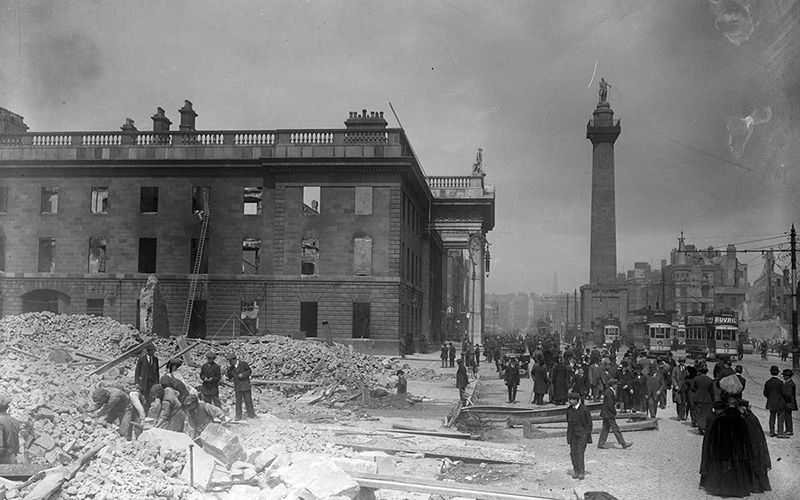
| Dole queue in north Dublin |
In my parents’ time, there were certain jobs available to people (the civil service, the bank, the farm, teaching or nursing) and most of them were long-term, secure and pensionable. The world we live and attempt to work in is now unrecognizable.
Don’t get me wrong, I’m not yearning for the fadó fadó days of narrow vocationalism by any stretch. It’s a marvelous thing to have not only a greater choice of jobs but better knowledge transfer and employment mobility, but as is often the case with Ireland we have oscillated from one extreme to the other with no concern for balance.
Currently, we have all the insecurity and uncertainty of mobile employment without the range or variety of jobs to make it work. Therefore, we have a host of young people struggling to find any job in any market, not least the one for which they’re qualified, and often multi-qualified.
With so much demand and so little supply, hiring practices have taken on a moral dimension. More and more young people trying to advance their careers are having to do more for less. With employers holding the cards and graduates desperate for experience, remuneration often amounts to “a lovely time and a good reference.”
The lines between serving your time and being outright exploited are being horribly blurred.
Instead of the pillars of employment of old we now have Job Bridge, a catastrophic attempt at a work scheme that has rightly drawn snorts of derision for being laden with jobs either too ridiculous (waitressing and cleaning) or too advanced in their requirements (a whole host of the media ones) to warrant a (much too long) nine month stretch of an “internship” for the princely price of the dole and a little bonus sprinkled on top. It’s not how they do things in Holland.
While I was in Brussels at the EU Open Days event, I attended a seminar that showcased the Dutch policy for tackling youth unemployment. Some of the proposals were a bit out there, and it’s far from a perfect system either, but on the whole their approach was multi-faceted, well coordinated and well targeted.
Amazingly, it’s illegal to leave Dutch school at 18 without a qualification of some kind, and people younger than 27 have to comply by the rather rigorous rules or they don’t receive dole at all. The flipside is there is a large structure in place to avoid that happening. The job fair circuit is an industry all of itself, along with a multitude of other initiatives such as work coaches, youth covenants and subsidies and premiums for business owners who co-operate actively in the process, as well as a robust internship and training sector. As a result, their unemployment rate among young people is half that in the BMW region (borders, midlands, west) of Ireland. The Dutch themselves sum up their plan thusly: partnership, personnel, political prudence and pressure. The Irish plan brings to mind another word that stars with “P”.
While in Brussels I also talked to Connie Hanniffy, a county councilor from Offaly and senior member of the Irish delegation on the Committee of the Regions, being appointed to the continental committee by three different leaders of Fine Gael and with a particular interest in enterprise, business and employment. She claimed that we not only have to concentrate on more funding for skills and jobs, but we have to concentrate attention on who gets that funding.
“We’re missing the very people we need to get at” claimed Hanniffy. “We need to be getting to people with traditions of unemployment in their family and their community and provide schemes for those that haven’t had the direction. We need to engage with many people on a partnership basis.”
She also pointed to the role EU funding can have in job creation and re-skilling, pointing to the globalisation fund for erstwhile construction workers and funding for people wishing to start up their own business and mentoring. “You can’t subsidise your way into business but a structure is needed for business to survive. They may have good ideas but they may need help getting access to markets. Businesses need to interlink and find new ways of doing things.”
On the more general question of the job market and the sort of jobs people do and the way they do them, Hanniffy pointed to the fantastic example she saw in Berlin, where more and more jobs were coming from the burgeoning creative sector. She also saw an important role for educational facilities. “It’s up to colleges and universities not to try and pack courses, to provide balance and offer different boxes. I think this is what has been wrong in the past”.
Of all the things Ireland is currently short on, talent is not one of them. And any future prosperity the country has will be determined by how serious government, business and all other interested stakeholders take the job of building a structure where that talent is valued and put to best use.



Comments