Irelands Michael Collins. Father of the Republic and father of insurgency
By: Ed Farnan | Published Tuesday, November 1, 2011, 7:08 PM | Updated Tuesday, November 1, 2011, 7:08 PM

I asked James Biesterfield for his expertise in understanding the impact Michael Collins had on the world of terrorism/insurgency. Mr. Biesterfield is a retired Special Agent for Counterintelligence from the US Army. He is currently a counter-terrorism consultant, author and trainer based in Riverside County, California. James and I co-authored this piece.
St. Michael, the Archangel, is considered to be the Patron Saint of Warriors. In some circles, Michael "Mick" Collins is almost considered a saint. There are truths, falsehoods and legends that surround this iconic man.
To some, he was one of the fathers of the Irish Republic – an honored hero. In the counter-terrorism field he is viewed as the father of modern day terrorist tactics. So, how should we view Collins?By all accounts, this youngest of 8 children, was exceptionally bright and his father, also named Michael, stated that his young son would do great things for his country in the future. This pronouncement made on the deathbed of the elder Collins. He would not be wrong.
In the world of violent groups, the old adage is, “One man’s terrorist is another man’s freedom fighter”. This could not have been truer in the case of Michael Collins.
From a purely analytic viewpoint, Michael Collins was absolutely critical in the advancement of modern terrorist & insurgency organizations.In the year 1909, the 19-year-old Collins joined The Irish Brotherhood. He rose quickly in the ranks, obtaining a solid reputation and being given a great deal of responsibility with their Finance Ministry and leadership with the Irish Republican Army. Collins made some significant contributions in logistics and organization for the IRA and the Republican government. As President of the Irish Republican Brotherhood, under the bylaws of the Brotherhood, he was President of the Irish Republic. Collins was shot and killed in August 1922, during the Irish Civil War.
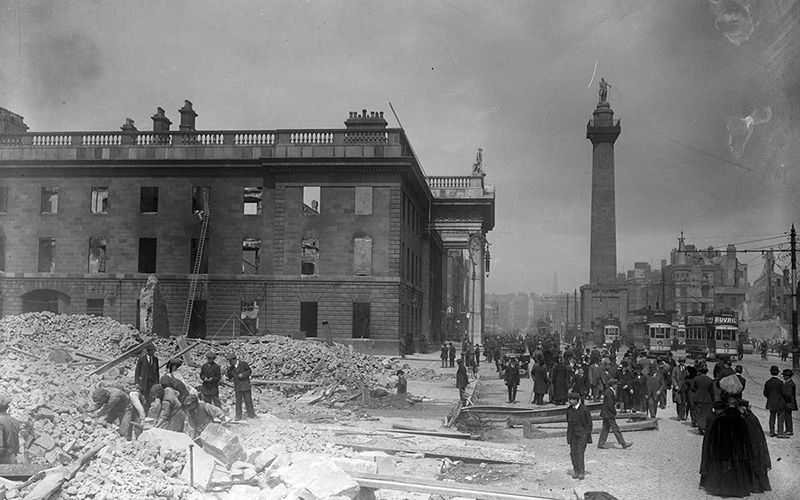
After the Easter Rising of April 1916, Collins was arrested after surviving the attack on the Dublin Post Office. Almost given the death penalty, he was instead sent to Frongoch Prison in Wales. He was released in a Christmas Amnesty in December 1916 and allowed to return to Ireland. While in prison, he had time to consider how IRA operations were being conducted.
For the most part, IRA fighters were loosely organized in their particular home areas and locally commanded and directed. This allowed no continuity of action between the various fighting groups. Collins played a prominent part, in re-organizing IRA fighters into what he called Flying Columns. He also centralized Logistics and Training allowing continuity among all of the Flying columns. Thus, if one guy got “too hot” in one area, he could be transferred to another area without appreciable changes in his training base.
This was incredibly innovative for the time. Previously, terrorist/insurgent groups operated independently, or in loose cooperative efforts. (Did you notice the variety of weapons among the Libyan Freedom Fighters? A logistical nightmare! A lack of training dragged that fight out for 6 months, even WITH NATO support.)
In following the timeline through the 20th Century terrorist groups, it appears that virtually ALL groups have and are following the IRA Model. The PLO used and improved upon this model in the 1960’s and 1970’s. This led to a vast number of terrorist fighters from all over the world attending training at PLO camps located in Libya during this period. Following this, we began to see cooperative efforts on the part of terrorist groups (i.e. Lod Airport, Rome Airport, Mogadishu, etc).
Even today, Islamist groups follow a similar model that allows interoperability between disparate groups throughout the world.
However one might view Michael Collins – saint or sinner – his contribution to insurgent/terrorist groups cannot be discounted. The important thing for law enforcement, special operations and intelligence organizations is to understand that impact, its relationship to groups in present day and begin to analyze future changes to the logistical and training capabilities on the part of such groups.
Mr. Biesterfield can be reached: On Twitter @xspook2 as well as Face book and Linkedin.
For other points of view visit Carroll Standard: www.carrollstandard.com
37 Comments
-
-
-
-
-
-
-
-
-
-
-
-
-
-
-
-
-
-
-
-
-
-
-
-
-
-
-
-
-
-
-
-
-
-
-
-
-
Switch to the desktop site to post a comment.Monsoonman | Sep 15, 2011, 12:14 PM EDT
How many members of the UK "voluntarily joined"?
ancavker | Sep 12, 2011, 10:18 AM EDT
Dan: The fact that Irish MP's sat in the British Parliament does not change the fact that Ireland was a conquered nation. forced into the UK; they did not join on their own accord. And how long did it take them to finally get representation, as far as the Catholic majority. And yes they did hold the balance of power at times, but they were never large enough to get Home Rule passed, even in the very limited form that the British government was prepared to offer. What Collins and Griffith negotiated was real independence for the country and not a talk shop like Home Rule would have been. As far as Germany gaining hegemony over all of mainland Europe, ironic in that that is exactly what is happening now. England was concerned that Germany was becoming too strong both militarily and economically, and would ultimately threaten their empire. It was a horrendous blood bath on all sides, and a complete waste, as it solved nothing and created more problems as witnessed later. As far as the U.s they got into the war because Wilson was an Anglophile
DanOLoingsigh | Sep 10, 2011, 01:39 PM EDT
Anc – Ireland was most certainly part of the UK, Irish MPs sitting at Westminster, and at times keeping the Liberals in power. Irish over 65s received pensions awarded by the 1909 Liberal Government, just as the rest of the UK. The main reason Britain went to war was to stop Germany gaining hegemony over all of mainland Europe by defeating France. They went to war reluctantly, just look how small pre-war British Army was – Britain had not set foot on mainland Europe for a century, happy to leave the French and Germans in an uneasy balance of power….if all countries were equally to blame…why would the isolationist US take sides?
DanOLoingsigh | Sep 09, 2011, 07:36 PM EDT
Anc – Ireland was most certainly part of the UK, Irish MPs sitting at Westminster, and at times keeping the Liberals in power. Irish over 65s received pensions awarded by the 1909 Liberal Government, as did all such in the then UK. The main reason Britain went to war was to stop Germany gaining hegemony over all of mainland Europe by defeating France. They went to war reluctantly, witness the size of the very small pre-war British Army – Britain had not set foot on mainland Europe for a century, happy to leave the French and Germans in an uneasy balance of power….it may be easy to say all countries were equally to blame, but the facts don’t support that revisionist view…why would the isolationist US take sides if that was the case?
ancavker | Sep 09, 2011, 03:09 PM EDT
Sirpeter: Collins thinking at the time and in his own words (To wards a new Ireland) he was not afraid of renewed war with the British if that was what the Irish people wanted. The Irish people were tired of war, Collins men were exhausted, and running out of arms. His plan was the stepping stone, th freedom to achieve freedom and he fully intended to dismantle those parts of the treaty that were objectionable. I think you would agree however that had he known the boundary commission was a sham he would not in the end have accepted the treaty, even if meant ultimate defeat and re-imposition of British rule in the entire Ireland.
ancavker | Sep 09, 2011, 03:04 PM EDT
Dan We can debate this back and forth, to say that Ireland was a constituent part of the UK was a stretch to say the least, and to state that somehow they were and should be responsible for it is ridiculous. And it built up through the centuries?? For what to pay for the country's development? But I will not belabor the point and leave ti there. As far as Britain not being responsible for WWI well now come on they were all responsible, to make the loser pay, well we all know how that turned out. Ironically one of the reasons that Britain went to war against Germany was German plans to create a common economic union on the continent. Ironically, look at where we Europe is today, and at who is being asked to bail the rest of the deadbeat Europeans out of their mess; the German taxpayers. Oh as far as Sudan well one side has the oil, and the other side has the refining capabilities, it works out for both.
sirpeter | Sep 09, 2011, 01:00 PM EDT
@ancavker.I can't say you are wrong because I don't know what Collins was thinking at the time.Maybe you know something or have read something i didn't.I'm inclined to agree with Dano that they did their best.I do know Michael Collins' view that the Treaty was a tactical move, or "stepping stone", rather than a final settlement.If the treaty wasn't passed then I believe the British would have come in with much more force.Who knows.
DanOLoingsigh | Sep 09, 2011, 12:15 PM EDT
ancavker - The debt was incurred by the then United Kingdom, not just England…it was, and is, standard practice to divide such debt between constituent parts of a country where separation takes place, the most recent example being Sudan, and this was agreed in the Treaty. The debt was built up over centuries, although it increased massively by the Great War. As to paying for a war you didn’t start, that was also the UK position, as they did not accept that they had started the war either…..hence the unwise decision to seek reparations from Germany. Not sure how you know at this stage what was in the mind of the Brits or Michael Collins; Lloyd George as a liberal had quite a different, and more sympathetic view of Home Rule, than conservatives, but his government was a coalition, with all the comprising that coalitions entail. As to partition, it has been and will be debated endlessly, who duped who etc. and it remains either a pragmatic ‘least worse’ temporary solution, or a shabby sellout…none of us had to make that life and death decision, and maybe we should respect the motives of all those involved as doing the best as they saw it for the people they represented?
ancavker | Sep 09, 2011, 10:56 AM EDT
sirpeter: No the border was established between the 2 entities 26 and 6. Keep in mind the 6 county entity was up and running at that point. The Free State side honestly believed that once things had settled down that the boundary commission would ultimately award large parts of the 6 counties to the new Free State. Lloyd George was under no such illusions. Collins in my opinion would not have signed the treaty has he not truly believed this,and would not have abandoned the Catholics/Nationalist population to the fascist Unionist regime that was established. He did not really care about the oath and the crown, and was quite amused at how the English would get their knickers in a bunch over this. He planned to ignore those aspects of the treaty once in place and break other parts that were not beneficial to Ireland. His mindset was the English broke every treaty with the Irish down through the years, we will do the same.
sirpeter | Sep 08, 2011, 06:19 PM EDT
@jerrydonovan Don't mind Creakygate he's full of crap.He's nearly worse then Georgy Boy at this stage.
sirpeter | Sep 08, 2011, 06:15 PM EDT
@ancavker The impression I have was that the boundary was deliberately kept very vague in the treaty in order to bring some moderate anti-treaty guys on board and to get the treaty passed.One of the arguments was that by the time they took the Catholics parts the rest would not be viable.As much as I'd like to say that the Brits tried to pull a fast one (which I might add they are capable of)Collins knew what they got in the treaty was as much as they were going to get for the time being.They did get the Brits out of the ports just before WW2.That was a bit of luck i think.It kept Ireland neutral.
ancavker | Sep 08, 2011, 02:39 PM EDT
sirpeter: I give no credit to Lloyd George, in fact I despise him. He had no intention of adjusting the border as established when Northern Ireland came into being. He tricked Collins and the rest of them, but then no one should really be surprised; the British through out their history are noted for that.
ancavker | Sep 08, 2011, 02:36 PM EDT
Dan: Ah no it is not. What happened after it was commenced, is quite different than from how it was presented during treaty negotiations. It was presented as the wishes of the inhabitants, and geographic considerations. However, in the minds of the British the border was basically not going to be altered unless geographically it made sense for the benefit of the now established Northern Ireland or six counties, hence the inclusion of east Done gal into the north, with the minor transfer of some border area in Fermanagh and south Armagh to the Free State. The Unionists never appointed any one because it was of no co sequence to them. Cosgrave sold out the nationalist people in Fermanagh Tyrone Etc, not for debt relief as you call it, but rather for Ireland s's share of the debt relating to England's expenses incurred in WWI. A little ironic don't you think, to be charged for a war you did not start? Anyhow had Collins lived he would have been seen that he was duped,a nd would I believe have challenged the British fiercely on the boundary commission, and he would have gotten rid of the debt as you call it as well.
DanOLoingsigh | Sep 08, 2011, 02:00 PM EDT
The history of the boundary commission and its report is a bit more complex than claimed here. The work of reviewing the border was delayed by the Civil War, and also by the NI refusal to appoint its representative. The Brits appointed a rep anyway, to act for NI. When a leaked copy of the report was published, indicating parts of East Donegal could be awarded to the North, all parties agreed to bury both the report and the commission, and the Free State got debt relief.
jerrydonovan | Sep 08, 2011, 10:08 AM EDT
Towngate,shooting at people from INSIDE tanks would hardly be described as "man to man".Croke park would not be described as"man to man".Collins was not only a great guerrilla leader,he was also a great visionary.Fact is, it is his blueprint which is basically being implemented in the north to-day.
ancavker | Sep 08, 2011, 09:28 AM EDT
sirpeter: Perhaps fleeing was not the right word, so I will change it to finishing. As for the boundary commission, the wording stated it would be changed to reflect the wishes of the inhabitants, based on that interpretation Collins and the rest of the signers assumed it would mean Fermanagh, Tyrone, west Derry, south Armagh, and perhaps parts of Down. Thereby making partition non workable, as the remaining entity would be too small. If Collins had thought partition was to be permanent, he never would have signed.
GeorgeDillon | Sep 08, 2011, 03:47 AM EDT
sirpeter: --I have the book "The Day Michael Collins was shot by Meda Ryan". Wow--finally it's revealed! Mada Ryan shot Michael Collins!
seanomelbourne | Sep 07, 2011, 07:08 PM EDT
The father of the republic is Wolfe Tone and rest are just interlopers.
sirpeter | Sep 07, 2011, 03:59 PM EDT
@ancavker.The boundary commission never readjusted the border.It wouldn't have been enough to make NI any less viable.But what it did do was keep a larger Catholic population inside the border.So I think you are giving to much credit to Lloyd George there.I have the book "The Day Michael Collins was shot by Meda Ryan" Most IRA had disbanded before the convoy came but some ran back when they saw Collins was coming.Fleeing is not a term I would use as it suggests panic.There was no panic
ancavker | Sep 07, 2011, 02:59 PM EDT
(Continued): And that Fermanagh, Tyrone, West Derry and south AMA, and some portions of Down would be awarded to the Free State, thereby making "Ulster" to small to be viable. As it turned out the Irish were outwitted by Lloyd George. Neither side expected partition would be permanent. Collins wanted the British out of the 26 counties, and his plan was that once the country was back on its feet with a standing army etc. He would dismantle the parts of the treaty that were not acceptable to a sovereign country
ancavker | Sep 07, 2011, 02:53 PM EDT
Again some misconceptions here> Collins was shot by a stray bullet after the fire fight was over, and the anti treaty forces were fleeing. It was purely by chance that he was shot. I suggest those who are interested read the Meda Ryan both on the death of Collins. As far as signing away the Republic, he had no choice at that point. Contrary to what was posted here by one poster, the British did know what he looked like after the truce was declared,a nd before negotiations started, prior to that of course they did not.. Also at the time of the signing of the truce the British were starting to gain the upper hand,and Collins was running out of armaments after several unsuccessful attempts to import arms form the continent. Collins was ambivalent about the terminology and wanted independence first. Even De Valera was not a dyed in the wool Republican and wanted what he referred to as External Association with the British Commonwealth. His plea to Griffith, please get me out of this straight jacket of a Republic. The main opposition to the treaty was the oath of allegiance, and the holding of the ports in the 26 counties. Contrary to some popular belief it was not due to partition. Both sides wrongly assumed the British would honor the wording and spirit of the boundary commission
sirpeter | Sep 07, 2011, 07:27 AM EDT
Creakygate.Take a good look in the mirror.Who will remember you?A brave highly respected man and loved even by the anti-treaty side died that August.Now lets look at some REAL PROFOUND COWARDICE from a Britisher who stayed in the area.Lieutenant General Arthur Percival the Britisher.The same man who had a far superior force of 90,000 men and gave up Singapore without firing a shot to the Japanese who were using riding stolen bicycles and without artillery support.With 90,000 men Collins would have taken Tokyo.As General Tom Barry always said~In the heat of battle one Irishman is worth TEN British soldiers.You don't know what you are talking about.You listened to your Daddy to much.It's a known fact that without Celtic blood filling the ranks of the British army all down through history.The English on their own were half useless on the field of battle.They don't make natural soldiers.Your comments as usual are showing you up as the idiot you are when it comes to Ireland.
sirpeter | Sep 07, 2011, 06:36 AM EDT
He was shot in a gun fight I agree and they did have an armored car(The Slieve na mBan).The facts are as follows:It was decided if they did come in contact with the IRA they would fight it out.The reason for this was Collins wanted to show the IRA that they would not run away and were not afraid.Collins had to show he was in control of the Country and it wouldn't look good if Collins drove away.He was a soldier first and far from been a coward.Collins was returning fire for quite a while,but the Vickers machine gun jammed on McPeak in the armoured car because the rounds needed to be placed in the belts with precision.His second gunner was unfamiliar with the work and messed up.So there was a an opportunity for the IRA men to take proper aim.They saw a guy fall but didn't know who it was,but they knew they got somebody important.The IRA claim Sonny Neill was the guy who killed Collins.
GeorgeDillon | Sep 07, 2011, 02:34 AM EDT
Trealach, as usual your ignorance doesn't detract from your arrogance. Collins was most certainly shot in a gunfight, in fact he had the benefit of an armored car and he himself was firing back at his adversaries when he was killed. His conduct appears to have been quite reckless that afternoon, indeed he had ben drinking earlier in the day. The title of this article is nonsense, since how could a man who signed away the Irish Republic be called the Father of the Republic. But trealach, why don't you go learn something before posting your garbage?
hancock | Sep 06, 2011, 08:06 PM EDT
Great man, got the English out as best he could, might have finished the job.
seanomelbourne | Sep 06, 2011, 07:14 PM EDT
My Forebearers fought against collins and the treaty maybe he was wrong in signing it,but that should not detract from the contribution he made in forwarding the republican cause.The same can be said about the detractors of Dev.Thay all gave their best and deserve to be acknowledged. A hundred years doon the track is to late for recriminations.
tomdoh345 | Sep 06, 2011, 07:06 PM EDT
99% improvement of this Ed Farnan Column with addition of James Biesterfield. Make it 100% by not posting any more Tea Party Propaganda. Hopefully the Teamsters will take the TP trash out soon anyway.
Trealach | Sep 06, 2011, 04:44 PM EDT
Michael Collins was NOT imprisoned in England. He was imprisoned in an internment camp at Frongoch in Merionethshire, Wales. Neither was Collins shot during a "man to man" gunfight. He was shot in the back of the head while still in his convoy which was ambushed at Béal na mBláth. It would be nice if 'authors' would get their facts straight. Without question, Collins proved himself to be the greatest military strategist in history. He took on a World Power and beat them with the weapons he and the IRA stole from them. Right up to the day he signed the Treaty, none of the British authorities knew what Collins looked liked - yet prior to the Rising he was a British Civil Servant in London - they had never taken a photograph of him. Collins, along with the signatories of the "Proclamation" are the founding fathers of the Republic of Ireland.
ancavker | Sep 06, 2011, 04:24 PM EDT
Towngate: you must be joking. Collins fought with limited men and limited resources,period. Perhaps if we were able to arm his men like the British were able to arm theirs we would have your so called fair fight. Also he was not the first guerrilla fighter, many of his tactics were used by Washington and his men in the American revolution. Michael Collins was the father of his country and should be honored as such.
OleSarge | Sep 06, 2011, 12:44 PM EDT
What the “Big Fellow” did for Ireland’s fight for freedom was based on expediency. He saw a problem, fixed it with limited resources and was able to defeat a much stronger and well equipped enemy. He was no lover of revolution for the sake of revolution, nor did he offer his tactics to others. George Washington was faced with a much stronger and well equipped enemy, the same one as Mick. He invented a whole espionage network. He does so because it was expedient. The fact that every government, including despotic ones has followed his example does not make Washington evil. Like Washington, Collins is the Father of his country.
Monsoonman | Sep 06, 2011, 11:41 AM EDT
However else could U fight an oppressive & overwhelming force like england on your home soil? Michael Collins was a brave man and died a warriors death for the country and ideals that he loved.
GeorgeDillon | Sep 06, 2011, 10:44 AM EDT
JamesDempsey: No need to correct yourself. The Civil War produced many guerillas, such as Nathan Bedford Forrest, Joseph Bailey and many others. These were CSA, but I am sure there were Union guerillas in parts of the South where support for the Confederacy was low, such as western North Carolina, north Georgia etc. Towngate's post is really weird--does he think the Nazi regular forces were preferable to the partisans or guerillas who fought them in Italy, France etc.?
bunkerisland | Sep 06, 2011, 10:00 AM EDT
What choices exist for a small nation dominated by the British Empire have to throw off "the yoke of the oppressor"? Head on confrontation would be a total failure. Selecting primarily the significant leaders to eliminate seems a wise choice. Let us not forget how the native Irish were treated over several centuries. Was Cromwell's slaughter using thousands of soldiers "man to man"? Hardly!
JamesDempsey | Sep 06, 2011, 09:06 AM EDT
I was supposed to say american war of independence below instead of the american civil war
JamesDempsey | Sep 06, 2011, 09:04 AM EDT
@Towngate How would the IRA talking on the British army have been in any way a "decent man to man soldierly conflict" ? Towngate you are an out right idiot with no sense of what real cowardice is. Gueriila tactics are far from cowardly. People who implement these tactics faces are far more unsavoury fate than any regular soldier and they know it too fact! Guerilla tactics have been around long before Michael Collins and there are examples of them being used in the American civil war too. Facts are that they are the tactic used by those who have some brains and less resources!
GeorgeDillon | Sep 06, 2011, 08:28 AM EDT
Towngate, you think guerillas should drive out into the countryside or desert somewhere and paint a "Kill Us Now" sign for all to see? And US Special Forces in Afghanistan etc are likewise cowards because they operate under cover? And what's this nonsense about "man to man"? Collins was killed in what by any standard was an open "man to man" gunfight in the Irish countryside. You're nuts, towngate.
Towngate | Sep 06, 2011, 04:28 AM EDT
The profound Cowardice of such tactics, is nothing to be proud of. Still, it saves your sorry arse from getting kicked in a decent 'man to man' soldierly conflict. Perhaps it was 'poetic justice' that he got a fatal dose of his own medicine from his own countrymen! :- Song: "Come out! Ya R.A. man! - why are ya fighting like yer Mam?!"