
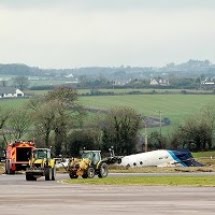
Cork, Ireland is still in a sense of shock after yesterday morning's tragic air crash which killed six and injured several others, when a light aircraft crashed at the airport on its third attempt to land in thick fog.
Strictly speaking this isn't the first crash at Cork (an Aer Lingus Viscount went down en route to London in '68, crashing into the sea off Tuskar Rock, County Wexord), but it's the first one to occur at the airport itself, and the first in many years.
Without wishing to take away from the seriousness of the crash, and the huge sense of tragedy that's accompanied it, I think it also needs to serve as an opportunity to evaluate the safety of Cork Airport, which is frequently plagued by thick fog due to its location on a hilltop to the South of the city.
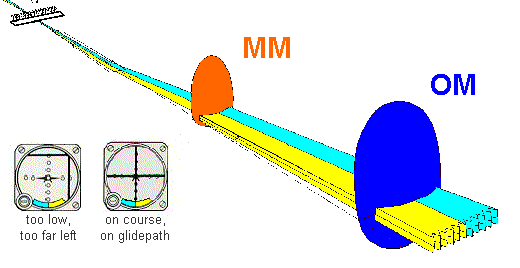
Without bogging this blog-post down in technical jargon (I'm building hours towards a private pilot's licence myself), an Instrument Landing System (ILS) is what guides an aircraft down to the runway in instrument conditions such as these. ILSs come in various grades: I, II, and III(A&B) and the higher the grade ILS the more powerful the system and the lower visibility the aircraft can land in. While runway 17, the most commonly used landing runway, is equipped with Cat II ILS, which gives landing aircraft a decision height of just 200ft above the runway surface, the opposite Northerly-facing end of the same runway, 35, only has a Cat I approach, which to me has always seemed very inadequate given how frequently fog plagues Cork; runway visibilities of just 100 metres are common during the winter, and visibility was so poor yesterday morning that the crash couldn't even be seen from the terminal building, just a couple of hundred metres away.
The second problem with Cork Airport - also due to its location and surrounding topography- is the sharply falling ground to the South of Runway 17.
Aircrafts use altimeters to gauge height. Most altimeters calculate height based on air pressure (a pressure altimeter) but commercial aircraft are also fitted out with radar altimeters which work - as the name would suggest - by sending back a laser team to allow for a more precise reading as the aircraft makes its final approach to the landing runway.
Above: Instrument Landing System: physically is just a radio antenna, but projects an electronic beam which guides aircraft down to the runway during adverse weather conditions
The only problem with Cork is that radar altimeters often stop working during the final stages of approach to 17 because the ground is sloping upwards so quickly. Again, this is a problem that's made particularly worse by Cork Airport's situation as extremely precise altimeter readings are needed in instrument conditions in order to asses the all-important 'decision height', which is the height above the runway at which a pilot has to commit either to land the aircraft or else to 'go around' and try again.
The third problem is that because the land falls so sharply at either end of the main runway - 17/35 - there's very little room for further expansion (the runway was already expanded from 6,000ft to 7,000ft). This means that Cork Airport can't ever have anything than a relatively short runway, which prevents big aircraft from landing and taking off, and therefore limits (in fact eliminates) its potential for long-haul or transatlantic travel. This is a huge negative to the future growth of Cork. A rumour has circulated around the airport and flying school for many years that the East-West runway would be extended to the appropriate length, but this has never happened.
Despite all these points though, Cork Airport and its navigational-aid infrastructure was almost certainly in no way to blame for yesterday's accident. A piece in this morning's Irish Independent speculates that the pilot may have descended past the decision height hoping that the fog would clear, but either way, it certainly wouldn't hurt to improve things.
Nothing we can do can take back the lives of the six people who died tragically at Cork Airport yesterday, but every disaster like this prevents an opportunity to see what went wrong and find out how we can prevent this from happening again in the future. The Irish Air Accident Investigation Unit (AAIU) will take a few months to produce a comprehensive report of what exactly caused this terrible tragedy, but perhaps once the money comes back in we can invest some money in Cork Airport's navigational aids to make sure that the frequent thick fog which plagues the airport presents only the minimum of safety hazards.
Correction
Contrary to what was stated above the Minimum Descent Altitude (MDA)/ decision height for the ILS Cat. II approach to Rwy. 17 at Cork Airport (EICK) is 69ft not 200ft.


Comments