Visit The Information about Ireland Site
The term 'Black Irish' has commonly been in circulation among Irish emigrants and their descendants for centuries. As a subject of historical discussion the subject is almost never referred to in Ireland. There are a number of different claims as to the origin of the term, none of which are possible to prove or disprove.
'Black Irish' is often a description of people of Irish origin who had dark features, black hair, dark complexion and eyes.
A quick review of Irish history reveals that the island was subject to a number of influxes of foreign people. The Celts arrived on the island about the year 500 B.C.
READ MORE:
Justin Bieber, Lady Gaga, Katie Perry and other stars jet into Belfast
Vatican officials ‘stunned’ by Irish decision to close embassy
Why Irishmen badly need to grow up -- Mammy’s Boys compare badly with American guys
Whether or not this was an actual invasion or rather a more gradual migration and assimilation of their culture by the natives is open to conjecture, but there is sufficient evidence to suggest that this later explanation is more likely.
The next great influx came from Northern Europe with Viking raids occurring as early as 795 A.D. The defeat of the Vikings at the Battle of Clontarf in the year 1014 by Brian Boru marked the end of the struggle with the invaders and saw the subsequent integration of the Vikings into Irish society. The migrants became 'Gaelicized' and formed septs (a kind of clan) along Gaelic lines.
The Norman invasions of 1170 and 1172 led by Strongbow saw yet another wave of immigrants settle in the country, many of whom fiercely resisted English dominance of the island in the centuries that followed. The Plantation of Ulster in the seventeenth century saw the arrival of English and Scottish colonists in Ulster after the 'Flight of the Earls'.
Each of these immigrant groups had their own physical characteristics and all, with the exception of the Ulster Planters, assimilated to some degree into Irish society, many claiming to be 'more Irish than the Irish themselves!'
The Vikings were often referred to as the 'dark invaders' or 'black foreigners'. The Gaelic word for foreigner is 'gall' and for black (or dark) is 'dubh'.
Many of the invaders families took Gaelic names that utilized these two descriptive words. The name Doyle is in Irish 'O'Dubhghaill' which literally means 'dark foreigner' which reveals their heritage as an invading force with dark intentions.
The name Gallagher is 'O Gallchobhair' which translates as 'foreign help'. The traditional image of Vikings is of pale-skinned blond-haired invaders but their description as 'dark foreigners' may lead us to conclude that their memory in folklore does not just depend on their physical description.
The Normans were invited into Ireland by Dermot McMurrough and were led by the famous Strongbow. Normans are ultimately of French origin where black haired people are not uncommon. As with the Vikings these were viewed as a people of 'dark intentions' who ultimately colonized much of the Eastern part of the country and several larger towns.
Many families however integrated into Gaelic society and changed their Norman name to Gaelic and then Anglo equivalents: the Powers, the Fitzpatricks, Fitzgeralds, Devereuxs, Redmonds.
It is possible that the term 'Black Irish' may have referred to some of these immigrant groups as a way of distinguishing them from the 'Gaels', the people of ultimately Celtic origin.
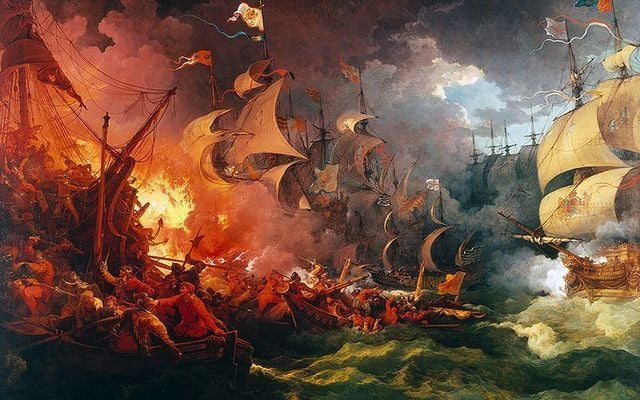
Another theory of the origin of the term 'Black Irish' is that these people were descendants of Spanish traders who settled in Ireland and even descendants of the few Spanish sailors who were washed up on the west coast of Ireland after the disaster that was the 'Spanish Armada' of 1588.
It is claimed that the Spanish married into Irish society and created a new class of Irish who were immediately recognizable by their dark hair and complexion. There is little evidence to support this theory and it is unlikely that any significant number of Spanish soldiers would have survived long in the war-torn place that was sixteenth century Ireland.
It is striking though how this tale is very similar to the ancient Irish legend of the Milesians who settled in Ireland having traveled from Spain.
The theory that the 'Black Irish' are descendants of any small foreign group that integrated with the Irish and survived, is unlikely. It seems more likely that 'Black Irish' is a descriptive term rather than an inherited characteristic that has been applied to various categories of Irish people over the centuries.
One such example is that of the hundreds of thousands of Irish peasants who emigrated to America after the Great Famine of 1845 to 1849. 1847 was known as 'black 47'. The potato blight which destroyed the main source of sustenance turned the vital food black. It is possible that the arrival of large numbers of Irish after the famine into America, Canada, Australia and beyond resulted in their being labeled as 'black' in that they escaped from this new kind of black death.
Immigrant groups throughout history have generally been treated poorly by the indigenous population (or by those who simply settled first).
Derogatory names for immigrant groups are legion and in the case of those who left Ireland include 'Shanty Irish' and almost certainly 'Black Irish.' It is also possible that within the various Irish cultures that became established in America that there was a pecking order, a class system that saw some of their countrymen labeled as 'black'.
The term 'Black Irish' has also been applied to the descendants of Irish emigrants who settled in the West Indies. It was used in Ireland by Catholics in Ulster Province as a derogatory term to describe the Protestant Planters.
While it at various stages was almost certainly used as an insult, the term 'Black Irish' has emerged in recent times as a virtual badge of honor among some descendants of immigrants. It is unlikely that the exact origin of the term will ever be known and it is also likely that it has had a number of different creations depending on the historical context. It remains therefore a descriptive term used for many purposes, rather than a reference to an actual class of people who may have survived the centuries.
52 Comments
-
-
-
-
-
-
-
-
-
-
-
-
-
-
-
-
-
-
-
-
-
-
-
-
-
-
-
-
-
-
-
-
-
-
-
-
-
-
-
-
-
-
-
-
-
-
-
-
-
-
-
-
Switch to the desktop site to post a comment.borefield | Jun 24, 2012, 01:32 PM EDT
Wearing the term "black Irish" as a badge of honor is a stretch . I grew up in Ireland and was taught the dark Irish were descendants of the Vikiings/Danes and some were from inter marrying the Spanish survivors from the wreck of the Spanish Armada.
joanxis | Nov 14, 2011, 11:01 PM EST
I always thought black Irish meant black hair and blue eyes, but I have no idea where I picked up that description. Probably some unreliable source.
Brethon | Nov 12, 2011, 03:49 PM EST
Posted by EphraimKibbey on Nov 05, 2011, 02:12 PM EDT Great article and great comments! Two notes: 1. The French got tired of Paris being raided up the Seine by the Vikings in their shallow draft longboats so the king bribed some of these Norsemen-Northmen-Normans to settle in what became Normandy along the french coast and let them fight future bands of their brother vikings. They then intermarried with the native french. Note the viking shapes of Duke William's ships in the Bayeau tapestry showing the Norman Invasion of England and the Battle of Hastings in 1066. 2. Since the Irish celtic group called the Scotti left Ireland, invaded what came to be called Scotland and subjugated the indiginous Pics, should the Scotch-Irish be called the Irish-Irish? The Irish Bagpipe? The Irish celtic plaid Highlander Regalia? Shouldn't we give credit where credit is due? I wrote regarding the last bit of this comment, as to why there should be no credit where credit is due, the myth of the Scotti and no recorgnisation that they were just a small populace that influenced a part of Britain that came to be called Scotland, the fact that Lowland Scotland is basically the same as Northern England, and why there should be an apology from Ireland to all the Britons. The comment did not appear.
EdMahoney | Nov 09, 2011, 05:44 PM EST
All 4 of my grandparents came to the States from Ireland. My father's father from Cork & my father's mother from Donegal. My mother's father from Galway & my mother's mother from Dublin. Both of my grandmothers were considered "black Irish" because of their appearance; black hair & a darker complection. Both granfathers had light colored (blondish) hair and a fair complection. The grandmothers considered themselves as primarily spanish influenced decendants while my grandfathers considered themselves as viking decendants. Each sides brothers & sisters had similar appearances. Neither side considered one decendancy to being superior to the other because of ancestry. That's just the way things were.
terrypat | Nov 07, 2011, 08:50 PM EST
I have always felt that the Black Irish ARE the Celts. I cite Sean Connerly as an example. From all depictions, Connerly resembles a Celtic Chieftan. All the fair and red haired Irish are from other foreign influence. I am a Nolan whose ancestry is from Galway. My Great grandfather was black haired, blue eyed and a Celt from top to bottom. I ,his great grandson, resemble Connerly except I have a full head of hair. Bite it Sean.
BallinaLass | Nov 07, 2011, 01:14 PM EST
I thought the connection to Spain had been genetically validated? This book I read a couple years ago, "Saxons, Vkings & Celts: the Genetic Roots of Britain & Ireland," written by a geneticist, syas the Milesian legend is true. The "Black Irish" migrated to Ireland from the Iberian peninsula.
CitizenWhy | Nov 07, 2011, 09:39 AM EST
@DomPedro .. To access the New bYork Times article, Google this string of key words: Basque Irish English New York Times
mamaginnty | Nov 06, 2011, 10:03 PM EST
Ah well we might never know the true meaning, but all those invaders to our tiny island, over hundreds of years, why?
carrieinkeene | Nov 06, 2011, 09:15 PM EST
I am a product of McCatherine,Corkery,Devine,and Amlaw...I am also black haired, brown eyed, medium complected. Most of my family is brown haired or blond, with blue or hazel eyes. My mother once told me "Black Irish" (as in coloring) skipped every other generation... anyone else heard of that? The brown haired in my family have red highlights in their hair and beards.
sirpeter | Nov 06, 2011, 02:06 PM EST
The term Black Irish is only used outside Ireland.In the southern United States,mixed-race descendants of European and Native Americans,or European and African Americans, sometimes called themselves "black Irish" or "black Dutch" to explain their colouring and conceal their minority heritage.This was particularly the case during the Indian Removal era of the 1830s.The forced removal of the Cherokee and other nations from native land to the Indian Territory,accompanied by laws that forbade Natives to own land,and denied them the right to vote,led Native Americans and people of mixed race to hide their ethnic heritage.This spurious identification as "black Irish" or "black Dutch" has persisted among the descendants of these people for over 100 years.To use the term Black Irish in Ireland would be rather silly as that would include the vast majority of the people.In Ireland the use of the word Black,Dubh,Dark ect refers to something been bad or someone to be wary of.Nothing to do with complexion at all.How could it??The Norman invasion consisted of less then a thousand men and they had to conquer real quick or your army would starve and be disease ridden within six months.These immigrant groups which were very small in number(Vikings/Normans ect where made up of men who took conquered land and married Irish women.Whose sons and daughters married Irish men and women.And the trickle of these immigrant groups was over a period of hundreds of years.
FrPeteOFeely | Nov 06, 2011, 10:04 AM EST
Aye, but Barack Obama is half Irish, and it is the white Zionists that control him, not the blacks.
etighe1130 | Nov 06, 2011, 09:50 AM EST
Once upon a time in this country the Irish were worse off than the blacks. Blacks were referred to as "smoked Irish" and that a black man was an Irishman turned inside out. In Louisiana, they used the Irish on the shrimp boats. They didn't want to use slaves, for if they fell overboard, they'd have to rescue them. Not so if you used and Irishman. If he fell overboard, there were plenty more back on shore. Slaves were valuable, the Irish were not. When the Irish moved into the south side of Chicago, the blacks moved out. Ultimate insult. What made the Irish successful was their faith and their ability to learn. And out of the hole they came and they put one of their own in the White House. Without the help of the lamestream media that put the present president there.
FrPeteOFeely | Nov 06, 2011, 02:10 AM EST
I think that Barack Obama is black Irish. Since his mother's name is Ann Dunham, surely Obama has an Irishman in the woodpile.
warlocks | Nov 06, 2011, 01:21 AM EDT
Well i know way back my Great Grand Mother told my Father her Mother was half spanish the Forde Family came from county Cork. I'm only a 1/4 Irish myself I'm Irish, German Italian & French But Born in the U.S.A MAKING ME A 100% American by Birth.
AltRockAddict | Nov 06, 2011, 01:06 AM EDT
Those Spanish Eyes! Ali (Stewart) Hewson is said to be black Irish. it doesn't get any more ROYAL than this classy lady!
warrenpoint00 | Nov 06, 2011, 12:57 AM EDT
What a joke , all of these posts about historical and genenoligcal significance.Ask any American or American/Irish citizen and they will undoubtly explain the true mneaning of black Irish. They were and still are the descendants of Scottish planters in the island of Ireland. Planted there by the English government of that time these crusaders will always be refered to as the "black irish', so sad
KMcSinger | Nov 06, 2011, 12:57 AM EDT
Thanks for this article. Way better informed than a previous one : )
ConchPotato | Nov 06, 2011, 12:04 AM EDT
Citing the Fitzpatricks in the context of families that changed their Norman name to Gaelic and then Anglo equivalents might cause some confusion when there are so many families of clear Norman origin to use as an example.
pilib04 | Nov 05, 2011, 10:06 PM EDT
the real black irish reside in jamaica. in particular, they located in the rural mountains. they were escaped irish prisoners who intermarried with escaped african slaves. they maintained their gaelic language sometimes mixing gaelic with bantu.
ciarajoyce | Nov 05, 2011, 06:44 PM EDT
It's an interesting article. I've got dark hair, hazel eyes, and nearly transparent skin. (I've gotten sun poisoning through tinted windows, so I avoid the sun.) I dohave one thing I have to take exception to: there was no famine in 1845-51 Ireland. The potato crop failed, but enough other food and animals (as well as fish) were available in Ireland. Anything that could be sold was exported to support the "life style" (drunken debauchery for the most part) of the would-be "upper class" British. The "Great Hunger" was a shortage of the food the Irish were allowed access to. There was no need for anyone to die, but british law did not see the Irish as people, so the deaths of so many Irish didn't upset anyone in england. (I've read estimates as high as 1.5 million dead with about the same number leaving for north America or Australia. We'll never know how many ships sank, taking all aboard to a watery grave, as soon as they were out of sight of Ireland. It's hard to know how many people actually died or emigrated.) Fishing in "his lordship's" lake could result in execution, hunting in the few forests that were left could also lead to death.
JOLIEJO | Nov 05, 2011, 06:17 PM EDT
An ENMU professor claims the red hair gene was brought to Ireland by the Vikings. I hadn’t heard that the Irish were taxed on windows. When we were in Ireland last spring, we were told at one of the castles we toured that during the 17 or 18 hundreds it was the roofs that were taxed. By then, most people weren’t living in those old castles so to avoid paying tax on them they burned the roofs off. You can’t drive five miles in Ireland without seeing at least one of those old, two or three story fortresses standing roofless and gutted out. Of course none of that may be true. When talking to tourist one tends to try and create a good entertaining stories.
oldboreen | Nov 05, 2011, 05:26 PM EDT
To answer JohnKinMD-No you can't-if that is a serious query. The 'O'in Irish surnames names simply means 'the son of...' or 'of the family of....'. So,O'Bama? Most unlikely!
Stiofain | Nov 05, 2011, 04:54 PM EDT
Two small observations: Norseman to Norman. As friend (Sgt Pipe Major Frazier/Black Watch)once told me, "dere 'r only ta tings dat 'r scotch: whisky an' tape. ALLL 'lse is Scots!""
Murph46 | Nov 05, 2011, 04:25 PM EDT
Another derogatory term for the Irish used by both noted English "Gentlemen"such as Oliver Crowell & Winston Churchill is Bog Savages. I wear a T-shirt proclaiming myself as a "Proud Bog Savage"
bootsjoyce4 | Nov 05, 2011, 02:39 PM EDT
I heard of this many times and my family from Galway had dark features. I remember anti Irish Catholic Protestants being called "black Protestants" cause of their bigotry.
Dompedro | Nov 05, 2011, 02:20 PM EDT
please ask CitizenWhy foe a citation Re: the Basques
EphraimKibbey | Nov 05, 2011, 02:12 PM EDT
Great article and great comments! Two notes: 1. The French got tired of Paris being raided up the Seine by the Vikings in their shallow draft longboats so the king bribed some of these Norsemen-Northmen-Normans to settle in what became Normandy along the french coast and let them fight future bands of their brother vikings. They then intermarried with the native french. Note the viking shapes of Duke William's ships in the Bayeau tapestry showing the Norman Invasion of England and the Battle of Hastings in 1066. 2. Since the Irish celtic group called the Scotti left Ireland, invaded what came to be called Scotland and subjugated the indiginous Pics, should the Scotch-Irish be called the Irish-Irish? The Irish Bagpipe? The Irish celtic plaid Highlander Regalia? Shouldn't we give credit where credit is due?
joan1954 | Nov 05, 2011, 02:11 PM EDT
I grew up hearing the term Black Irish but in my family it represented those, and my mom was jet black haired blue eyes and light brown coloring who may have had Spanish blood in them. Her grandmother was from Cark and the other was from Cavan we think. I had, as a child, blond hair that went brown with very fair skin and hazel eyes which her father had as well.
PhelanandDunne | Nov 05, 2011, 01:53 PM EDT
My father, half Irish, was a blue eyed, painfully fair, always sun burned badly, carrot top. His sister, the other half Irish, was dark haired, blue eyed with gorgeous bronze skin, always with a suntan. Both looked so Irish, but in opposite ways.
tocon1941 | Nov 05, 2011, 01:26 PM EDT
Funny how I never heard the term applied to a woman. It was always a man who was "Black Irish." Me old mum used to say "He has the look of the hangman."
walleyeman | Nov 05, 2011, 01:03 PM EDT
Give me an O. Give me a B. Give me a A. Give me a M. Give me an A..
Liamkeyes | Nov 05, 2011, 12:52 PM EDT
When the Spanish Armada was sunk off the coast of Ireland, the survivors made their way to Galway hence the Spanish Arch in Galway. They mated with the pretty Colleens and hence we had the "West Irish Spaniards" who had dark features. Very simple or was it????
cillowen | Nov 05, 2011, 12:47 PM EDT
the black irish come in various shades as the world's melting pot is becoming ever browner with time.
cybersharque | Nov 05, 2011, 12:26 PM EDT
my grandparents taught me that the black irish were/are the autocthonous people who were on the island before 500 BC
slainte9 | Nov 05, 2011, 12:10 PM EDT
I'm a descendant of a Spanish Armada sailor. The Normans were Vikings who settled in France. The Celts of Ireland came there from Spain and Portugal.
OBPiper | Nov 05, 2011, 12:07 PM EDT
Thank you for covering this topic on which I have read for 20 years and asked even longer with results far short of what you published.
OBPiper | Nov 05, 2011, 12:06 PM EDT
Now for my late-emigrant family history: My recollection of my paternal aunts on this subject was that there father or his father (emigrant from Ireland in 1858) was that we are "Black Irish". I like both of those men (but not my father with light brown hair and red beard and brown eyes) are of dark brown hair and blue eyes. My emigrant great grandfathet, above, married a red-haired blue-eyed lassie. My father's mother's family (have German and half post-famine Irish) was said to be "lace curtain" (or just "lace"?) Irish.
OBPiper | Nov 05, 2011, 11:59 AM EDT
Normans were Norwegian colonizers of France. Judging from ancient artwork, they substantially merged with the French genetically.
OBPiper | Nov 05, 2011, 11:57 AM EDT
The term is "Scotch-Irish", not "Scots Irish", the latter apparently being historical revisionism fueled by the prohibition mentality.
OBPiper | Nov 05, 2011, 11:55 AM EDT
Yes, the Ulster Scots did refer to themselves as "Irish". An ancestor of mine was one big in the American Revolution and was active in the Irish-American society about which was written the book "History of Friendly Society of St. Patrick and the Hibernian Society and of the Hibernian Society for the Relief of Emigrants From Ireland" by John H. Campbell.
CitizenWhy | Nov 05, 2011, 11:39 AM EDT
Please, genetic research has shown that the Irish, like the English and Welsh, are most genetically related to the Basques of northern Spain and southern France, with the Celts, Normans , Vikings and Germans (Saxons) as thin overlayers on the Basque base. The Basques have dark features. Light haired Irish inherit from the later invaders. There was a long article on this research in the New York Times.
mcdolan | Nov 05, 2011, 11:32 AM EDT
Following on previous comment -- my mother's family all from the North are without exception are olive skinned, brown-eyed and dark-haired, while my father's people from Mayo are all blue or gray-eyed with light brown, blond or reddish hair.
mcdolan | Nov 05, 2011, 11:24 AM EDT
A very interesting article, thanks. Growing in Brooklyn, NY, Irish-Americans (generally the second generation) used the term 'lace curtain Irish' to distinguish those who had made it into middle class or better as distinct from the newly-arrived or 'shanty' (living in poor conditions) Irish. Two other points: I read recently that the Normans were actually of Viking lineage, and also that the Planters were, in the main, descendants of those very early people who had immigrated to Scotland from Ulster, and thus were only returning to their homelands.
eiregirl | Nov 05, 2011, 11:19 AM EDT
I agree with kennymcg and the black faces from fire due to no windows. BUT there are alot of black Irish down around the south west coast of Ireland where the Spanish Armada met it's demise. No one can tell now a days anyway with all the oompa loompas walking around in their fake tans in the middle of winter.
kennymcg | Nov 05, 2011, 10:51 AM EDT
According to Tomas MacCormaic: The "Black Irish" term had nothing to do with invaders, etc. During the early times, Irish houses were taxed by the number of windows. Most had only one window, and the peat fire inside was the only means of heat. For a lack of proper ventilation (windows),the smoke from the fire blackened the faces of the occupants. Whether Tomas tells this tale with tongue in cheek or not, this seems as plausible a reason for the "Black Irish" as any other listed in this article.
JohnKinMD | Nov 05, 2011, 10:35 AM EDT
Can you say O'Bama.
TIMFITZ | Nov 05, 2011, 10:21 AM EDT
The Black Irish genes come down through the ages from the Mezolithic and Neolithic inhabitants of Ireland, who were described as a dark people with origins in southern Europe. They were in Ireland for thousands of years before the Celts and they assimilated with the invaders. There are numerous Black Irish people in Northwest Donegal, an area that was never invaded by Vikings, Normans or any other group so those Black genes could only come from the pre Celtic people.
BishopSean | Nov 05, 2011, 10:12 AM EDT
And there are the West Indies Black Irish who, of course, are descendents of the Irish who came on the famine boats, found adoptive countries and intermarried with those of African descent. I know some Islanders with names like Walsh, Flynn and Flannigan who are unmistakably black Irish. I hope that IC will chat up getting more involvements with the Black Irish--and the Latino Irish as well! There was a Presidente O'Farrell of Argentina, who was kicked out of office by Peron; there was Bernardo O'Higgens of Chile; there was Comandante O'Donovan in Peru and Lynch in Venezuela. Then there was a MacMahon in Paris who became the French PM.
madeleine7 | Nov 05, 2011, 09:59 AM EDT
Very interesting article. My family on my mother´s side (Muldoon)were mostly "Black Irish." Actually, I remember reading that the dark hair and eyes came from much further back in history i.e. the Bronze Age. Ireland ( and Cornwalls in England) were rich in tin, and, so , sometimes received "visits" from Mediterranean ships - no doubt with some inter-acting between visitors and natives. What is a fact, is , that on deciphering the human genome, it was found that the (auctonous) Irish had large genetic similarities to the Basques and to the Berbers of North Africa. They have higher ratios of Blood Group O, and, especially of O negative.
manhattan | Nov 05, 2011, 09:57 AM EDT
In my family they said "black Irish meant black hearted Protestants". The Normans were descended from the Vikings not the French. Have you ever seen an Irish family that didn't all have different color hair? My Grandmother from County Kerry had jet black hair, Grandfather had brown. Two of their children were very blonde. Where they came from was so remote I doubt anyone but Celts were their ancestors.
Springfield9 | Nov 05, 2011, 09:53 AM EDT
I don't think thisone will ever be properly sorted out. It usually doesn't contribute much. On the other hand "Scots-Irish" is a very interesting and thoroughly American term. It denotes a Protestant. IN the 19th Century it wasn't only the Irish "invasion" but the "Papist" element. People with "Irish" names needed some acceptable way to say I'm not Catholic - and that was it. MY Grandfather's name was Mc Manus he always laughed and said he could claim to be anything including an old goat!
carrickcourt | Nov 05, 2011, 09:36 AM EDT
Interesting article about the "Black" Irish. I had always heard that the "Black" Irish were descended from Spanish from the Spanish Armada. Noted the comment about the Ulster Scots not integrating into Ireland. It is interesting to note that the Ulster Scots who came to America starting in the early 18th Century were referred to as Irish when they arrived in America. The term Scots Irish did not come into use until the 19th century in the USA. By that time the Ulster Scots/Scots Irish had become "integrated" into America. The later Irish immigrants being Catholic and Irish speakers suffered discrimination in the USA.