There are a number of different claims as to the origin of the term Black Irish, none of which are possible to entirely prove or disprove.
The term "Black Irish" has been in circulation among Irish emigrants and their descendants for centuries. Yet, as a subject of historical discussion, it is almost never referred to in Ireland.
There are a number of different claims as to the origin of the term, none of which are possible to entirely prove or disprove.
The term is commonly used to describe people of Irish origin who have dark features, black hair, a dark complexion and dark eyes.
A quick review of Irish history reveals that the island was subject to a number of influxes of foreign cultures. The Celts arrived on the island about the year 500 B.C.
Whether or not this was an actual invasion or rather a more gradual migration and assimilation of their culture by the native Irish is open to conjecture, but there is sufficient evidence to suggest that this latter explanation is more likely.
The next great influx came from Northern Europe, with Viking raids occurring as early as 795 A.D. The defeat of the Vikings at the Battle of Clontarf in the year 1014 by Brian Boru marked the end of the struggle with the invaders and saw the subsequent integration of the Vikings into Irish society. The migrants became 'Gaelicized' and formed septs (a kind of clan) along Gaelic lines.
The Norman invasions of 1170 and 1172 led by Strongbow saw yet another wave of immigrants settle in the country, many of whom fiercely resisted English dominance of the island in the centuries that followed. The Plantation of Ulster in the seventeenth century saw the arrival of English and Scottish colonists in Ulster after the Flight of the Earls.
Each of these immigrant groups had their own physical characteristics and all, with the exception of the Ulster Planters, assimilated to some degree into Irish society, many claiming to be "more Irish than the Irish themselves".

Love Irish history? Share your favorite stories with other history buffs in the IrishCentral History Facebook group.
The Vikings were often referred to as the "dark invaders" or "black foreigners." The Gaelic word for foreigner is "gall" and for black (or dark) is "dubh."
Many of the invaders' families took Gaelic names that utilized these two descriptive words. The name Doyle is in Irish "O'Dubhghaill" which literally means "dark foreigner" which reveals their heritage as an invading force with dark intentions.
The name Gallagher is "O Gallchobhair" which translates as "foreign help." The traditional image of Vikings is of pale-skinned blond-haired invaders but their description as "dark foreigners" may lead us to conclude that their memory in folklore does not necessarily reflect their physical description.
The Normans were invited into Ireland by Dermot McMurrough and were led by the famous Strongbow. The Normans originated in France, where black-haired people are not uncommon. As with the Vikings, these were viewed as a people of "dark intentions" who ultimately colonized much of the Eastern part of the country and several larger towns.
Many families, however, integrated into Gaelic society and changed their Norman name to Gaelic and then Anglo equivalents: the Powers, the Fitzpatricks, Fitzgeralds, Devereux, Redmonds.
It is possible that the term "Black Irish" may have referred to some of these immigrant groups as a way of distinguishing them from the "Gaels," the people of ultimately Celtic origin.
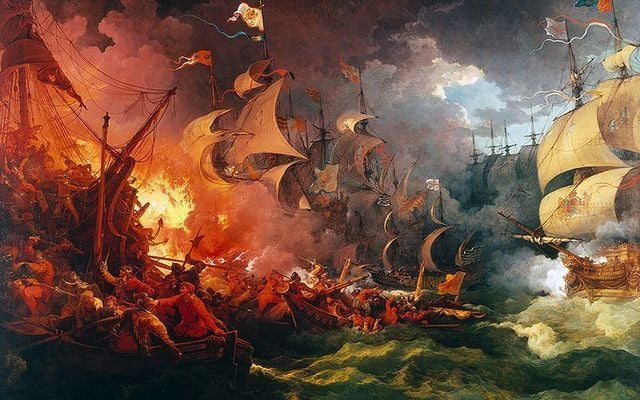
Another theory of the origin of the term "Black Irish" is that these people were descendants of Spanish traders who settled in Ireland and even descendants of the few Spanish sailors who were washed up on the west coast of Ireland after the disaster of the Spanish Armada of 1588.
It is claimed that the Spanish married into Irish society and created a new class of Irish who were immediately recognizable by their dark hair and complexion. There is little evidence to support this theory and it is unlikely that any significant number of Spanish soldiers would have survived long in the war-torn place that was 16th century Ireland.
It is striking, though, how this tale is very similar to the ancient Irish legend of the Milesians who settled in Ireland having traveled from Spain.
The theory that the "Black Irish" are descendants of any small foreign group that integrated with the Irish and survived is unlikely. It seems more likely that "Black Irish" is a descriptive term rather than an inherited characteristic that has been applied to various categories of Irish people over the centuries.
One such example is that of the hundreds of thousands of Irish peasants who emigrated to America after the Great Famine of 1845 to 1849. 1847 was known as "black 47." The potato blight which destroyed the main source of sustenance turned the vital food black. It is possible that the arrival of large numbers of Irish after the famine into America, Canada, Australia, and beyond resulted in their being labeled as "black" in that they escaped from this new kind of black death.
Immigrant groups throughout history have generally been treated poorly by the indigenous population (or by those who simply settled first).
Derogatory names for immigrant groups are legion and in the case of those who left Ireland include "Shanty Irish" and almost certainly "Black Irish." It is also possible that within the various Irish cultures that became established in America that there was a pecking order, a class system that saw some of their countrymen labeled as "black."
The term "Black Irish" has also been applied to the descendants of Irish emigrants who settled in the West Indies. It was also used in Ireland by Catholics in Ulster Province as a derogatory term to describe the Protestant Planters.
While it at various stages was almost certainly used as an insult, the term "Black Irish" has emerged in recent times as a virtual badge of honor among some descendants of immigrants. It is unlikely that the exact origin of the term will ever be known and it is also likely that it has had a number of different iterations, depending on the historical context. It remains, therefore, a descriptive term used for many purposes, rather than a reference to an actual class of people who may have survived the centuries.
Visit The Information about Ireland site to read more about Irish history, culture, and heritage.
* Originally published 2013. Updated in 2022.
Love Irish history? Share your favorite stories with other history buffs in the IrishCentral History Facebook group.
Comments