Today was the Winter Solstice 2018, meaning that Newgrange in Ireland would have been lit up by the sunrise. We explain the importance of the prehistoric site.
Newgrange, in County Meath, is one the most famous prehistoric sites in the world for good reason. It’s constructed in such a way that at dawn on the shortest day of the year (December 21, the winter solstice) a narrow beam of sunlight illuminates the floor of the structure’s inner chamber just after sunrise, filling the long passageway with a bright shaft of sunlight.
It is a marvel of early astronomy that never fails to amaze because Newgrange actually predates the great pyramid of Giza in Egypt by at least 500 years. Built somewhere between 3100 and 2900 BC, the famous passage tomb at Newgrange is estimated to be approximately 5,000 years old, even predating Stonehenge in Britain by 1,000 years.


The sophistication of the passage tombs design, aligned to mark the passage of the sun in less than 20 minutes on December 21 - the shortest day of the year - is still a cause for wonder in those lucky enough to win tickets allowing them into the tomb to attend the annual event.
Read more: Irish humor shines through despite clouds at Newgrange Winter Solstice
How does Newgrange light up during the winter solstice?
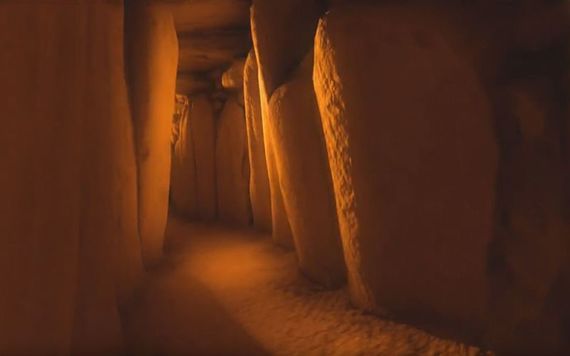
A visualization of the inside of Newgrange. Image: YouTube/Discovery Channel.
The sunlight enters the passage through a specially contrived opening, known as a roofbox, directly above the main entrance. Although solar alignments are not all that uncommon among prehistoric passage graves, Newgrange is one of few to contain the additional roofbox above the passage entrance, a sophisticated construction allowing the light to hit the floor of the inner chamber.
On December 21, the first light enters about four minutes after sunrise, but calculations based on the precession of the Earth show that 5,000 years ago first light would have entered exactly at sunrise. That makes the solar alignment at Newgrange very precise compared to similar phenomena at other passage graves in England and Scotland.
When was Newgrange discovered?

Newgrange from the surrounding land. Image: Tourism Ireland.
The structure itself lay hidden beneath the earth for over 5,000 years due to mound slippage, which effectively preserved it, until its rediscovery in the late 17th century, when men looking for building stone came across what they thought was a cave.
It wasn’t until 1975 that Newgrange was fully excavated and largely restored under the supervision of Professor Michael J. O’Kelly from the Department of Archaeology at University College, Cork. (Professor O’Kelly was the first person in modern times to observe this event on December 21, 1967)
Restored to its former glory the Newgrange mound is a solid structure that’s 250 feet across and 40 feet high, covering one acre of land. Within the mound, a long passage stretching approximately one-third of the length of the mound itself leads to a cross-shaped inner chamber. The passage is over 60 feet long, so the shaft of sunlight illuminating it on December 21 makes for a particularly dramatic moment. A tribute to its builders, the roof has remained essentially intact and waterproof for over 5,000 years.
Read more: Magical winter solstice in Ireland as the Northern Lights are aglow (PHOTOS)
How can I go to Newgrange during the winter solstice?

Newgrange. Image: RollingNews.ie.
Not surprisingly, there’s a lot of interest in attending the annual solstice event, and in recent years a lottery has been held for tickets to be allowed into the tomb to view it.
But don’t worry if you’re not lucky enough to score tickets in the draw for this once in a lifetime event. Visitors to Newgrange are always treated to a re-enactment of the solstice through the use of electric lights within the tomb. The grand finale of a Newgrange tour results in tour members standing inside the tomb where the tour guide then turns off the lights and then lights simulating the sun as it would appear on the winter solstice come on. Anyone visiting the historic site will tell you it’s the highlight of the tour.
Read more: Is Newgrange’s famous solstice light show a fake?
There is no online application system. However, the staff at the Newgrange Visitor Centre will fill out a form on your behalf. Ah, Ireland,where the customer service ethic is world class. Email your postal details and a contact telephone number to [email protected] and they will complete an application form on your behalf. How impressive is that?
Did you watch the live stream of the winter solstice at Newgrange today?
* Originally published in December 2009.

Comments