roots


The controversial pope who gave the King of England permission to invade Ireland

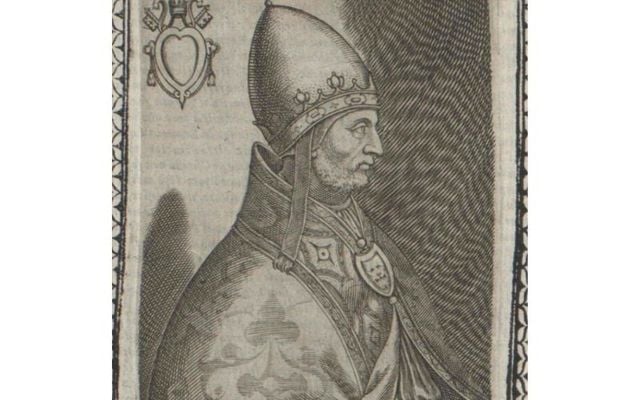
Pope Adrian IV, “The Bull” handed Ireland over for the "correction of morals" and "introduction of virtues”


Pope Adrian IV, “The Bull”
Photo by Hertfordshire County Council; Supplied by The Public Catalogue Foundation

Guinness PubFinder Ad

In Italy, Adrian IV agreed to invest William with the crowns of Sicily and Apulia and William became the liegeman of the pope and agreed to defend papal territories. Adrian IV returned to Rome in 1157. Since the pope had given to William I lands, which the Emperor Frederick claimed to possess, conflict broke out between Frederick and Adrian IV for this and other reasons. Still in the midst of conflict, Adrian IV died in Anagni in 1159, possibly from a tonsillitis infection. 

Adrian IV’s did not see the impact of the Bull during his lifetime. It was not until 1166, when Henry sent over Anglo-Norman soldiers in answer to Dermot MacMurrough, king of Leinster request for help retaking his kingdom that soldiers invaded Ireland. It was the invasions of Henry the VIII and Elizabeth I that led to the end of the old Gaelic order in Ireland.

See more: Irish Roots , Irish History , Irish Catholic Church
Nster.com


40 Comments

15 - 40 | See all comments

phlutie is off his meds again, maybe its shell shock from the eggs he had at breakfast time.
The equation of Holy Roman and Anglo-Norman/Anglo-Saxon imperialism - 4 Adrian's and 2 Henry's equals 0 Ireland! But then, what could one expect from the triumph of Christian orthodoxy over heterodoxy and it's kingdom being of this world, unlike the Messiah it supposedly follows. (PS Thanks seanomelb! Had though so but wasn't sure. Mixed up Archbishop Paul Marcinkus of Chicago with Archbishop Makarious of Cyprus.)
This is parallel to John XXIII signing off on a secret agreement with Ho Chi Minh to allow for the invasion of South Vietnam with consideration for Catholics once the occupation took place. It is stated that Ho Chi Minh allowed for the repatriation of Catholics to South Vietnam with the realization that this would destabilize the South. It is also noted that John XXIII who called the "Fatima Three" deluded shepherd children knew this as well. The XXIII had been a medic in WWI. To a Vietnam era Navy vet, this is disconcerting to say the least. While our boys, including J Mac, were POWs defending the rights of Catholics, John XXIII was "selling them down the river" just as Adrian VI. There is no doubt that we left POWs behind to serve as slave labor. William Jefferson guaranteed this because of his rush to make economic accomodation with the new Communist government.
Gaelic resurgence (1350–1500), The Tudors, Cromwell, The Ascendancy, Irish War of Independence, the Republic of Ireland and Northern Ireland. Wow great now everyone is up to date.
The plague killed of most of the Normans in Ireland around 1348 to 1350 and the Gaels of Ireland whom had fled from the Normans especially in the Pale survived because the disease was spread through the Trade ports. What was left of the Normans Joined the Gaels.
Archbishop Paul marcinkus of Chicago
coleenmb! The original Britain was Wales, then much more extensive than now prior to incursion by low country (Belgium/Netherlands) Angles. After the fall of Wales, Ireland must surely have only been a mater of time. My point, Pope Adrian may not have been a British pope proper but merely an Anglo-Norman one, or an Angle. The Commentator! Pope John Paul II's bodyguard, ex-American footballer from Chicago (whose name excapes me), once said: "Your can't run a church on Hail Mary's!" Someones got to lick a stamp. Besides, the Anglican Church are not exactly penniless, and have a rather impressive global real estate portfolio just like the Vatican. What sauce for the goose is sauce for the gander.
St Columbanus, one of the great Irish Saints and who established many religious houses across Europe in the 6th-7th centuries A.D. wrote these words to a pope- "We Irish, though dwelling at the far ends of the earth, are all disciples of St. Peter and St. Paul. The Catholic Faith, just as it was first delivered to us by yourselves, the successors of the Apostles, is held by us unchanged. We are bound to the Chair of Peter."
@Citizenwhy, There never was a celtic "church" in the institutional meaning of the term and the natives of Ireland back in the early days of Christianity, would've been nonplussed by your attempts to separate them from the rest of Latin Christendom. Most reputable experts on the early Christian centuries in Ireland would not subscribe to this myth of a "celtic" church which only religious sectarians, new agers, and those who have an animus towards Rome seem to support. The reality was both Irish Christians and their counterparts in continental Europe, believed in the same doctrines and tenets. There were slight differences in the rite of mass, monkish hairstyles and penitence but these should not obscure the fact that they were all part of the one universal Catholic Church. There was also a dichotomy concerning the dating of Easter but all these differences were thrashed out and resolved at the momentous Synod of Whitby in 664 A.D.


Log into IrishCentral with your Facebook account


or sign-in directly

E-Mail:
Password:
 Remember me Forgot my password
Not a member? Register Now!
print this article Print
email this articleE-mail