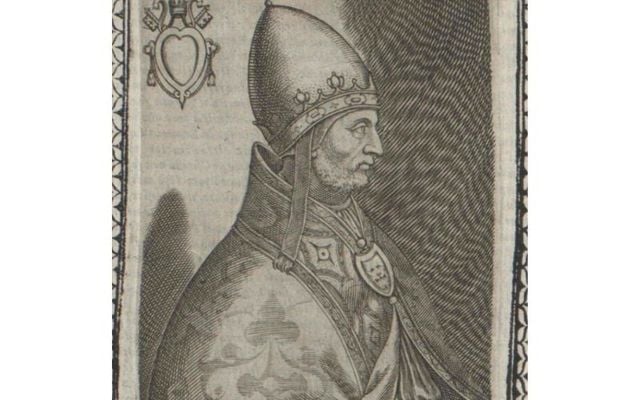
Pope Adrian IV is one of the most controversial popes for the Irish. He issued the “Laudabiliter” or as it is better known “Bull,” which gave Henry II the Pope’s permission to invade Ireland “for the correction of morals and the introduction of virtues, for the advancement of the Christian religion.” The Papal Bull became the most well known and controversial part of the pope’s legacy.
Born near St. Albans in England around 1100, Nicholas Breakspear as he was originally known went to France at an early age for his studies. There he took the vows and habit of an Austin canon. He was later elected abbot and made a cardinal by Pope Eugenius III when business regarding the monastery took him to Rome. In 1152 Nicholas was sent as a papal legate on a mission to Scandinavia, where he established an independent archiepiscopal see. When he returned to Rome he was hailed as the Apostle of the North. Soon after Pope Anastasius died in December of 1153 and the cardinals unanimously made Nicholas the next pope, the only English born pope to date.
The early years of Adrian IV’s papacy were fraught with conflict and power struggles. King Henry II petitioned the new pope for a papal Bull, but Adrian IV did not issue it from some years. When Adrian IV refused to recognize William I of Sicily in 1154, William I responded by laying siege to the papal possession of Beneventum. Adrian IV excommunicated him and his vassals marched on Beneventum, where he stayed until 1156.
During that year, Adrian IV issued the Bull. Scholars debate whether an Italian born pope would have given Henry permission or whether Henry would have invaded Ireland even without a papal Bull. Some scholars suggest that Adrian IV believed Henry would invade regardless and issued the Bull so the Church would end up on the winning side.
The Bull is erroneously believed to have given Henry a carte blanche to conquer Ireland. Adrian wrote that Henry was to respect the Church in Ireland. In translation from The Wild Geese, the Bull states, “And may the people of that land receive thee with honor, and venerate thee as their master: provided always that the rights of the churches remain inviolate and entire, and saving to St. Peter and the holy Roman Church the annual pension of one penny from each house.” Later English monarchs would violate this part.
When Adrian IV issued the Bull in 1156, Henry II was not in a position to invade Ireland. Henry was occupied with subduing the Welsh abroad and subduing Archbishop of Canterbury Thomas Becket at home. During that year, Henry proposed giving the job of subduing Ireland to his brother, William, but this idea was not pleasing to his mother Matilda, whose opinion carried considerable weight, and the expedition was postponed.
Ireland at this time was flourishing in the arts. The monastery Columbia had founded in Durrow, Co Laois in the sixth century taught students from a diverse geographical background by the seventh century. Irish students boasted achievements in architecture, astronomy, and science. The Normans never fully conquered Ireland; they intermarried and adopted Irish law, manners, language and became “more Irish than the Irish themselves.”
In Italy, Adrian IV agreed to invest William with the crowns of Sicily and Apulia and William became the liegeman of the pope and agreed to defend papal territories. Adrian IV returned to Rome in 1157. Since the pope had given to William I lands, which the Emperor Frederick claimed to possess, conflict broke out between Frederick and Adrian IV for this and other reasons. Still in the midst of conflict, Adrian IV died in Anagni in 1159, possibly from a tonsillitis infection.
Adrian IV’s did not see the impact of the Bull during his lifetime. It was not until 1166, when Henry sent over Anglo-Norman soldiers in answer to Dermot MacMurrough, king of Leinster request for help retaking his kingdom that soldiers invaded Ireland. It was the invasions of Henry the VIII and Elizabeth I that led to the end of the old Gaelic order in Ireland.
40 Comments
-
-
-
-
-
-
-
-
-
-
-
-
-
-
-
-
-
-
-
-
-
-
-
-
-
-
-
-
-
-
-
-
-
-
-
-
-
-
-
-
Switch to the desktop site to post a comment.seanomelb | Feb 17, 2013, 06:53 PM EST
phlutie is off his meds again, maybe its shell shock from the eggs he had at breakfast time.
IrelandNorth | Feb 17, 2013, 03:43 PM EST
The equation of Holy Roman and Anglo-Norman/Anglo-Saxon imperialism - 4 Adrian's and 2 Henry's equals 0 Ireland! But then, what could one expect from the triumph of Christian orthodoxy over heterodoxy and it's kingdom being of this world, unlike the Messiah it supposedly follows. (PS Thanks seanomelb! Had though so but wasn't sure. Mixed up Archbishop Paul Marcinkus of Chicago with Archbishop Makarious of Cyprus.)
PhlutiePhan | Feb 17, 2013, 11:19 AM EST
This is parallel to John XXIII signing off on a secret agreement with Ho Chi Minh to allow for the invasion of South Vietnam with consideration for Catholics once the occupation took place. It is stated that Ho Chi Minh allowed for the repatriation of Catholics to South Vietnam with the realization that this would destabilize the South. It is also noted that John XXIII who called the "Fatima Three" deluded shepherd children knew this as well. The XXIII had been a medic in WWI. To a Vietnam era Navy vet, this is disconcerting to say the least. While our boys, including J Mac, were POWs defending the rights of Catholics, John XXIII was "selling them down the river" just as Adrian VI. There is no doubt that we left POWs behind to serve as slave labor. William Jefferson guaranteed this because of his rush to make economic accomodation with the new Communist government.
darragh S | Feb 17, 2013, 04:29 AM EST
Gaelic resurgence (1350–1500), The Tudors, Cromwell, The Ascendancy, Irish War of Independence, the Republic of Ireland and Northern Ireland. Wow great now everyone is up to date.
darragh S | Feb 17, 2013, 02:40 AM EST
The plague killed of most of the Normans in Ireland around 1348 to 1350 and the Gaels of Ireland whom had fled from the Normans especially in the Pale survived because the disease was spread through the Trade ports. What was left of the Normans Joined the Gaels.
seanomelb | Feb 16, 2013, 06:22 PM EST
Archbishop Paul marcinkus of Chicago
IrelandNorth | Feb 16, 2013, 03:02 PM EST
coleenmb! The original Britain was Wales, then much more extensive than now prior to incursion by low country (Belgium/Netherlands) Angles. After the fall of Wales, Ireland must surely have only been a mater of time. My point, Pope Adrian may not have been a British pope proper but merely an Anglo-Norman one, or an Angle. The Commentator! Pope John Paul II's bodyguard, ex-American footballer from Chicago (whose name excapes me), once said: "Your can't run a church on Hail Mary's!" Someones got to lick a stamp. Besides, the Anglican Church are not exactly penniless, and have a rather impressive global real estate portfolio just like the Vatican. What sauce for the goose is sauce for the gander.
Gearoid4 | Feb 16, 2013, 12:10 PM EST
St Columbanus, one of the great Irish Saints and who established many religious houses across Europe in the 6th-7th centuries A.D. wrote these words to a pope- "We Irish, though dwelling at the far ends of the earth, are all disciples of St. Peter and St. Paul. The Catholic Faith, just as it was first delivered to us by yourselves, the successors of the Apostles, is held by us unchanged. We are bound to the Chair of Peter."
Gearoid4 | Feb 16, 2013, 12:02 PM EST
St Columbanus, one of the great Irish Saints and who established many religious houses across Europe in the 6th-7th centuries A.D. wrote these words to a pope- "We Irish, though dwelling at the far ends of the earth, are all disciples of St. Peter and St. Paul. The Catholic Faith, just as it was first delivered to us by yourselves, the successors of the Apostles, is held by us unchanged. We are bound to the Chair of Peter."
Gearoid4 | Feb 16, 2013, 12:01 PM EST
@Citizenwhy, There never was a celtic "church" in the institutional meaning of the term and the natives of Ireland back in the early days of Christianity, would've been nonplussed by your attempts to separate them from the rest of Latin Christendom. Most reputable experts on the early Christian centuries in Ireland would not subscribe to this myth of a "celtic" church which only religious sectarians, new agers, and those who have an animus towards Rome seem to support. The reality was both Irish Christians and their counterparts in continental Europe, believed in the same doctrines and tenets. There were slight differences in the rite of mass, monkish hairstyles and penitence but these should not obscure the fact that they were all part of the one universal Catholic Church. There was also a dichotomy concerning the dating of Easter but all these differences were thrashed out and resolved at the momentous Synod of Whitby in 664 A.D.
Gearoid4 | Feb 16, 2013, 12:01 PM EST
@Citizenwhy, There never was a celtic "church" in the institutional meaning of the term and the natives of Ireland back in the early days of Christianity, would've been nonplussed by your attempts to separate them from the rest of Latin Christendom. Most reputable experts on the early Christian centuries in Ireland would not subscribe to this myth of a "celtic" church which only religious sectarians, new agers, and those who have an animus towards Rome seem to support. The reality was both Irish Christians and their counterparts in continental Europe, believed in the same doctrines and tenets. There were slight differences in the rite of mass, monkish hairstyles and penitence but these should not obscure the fact that they were all part of the one universal Catholic Church. There was also a dichotomy concerning the dating of Easter but all these differences were thrashed out and resolved at the momentous Synod of Whitby in 664 A.D.
Gearoid4 | Feb 16, 2013, 12:01 PM EST
@Citizenwhy, There never was a celtic "church" in the institutional meaning of the term and the natives of Ireland back in the early days of Christianity, would've been nonplussed by your attempts to separate them from the rest of Latin Christendom. Most reputable experts on the early Christian centuries in Ireland would not subscribe to this myth of a "celtic" church which only religious sectarians, new agers, and those who have an animus towards Rome seem to support. The reality was both Irish Christians and their counterparts in continental Europe, believed in the same doctrines and tenets. There were slight differences in the rite of mass, monkish hairstyles and penitence but these should not obscure the fact that they were all part of the one universal Catholic Church. There was also a dichotomy concerning the dating of Easter but all these differences were thrashed out and resolved at the momentous Synod of Whitby in 664 A.D.
Gearoid4 | Feb 16, 2013, 12:01 PM EST
@Citizenwhy, There never was a celtic "church" in the institutional meaning of the term and the natives of Ireland back in the early days of Christianity, would've been nonplussed by your attempts to separate them from the rest of Latin Christendom. Most reputable experts on the early Christian centuries in Ireland would not subscribe to this myth of a "celtic" church which only religious sectarians, new agers, and those who have an animus towards Rome seem to support. The reality was both Irish Christians and their counterparts in continental Europe, believed in the same doctrines and tenets. There were slight differences in the rite of mass, monkish hairstyles and penitence but these should not obscure the fact that they were all part of the one universal Catholic Church. There was also a dichotomy concerning the dating of Easter but all these differences were thrashed out and resolved at the momentous Synod of Whitby in 664 A.D.
Gearoid4 | Feb 16, 2013, 12:00 PM EST
@Citizenwhy, There never was a celtic "church" in the institutional meaning of the term and the natives of Ireland back in the early days of Christianity, would've been nonplussed by your attempts to separate them from the rest of Latin Christendom. Most reputable experts on the early Christian centuries in Ireland would not subscribe to this myth of a "celtic" church which only religious sectarians, new agers, and those who have an animus towards Rome seem to support. The reality was both Irish Christians and their counterparts in continental Europe, believed in the same doctrines and tenets. There were slight differences in the rite of mass, monkish hairstyles and penitence but these should not obscure the fact that they were all part of the one universal Catholic Church. There was also a dichotomy concerning the dating of Easter but all these differences were thrashed out and resolved at the momentous Synod of Whitby in 664 A.D.
Gearoid4 | Feb 16, 2013, 12:00 PM EST
@Citizenwhy, There never was a celtic "church" in the institutional meaning of the term and the natives of Ireland back in the early days of Christianity, would've been nonplussed by your attempts to separate them from the rest of Latin Christendom. Most reputable experts on the early Christian centuries in Ireland would not subscribe to this myth of a "celtic" church which only religious sectarians, new agers, and those who have an animus towards Rome seem to support. The reality was both Irish Christians and their counterparts in continental Europe, believed in the same doctrines and tenets. There were slight differences in the rite of mass, monkish hairstyles and penitence but these should not obscure the fact that they were all part of the one universal Catholic Church. There was also a dichotomy concerning the dating of Easter but all these differences were thrashed out and resolved at the momentous Synod of Whitby in 664 A.D.
Gearoid4 | Feb 16, 2013, 12:00 PM EST
@Citizenwhy, There never was a celtic "church" in the institutional meaning of the term and the natives of Ireland back in the early days of Christianity, would've been nonplussed by your attempts to separate them from the rest of Latin Christendom. Most reputable experts on the early Christian centuries in Ireland would not subscribe to this myth of a "celtic" church which only religious sectarians, new agers, and those who have an animus towards Rome seem to support. The reality was both Irish Christians and their counterparts in continental Europe, believed in the same doctrines and tenets. There were slight differences in the rite of mass, monkish hairstyles and penitence but these should not obscure the fact that they were all part of the one universal Catholic Church. There was also a dichotomy concerning the dating of Easter but all these differences were thrashed out and resolved at the momentous Synod of Whitby in 664 A.D.
Gearoid4 | Feb 16, 2013, 12:00 PM EST
@Citizenwhy, There never was a celtic "church" in the institutional meaning of the term and the natives of Ireland back in the early days of Christianity, would've been nonplussed by your attempts to separate them from the rest of Latin Christendom. Most reputable experts on the early Christian centuries in Ireland would not subscribe to this myth of a "celtic" church which only religious sectarians, new agers, and those who have an animus towards Rome seem to support. The reality was both Irish Christians and their counterparts in continental Europe, believed in the same doctrines and tenets. There were slight differences in the rite of mass, monkish hairstyles and penitence but these should not obscure the fact that they were all part of the one universal Catholic Church. There was also a dichotomy concerning the dating of Easter but all these differences were thrashed out and resolved at the momentous Synod of Whitby in 664 A.D.
Gearoid4 | Feb 16, 2013, 11:59 AM EST
@Citizenwhy, There never was a celtic "church" in the institutional meaning of the term and the natives of Ireland back in the early days of Christianity, would've been nonplussed by your attempts to separate them from the rest of Latin Christendom. Most reputable experts on the early Christian centuries in Ireland would not subscribe to this myth of a "celtic" church which only religious sectarians, new agers, and those who have an animus towards Rome seem to support. The reality was both Irish Christians and their counterparts in continental Europe, believed in the same doctrines and tenets. There were slight differences in the rite of mass, monkish hairstyles and penitence but these should not obscure the fact that they were all part of the one universal Catholic Church. There was also a dichotomy concerning the dating of Easter but all these differences were thrashed out and resolved at the momentous Synod of Whitby in 664 A.D. St Columbanus, one of the great Irish Saints and who established many religious houses across Europe in the 6th-7th centuries A.D. wrote these words to a pope- "We Irish, though dwelling at the far ends of the earth, are all disciples of St. Peter and St. Paul. The Catholic Faith, just as it was first delivered to us by yourselves, the successors of the Apostles, is held by us unchanged. We are bound to the Chair of Peter."
Gearoid4 | Feb 16, 2013, 11:59 AM EST
@Citizenwhy, There never was a celtic "church" in the institutional meaning of the term and the natives of Ireland back in the early days of Christianity, would've been nonplussed by your attempts to separate them from the rest of Latin Christendom. Most reputable experts on the early Christian centuries in Ireland would not subscribe to this myth of a "celtic" church which only religious sectarians, new agers, and those who have an animus towards Rome seem to support. The reality was both Irish Christians and their counterparts in continental Europe, believed in the same doctrines and tenets. There were slight differences in the rite of mass, monkish hairstyles and penitence but these should not obscure the fact that they were all part of the one universal Catholic Church. There was also a dichotomy concerning the dating of Easter but all these differences were thrashed out and resolved at the momentous Synod of Whitby in 664 A.D. St Columbanus, one of the great Irish Saints and who established many religious houses across Europe in the 6th-7th centuries A.D. wrote these words to a pope- "We Irish, though dwelling at the far ends of the earth, are all disciples of St. Peter and St. Paul. The Catholic Faith, just as it was first delivered to us by yourselves, the successors of the Apostles, is held by us unchanged. We are bound to the Chair of Peter."
The Commentator | Feb 16, 2013, 11:55 AM EST
A penny per household. Why is it that almost everything the Roman Catholic Church involves itself in has to do with money. Somehow, someway it seems money is behind the actions the church takes. Examine the past and become aware of the vast riches the church acquired through plunder by Roman Catholic initiated wars, battles, conflicts etc. The adherence to tithing, although is supposed to be "giving freely as one is able to" seems to be more of an obligation than a requirement. Guilt and subtle general hints by the priest might be an influence. For many, many years the Vatican has been involved with money laundering with the mafia. The Roman Catholic Church is just one of the many religious organizations, sects and individuals that take advantage of the believers and become filthy rich and live lavish lifestyles.
colleenmb | Feb 16, 2013, 10:02 AM EST
We ran a business in Dublin and had an employee who was really full of herself. Her name was Adrianne. One day she was bragging how her mother had named her after a pope. I couldn't resist. I told her that yes. Adrian was a pope; a British pope who invited the invasion of Ireland. The answer shut her up. It took her at least a half an hour to begin bragging about other nonsense.
CitizenWhy | Feb 16, 2013, 01:40 AM EST
The reason for authorizing the invasion was to bring the Irish Celtic Catholic? Orthodox? church into conformity with the Roman Catholic Church. There seemed to have been confusion about the Celtic church - the pope understood it to be perfectly Catholic and Orthodox in doctrine and sacraments but out of line in regard to the ecclesiastical calendar (celebrating Easter as it is celebrated in the Eastern Church), liturgy and church governance, especially the subordination of bishops to abbots. Rome had long worked to bring all of Europe not controlled by the Byzantine Emperor into total conformity with Roman liturgy and governance. Ireland was the last holdout. Many of the Normans, however, did not understand that the Irish were already Christians. ... The O'Briens of Clare, descended from Brian Boru, hastened to Dublin to swear allegiance to Henry. Perhaps they were still mad that the High Kingship had reverted to the O'Neills, Brian Boru being a usurper. The O'Nerills were completely inept in defending Ireland from the Vikings raids so Brian Boru seized the high kingship and drove out the Vikings/Danes, except for those who agreed to be Irish.
darragh S | Feb 15, 2013, 10:29 PM EST
The plauge you catholic scum with your nominal ownership. Go back to Rome.
darragh S | Feb 15, 2013, 10:26 PM EST
The Plauge idiots. The Plauge wiped out the Normans in their Towns and Ports because it traveled on Flea infested animals like rats. The Great Irish people survived the Normans and even integrated the filthy scum into their Tribes just like they did with the Original Vikings. Ireland thus has never been conquered. Many have tried to occupy her but we have prevailed for many reasons. When the last British Scum marched out of my Curragh, I Darragh was once again King and always will be Dalcassian since ancient times.
darragh S | Feb 15, 2013, 10:17 PM EST
I think you left out the Plauge and how it decimated the Normans. I think you left out how it caused the Normans to be diseased while us Gaelic People stayed off the norman trade routes and rivers etc. The Irish were graced and able to adapt. When the English Normans came back after the Plauge most of the Normans that were left behind were speaking Gaelic and at one point when the king tried to declare he was our king no body accept one person was able to explain it. We still survive and like we eventually adapted our warfare to the Normans we also eventually rallied and kicked out the British. Only at that time it was the Boer War, World War 1 and then World War 2 that was the new Black Death for the English and other European Scum Lords. If you learn anything from that its that if there is a zombie outbreak it will be most concentrated along the major trade routes and in the big populations unless it emerges in a small population that is quarantined, you would hope. The moral of the story here is that you will have a massive n-naught with a zombie plauge and will need to get out of the city as soon as it emerges and head to the high ground in colorado with Maggie.
seanomelb | Feb 15, 2013, 05:32 PM EST
The pope assisted in the invasion of Ireland and the Irish remains strong papist how tragic.
bunkerhill | Feb 15, 2013, 04:19 PM EST
We think this is a wonderful discussion but the pop-up is back so I will try to get around it and make this as coherent as possible. For Nicomax, the true glory of Irish History is just coming to the forefront. I suppose you have been to Newgrange, have researched the approx 3,000 Irish Castles, and hopefully your family can trace back to one of them. The young Irish are researching the lost Irish history and bringing it forward. As for Gearoid4, we agree that Benedict was indeed a great intellectual Pope, and given the high standards he has set for himself, feels he should step down. My Clare born father told us we were Danes in Munster who married Irish. His family was connected to Cahermurphy Castle which has been thought to be originally a Dane's Fort. Ireland has a glorious history which is only now coming to light. Hope this makes sense as the pop-up is back again. Have to take this darm computer back.
Gearoid4 | Feb 15, 2013, 03:26 PM EST
Spare us the "God's rottweiller" stereotype with regards to the incumbent pope, Benedict XV1 who after much deliberation and thought has freely chosen to give up the very onerous that comes with the papal office. This negative image has been perpetrated by an unthinking media who have little grounding in religious Faith or Theology. Benedict in reality is a warm-hearted, humorous and very self-effacing person, as described by people who have met him personally. He possesses an outstanding intellect and his diagnosis of the social and moral ills which beset modern society is spot-on and should never be dismissed. His clarity of thought and breadth of vision are qualities which few seem to possess in world leadership today. Cathcav had made some very interesting points concerning the mounting historical evidence which points to the inauthenticity of the "De Laudbiliter" document. Some historians are of the opinion that it was at best a forgery or doctored document which was redacted to go beyond the aims of Pope Adrian 1V. He had instructed Henry 11 not to mistreat the inhabitants of Ireland but rather to correct any vices or inappropriate religious practices like a wise ruler would correct subjects who err. But Henry decided to go beyond this remit and landed in Ireland n 1171 proclaiming his aims to subdue the Irish kings.
Nicomax | Feb 15, 2013, 02:10 PM EST
Hmmm? With all those irish accomplishments, was it jealousy that pushed the Brits into the invasion?
IrelandNorth | Feb 15, 2013, 01:52 PM EST
Hmmm! From Breakespear to Strongbow in one generation. For the "correction of morals and the introduction of virtues". Not a bad excuse for a hostile takeover of somebody's else's national real estate, still used today as an excuse for invading other people's countries. Perhaps the next (last?) pontiff can rescind his predecessors bull, bringing to an end a millenium of military misadventure between the British and/or Irish Isles, authenticated by a leader of large swaithe of their respective mainland.
Dompedro | Feb 15, 2013, 01:14 PM EST
hail Columbia
Butch1 | Feb 15, 2013, 11:12 AM EST
Many thanks for the history lesson of a church that continues to try and remain politically relevant in today's world. They have much blood on their hands collected over the centuries from their greed and perhaps, soon they will be answering for their crimes. Their sleeping flock of sheeple have grown restless and have stopped listening to pedophile-rapist priests and their enabling bishops, cardinals and a pope, as it turns out. There is much that has made this man, formally known as "God's Rottweiler," to abdicate his throne; it hasn't been done in centuries. Popes are supposed to die in office and seeing one quit like this tells me that he is hiding something and if he doesn't quit he will be charged with it and as the Head of this Church, he will be responsible for it. I do not believe all of this, "He's getting too old and tired to do his job," excuses. All one had to do was remember Pope John-Paul II and remember how he was basically "propped up" and wheeled around to know better. His Parkinson's Disease gave him a "stone-face" countenance with a drool, which is a normal side effect of this disease. Compared to Ratzinger, Benedict is in excellent health. No, he is hiding plenty and they are now coming to the surface and that is why he has "cashed in his chips." One notices he will still live in the Sanctuary of the Vatican where no one will be able to touch him just like Cardinal Law who escaped justice and ran from the United States.
Searlit | Feb 15, 2013, 11:11 AM EST
I thank IC too, for this great article. I had read about all the Kings and popes mentioned, only, you have filled in little details, previously unknown to me. Please more articles like this.
bunkerhill | Feb 15, 2013, 10:43 AM EST
Thank you Irish Central for this grea great piece of Irish History. The world actually knows so little about the amazing history of Ireland My father from Munster Province told us Pope Adrian used the excuse that the invading Danes were Pagans and would not pay tribute to the Church. And then there was McMurrough of course whoor course invited in the original Anglo-Normans. I have always wondered if the Irish Danes and the Norman Danes were in fact related. From what I understand McMurrough was a grandson of Brian Boru and a Dane mother. There was indeed a large Norman presence in Munster Province. I may have to resubmit this as I have a new computer and all it is good for is pop up ads one of which is blocking my submission. Again many thanks.
CelticQueenUSA | Feb 15, 2013, 10:31 AM EST
Well given today's status, this pope was a real screw-up.
Paul Hogan | Feb 15, 2013, 10:09 AM EST
All that history is water over the dam. But what we do know for sure is that Lenehan and Kenny gave herr Merkel and the European banks the right to invade Ireland and drive the present Irish into paupery and to the workhouse. We know this to be a fact. So let's cut out the bullshit and call a spade a spade.
CathalCav | Feb 15, 2013, 09:58 AM EST
No original of this Laudabiliter has ever been found and the only text available comes from the Norman Welsh monk who was closely related to the leading original invaders. He was also known to be partial to telling lies when it suited him. Professor Anne Duggan of London University who carried out a detailed examination of the purported text feels that it has been fiddled with. So there is considerable uncertainty as to what the original text said. Dermot McMurrough was following an established practice in seeking assistance of mercenaries from abroad to regain the kingdom of Leinster from which he had been expelled. It was subsequent to his death in1171 that the Norman mercenaries under Strongbow began to seek to set up an independent kingdom for themselves. At this stage Henry II, an enemy of Strongbow intervened to curb his power and ensure that such an independent kingdom did not emerge. Henry II had indeed planned for some time (and King Stephen prior to him) to add Ireland to his extensive portfolio of lands, mainly in France at that stage.
fmcevoy | Feb 15, 2013, 09:28 AM EST
Well, as luck would have it, I wrote a play when I was a college undergraduate (and produced it to boot) about this maneuver. Hadrian gave Henry Ireland because Ireland wouldn't sent men for the Crusades (12th-century wisdom) and was delinquent on the Peter's Pence (I don't contribute to it these days--ever). Henry needed land for Prince John, who was out of luck on that issue. (John's nickname was "Lackland."
HorsesInMdstrm | Feb 15, 2013, 09:22 AM EST
Shoulda read page 2 - Seanmor
Seanmor | Feb 15, 2013, 08:41 AM EST
I'm not trying to refute tghe claims made in this article, but there is no mention of McMurrough, the Leinster 'King' whos sought help from the Norman knights against Ireland's High King. In any case, many Irish prelates, including those whop hold office today, seem quite happy with British rul;e in the North of Ireland.