Imbolc, also known as the Feast of Brigid, on February 1 celebrates the arrival of longer, warmer days and the early signs of spring.
It is one of the four major "fire" festivals (quarter days), referred to in Irish mythology from medieval Irish texts. The other three festivals on the old Irish calendar are Beltane, Lughnasadh and Samhain.
The word Imbolc means literally "in the belly" in the Old Irish Neolithic language, referring to the pregnancy of ewes.
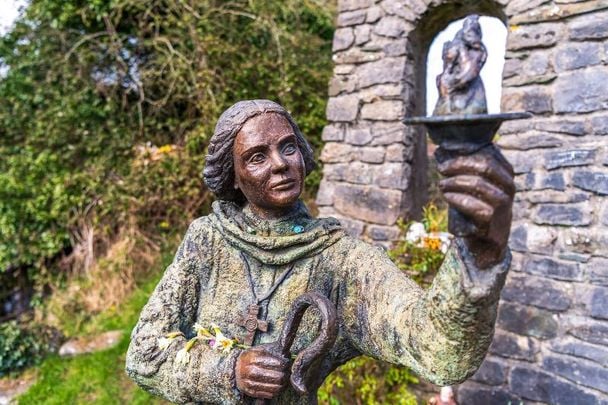
In ancient Irish mythology Brigid was a fire goddess. Nowadays her canonization is celebrated with a perpetual flame at her shrine in Kildare.
St. Brigid represents the Irish aspect of divine femininity in her role as patron of babies; blacksmiths; boatmen; cattle farmers; children whose parents are not married; children whose mothers are mistreated by the children's fathers; Clan Douglas; dairymaids; dairy workers; fugitives; infants; Ireland; Leinster, mariners; midwives; milk maids; nuns; poets; poor; poultry farmers; poultry raisers; printing presses; sailors; scholars; travelers; watermen.
___________
Read More:
What’s going on in Ireland in February - music, festivals, and more
Irish women should follow St. Brigid, not just St. Patrick
How to make a Saint Brigid's Cross - SEE VIDEO
___________
One folk tradition that continues in both Christian and Pagan homes on St. Brigid's Day (or Imbolc) is that of the Brigid's Bed.
As Wikipedia points out, the girls and young, unmarried, women of the household or village create a corn dolly to represent Brigid, called the Brideog ("little Brigid" or "young Brigid"), adorning it with ribbons and baubles like shells or stones. They make a bed for the Brideog to lie in.
On St. Brigid's Eve (January 31), the girls and young women gather together in one house to stay up all night with the Brideog, and are later visited by all the young men of the community who must ask permission to enter the home, and then treat them and the corn dolly with respect.
Brigid is said to walk the earth on Imbolc eve. Before going to bed, each member of the household may leave a piece of clothing or strip of cloth outside for Brigid to bless. The head of the household will smother (or "smoor") the fire and rake the ashes smooth.
In the morning, they look for some kind of mark on the ashes, a sign that Brigid has passed that way in the night or morning. The clothes or strips of cloth are brought inside, and believed to now have powers of healing and protection.
On the following day, the girls carry the Brideog through the village or neighborhood, from house to house, where this representation of the saint/goddess is welcomed with great honor.
Adult women — those who are married or who run a household — stay home to welcome the Brigid procession, perhaps with an offering of coins or a snack. Since Brigid represents the light half of the year, and the power that will bring people from the dark season of winter into spring, her presence is very important at this time of year.
Neopagans of diverse traditions observe this holiday in a variety of ways. As forms of Neopaganism can be quite different and have very different origins, these representations can vary considerably despite the shared name.
Some celebrate in a manner as close as possible to how the ancient Celts are believed to have observed the festival, as well as how these customs have been maintained in the living Celtic cultures. Other types of Neopagans observe the holiday with rituals taken from numerous other unrelated sources, Celtic cultures being only one of the sources used.
Imbolc is usually celebrated by modern Pagans on February 1 or 2 in the Northern Hemisphere, and August 1 or 2 in the Southern Hemisphere, or at the solar midpoint between the winter solstice and spring equinox, which now falls later in the first week or two of February.
___________
Read More:
What’s going on in Ireland in February - music, festivals, and more
Irish women should follow St. Brigid, not just St. Patrick
How to make a Saint Brigid's Cross - SEE VIDEO
___________
18 Comments
-
-
-
-
-
-
-
-
-
-
-
-
-
-
-
-
-
-
Switch to the desktop site to post a comment.IrelandNorth | Feb 03, 2012, 07:42 AM EST
Poor Brighid! She's carrying one helluva a portfolio there. All those people to be patron saint of. Hope she's on a retainer. Yes, indeed! Brighid represented the glory days of true Divinely Feminine Irish spirituality/Celtic Christianity. Before the misogynists patriarchs of Rome supplanted it with their orthodox religious imperialism, paving the way for more temporal imperialism of the Anglo-Norman/Saxons.
johnshiel | Feb 02, 2012, 09:56 AM EST
this piece and its posted comments are a real headspinner for an irish american distant from irish lore. also a fine entre for newcomers to the irish central site. also a rich patina to place over our very mild midwestern winter days and nights of the moment... thanks to all -
upsceach | Feb 02, 2012, 01:25 AM EST
Nice article Mairead. Thx
upsceach | Feb 02, 2012, 01:21 AM EST
Is cuimhniu liom ar baile agus me og,in Inis Oirr go raibh ceiliura no,go raibh no cailini ag deanamh rud eigin. Was it Sean O Riardain who sang it, or the same fella who sang An Poc Ar Buile..Nil gaeilge no bearla agam, well ag an computer.
Curitiba | Feb 02, 2012, 01:16 AM EST
Lovely old traditions from the days before we had to become wage slaves and get up every morning go to some crummy job to pay the mortgage on some overpriced property or inflated rent. If only life was as simple and free as it was then!
gaeilgesdamhsa | Feb 01, 2012, 06:57 PM EST
Muiris agus Niall, Is breá liom an dán atá I gceist agaibh, Rugadh mé dhá mhíle ón áit sin i Maigh Eo. I love that poem that Muiris & Niall are referring to. I was born two miles from Cill Aodáin – the place Rafertí praises in the poem about the coming of spring and the days getting longer, after the feast of Brigid.
Niall O'Dowd | Feb 01, 2012, 06:14 PM EST
LOvely Muiris think I learned it in second grade too and it is still with me all these years later -- go mairimid cead!
jacersagain | Feb 01, 2012, 06:06 PM EST
(...more) Brigid is also associated with the sun and therefore God through a famous romantic story told about her sitting in her convent at sunset with another nun, Dara, who was blind, describing the setting sun to her. The story goes that Brigid talked throughout the night about the sun’s brightness and its likeness to the glory of God and Paradise. The two prayed together during the night and the story goes on... "Quickly the hours of darkness sped, and the sun came up again behind the Wicklow mountains, and the pure white light made the face of the earth bright and gay. Then Brigid sighed when she saw the loveliness of earth and sky, knowing that Dara's eyes were dark, and closed to all this beauty. So she prayed to God, and laid her hands on the eyes of the gentle sister. Then, the darkness passed away from them, and Dara saw the golden ball in the east, and the trees and the flowers and the green fields, and the curragh glittering with dew in the morning light. She looked for a while. Then she turned to her Abbess (Brigid), saying: 'Close my eyes again, dear Mother, for it seems to me that when the world is so visible to the eyes, God is seen less clearly to the soul!' So Brigid prayed once more, and Dara's eyes grew dark again."
jacersagain | Feb 01, 2012, 05:58 PM EST
The association of St. Brigid with Celtic Fire and the Sun is famous. St. Brigid is wrongly attributed as the goddess of Fire; it was an earlier pagan woman also named Brigid who held that name (Breeyith of the Ashless Fire, the great nature goddess, the Healer, the Mother of Poets, and of Fire Smiths, was wrongly attributed to the historical St. Brigid. However, Brigid is reputed to hold great control over fire even today... as an infant, she miraculously survived a fire that burned the house she was in down to the ground (at Fochart, near Dundalk); though everything else was reduced to ashes, she and her cradle were untouched by the fire. Later on, in her convent in Kildare, she lit a fire with brushwood and logs but there were never any ashes left despite the fire being fed wood 24hrs a day. Though the fire at Kildare was destroyed during the Reformation years, it was later re-lit and still burns to this day in Kildare where you can visit it. The mistake common pagan attachment of Brigid with fire also emanates from her father who was a druid who lit many fires during his rituals. She attended many of them but used the occasions to preach Christianity to the crowds gathered around the fires. She converted her father on his deathbed when she prayed to God to let him see the glory of Paradise, whereupon he immediately became a believer and was baptised by Brigid before he died. BTW - the saintly Brigid, who was known for many miricales in her lifetime, was a ordained a bishop by St. Mel, nephew of St. Patrick and men were allowed to join her convent but stayed in separate quarters (More...)
jacersagain | Feb 01, 2012, 05:04 PM EST
@ PatriciaMarya – Yes, St. Brigid is known for blessing home and hearth. The Irish tradition is to place the straw St. Brigid’s Cross over the entrance door. St. Brigid is then said to bless all passing under her cross as they enter the home and as they leave it. In the old days, the entrance door of an Irish family home usually led you straight into the kitchen where the large turf fire burned for cooking and heat purposes; thus the blessing of home and hearth.
antoman | Feb 01, 2012, 03:28 PM EST
Brigid is a nice name. Never dated a girl called Brigid but the day is still young.
muirisobric | Feb 01, 2012, 01:45 PM EST
Niall: O chuir mé im cheann é. Ní stadaidh mé chaoíche. Go seasaidh thíos i lár Chonntae Mhuigheó. I gClár Chluinne Mhuiris bheas mé an chéad oíche. is san mbaile taobh thíos do tosnóidh mé ag óll. Go Caoilte 'Mach rachad is déanfad cuairt míosa ann....I learned it in 2nd grade so it may be a little mixed but that's the gist of it. Reaftaraí was an incredible poet.
PatriciaMarya | Feb 01, 2012, 12:40 PM EST
Finally - nothing political, just beautiful observation of a wonderful Goddess' Day. I love the people she watches over. I also believe that she blesses the home and the hearth. Any information on that thought? St. Brigid's Cross - I saw them in the West of Ireland when I visited two years ago and reflected on how beautiful and easy to transport are they instead of the heavy, metal made ones.
CitizenWhy | Feb 01, 2012, 12:38 PM EST
In the ancient Irish pagan system Brigid was the sun goddess, but with the sun not envisioned as a distant disk in the sky. Brigid instead was envisioned as the rays of the sun as they enter the earth and make all things fertile and alive. She was the mother of the earth and all the living.
gaeilgesdamhsa | Feb 01, 2012, 10:35 AM EST
Tá an ceart ag Muiris. Cloisim anois iad. Muisis is right. I can hear the birds. I'm delighted that Irish Central covered this ancient Celtic holiday. Now, I'm going to get some straw or rushes & see if I remember how to make a Brigid's cross.
Niall O'Dowd | Feb 01, 2012, 10:34 AM EST
Muiris an chumnionn tu are seo ---Anois teacht an Earraig beidh an la ag dul chun sinead is tar eis na feile bhride ardoidh me mo sheol ----Now that spring has come and the days are longer, after St Brigids Day I' ll set up my sail --Rafterie the poet
Murph46 | Feb 01, 2012, 10:28 AM EST
Beautiful language!
muirisobric | Feb 01, 2012, 10:15 AM EST
ó lá le Bríde amach bíonn na h-éin ag déanamh nead. After St. Bridget's day birds commence to build their nests.