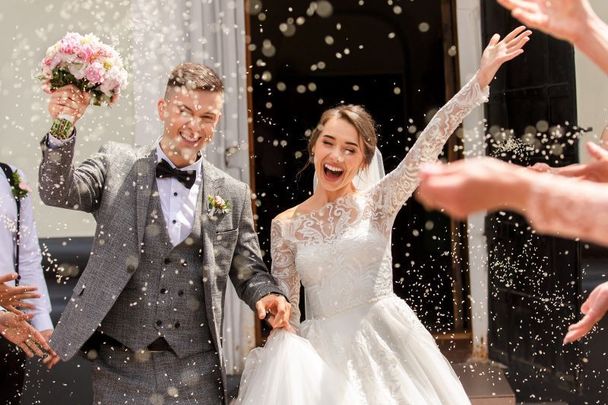
From arranged marriages to the role whiskey played in the nuptials, a look at Irish wedding history and traditions that remain.
Just when I think I have my dad all figured out, a new snippet of info comes to light, and June always finds me thinking more about him than usual. It’s Father’s Day month, his birthday was the 3rd, and my parents were married on June 16th, now celebrated globally as Bloomsday, the day Leopold Bloom wandered through Dublin in Ulysses by James Joyce, Dad’s favorite author.
June is also the prime month for weddings, and Dad was a wedding photographer. He used to say he’d like to write a book about his wedding adventures titled "I Shot the Bride with a 4-5" meaning his trusty 4x5 press camera.
Almost immediately on beginning the research for this article on Irish wedding traditions, I chanced upon some eye-opening Irish marriage advice: “Monday for health, Tuesday for wealth, Wednesday the best day of all, Thursday for losses, Friday for crosses, and Saturday no day at all.”
Another Dad revelation!
For the year my parents were married, June 16, occurred on a Wednesday, and why they chose a midweek nuptial instead of the usual Saturday had always mystified me.
Finding a life partner to love and cherish, for richer or poorer, for better or worse, in sickness and in health is certainly the best reason to marry. It appears that my father was taking no chances and picked an auspicious Irish traditional day to tie the knot.
For centuries, most Irish marriages were arranged to benefit the families involved with increased land holdings, power or wealth. A daughter who was not pretty could be made beautiful with a handsome dowry. Love came later, if at all.
Producing healthy offspring was what brought the sexes together. In pre-Christian times, people believed that breeding healthy children was the only way to persuade nature to provide abundant crops and wells that would not run dry. Sterility was a social disgrace and an economic tragedy, and testing a prospective partner’s fertility by trial marriage or bed sharing (“bundling”) was widely accepted.
These practices faded during the Famine years, but charms and rituals continued being employed to ensure a couple’s fertility. Though the phrase tying the knot now means uniting two people with marriage vows, folk once believed the bride could be made sterile by anyone who tied knots in a string during the marriage ceremony. A protective ritual involved tying a hen that was about to lay an egg to the newlyweds’ bedpost.
Whiskey played a part at every stage of the nuptials. In A Historical and Statistical Account of the Barony of Upper Fews in the County of Armagh, 1838, J. Donaldson described a country wedding. “The male brings the female to his relations’ house, and the girl’s relatives follow to negotiate the match. When the couple’s families agree on a mutually acceptable bride price, an agreement bottle of whiskey is shared, whereupon the bride returns home to prepare for her marriage.
On the wedding day, the groom’s party rides to the bride’s home, where they are met by the bridal party. Before leaving her home, the couple take three mouthfuls from a plate of oatmeal and salt to ward off the evil eye. Then all ride to the priest’s residence. After the nuptial blessing, everyone retires to an ale house for the bride’s drink, from whence they gallop to the bride’s house in a race for the bottle.

Love Irish history? Share your favorite stories with other history buffs in the IrishCentral History Facebook group.
The first person to arrive at the bride’s house receives the bottle, returns to the wedding party, and gives the whiskey to the bridegroom, who drinks then hands it to his bride, who also partakes. The bottle is passed around until nearly empty, at which point the bridegroom flings it and its dregs away. They return to the bride’s home, where a cake is broken over the bride’s head while young people scramble for bits to place under their pillows so they may dream of their future mates.”
Since ancient times, a couple’s marriage contract has been sealed with a ring, the symbol of eternity. During Ireland’s medieval period, it was often a three-part ring of two hands clasped over two hearts. One each of the three parts was kept by the girl, her suitor and the priest, and all sections were united at the marriage ceremony. The design is very much like today’s popular Claddagh ring.
The highlight of every wedding dates from ancient Rome. To signify their willingness to share all things, Roman brides and grooms shared a piece of cake. The rest of the cake was crumbled over the bride’s head to guarantee she would produce many children. By the time Christianity arrived in Ireland, one cake had evolved into many thin wheat biscuits. They were still broken over the bride’s head, and guests scrambled for “lucky” crumbs that fell to the floor.
During the Tudor period, the biscuits evolved into buns made with spices and currants. One bun was crumbled over the bride’s head, some were given to the poor and the rest stacked in a centerpiece, over which the couple kissed for luck.
In the 17th century, English royalists who had fled to France to escape Puritanism returned home bringing French pastry cooks with them. On some obscure wedding day, an inspired French chef frosted all the little fruitcakes with white sugar icing so they would stick together in a tiered mound. But they kept the tradition of dropping the cake on the poor bride’s head.
By the mid-1800s, the cake-dropping custom was replaced by the brilliant concept of cutting the cake in slices. At about the same time, milling techniques produced fine white flour, and a new cake appeared on the scene. The rich golden pound cake became the “bride’s cake,” while the spicy fruit cake, liberally laced with whiskey and wrapped in marzipan, became the “groom’s cake.”
Eventually, the two cakes were combined into a tiered masterpiece. The bottom pound cake layer was sliced and distributed to all attending. The upper fruitcake layer was kept until the birth of the first child. Sometimes, a third fruitcake layer was saved for the couple’s 25th wedding anniversary celebration! Regular whiskey drenching allowed it to age as gracefully as the couple themselves.
Any way you cut it, the cake is still the high point of every wedding feast. Surrounded by family and friends, the bride and groom ceremoniously feed each other the first piece, just as newly married couples have done since antiquity. The ancient ritual of sharing a small piece of cake symbolizes the new life the happy couple will share, and the promise of prosperity and fruitfulness their future holds.
Over the many years that Dad shot his brides, he captured some classic images of the wedding couple cutting the cake and feeding each other that first piece. And he always brought home a piece for me.
Sláinte!
* Originally published in 2009, updated in Oct 2023.
Comments