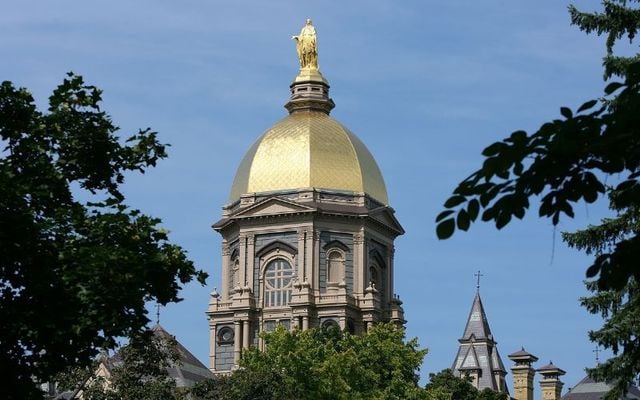
Notre Dame is a wonderful place to teach Irish American history.
The topic fascinates students, many of whom take great pride in their Irish heritage.
The place also stands as a living monument to the rags-to-riches narrative that animates much of Irish American identity.
For many Irish Americans, the nickname “the Fighting Irish” epitomizes the mythic story that many believe defines the group. Once a term of derision, “fighting Irish” now resonates as a point of pride.
Notre Dame also holds surprises. When I was preparing a lecture on Éamon de Valera’s visit to the university during his 1919 American tour, I discovered that on the stop he viewed the Civil War sword of Thomas Francis Meagher.
Known as a leader of the failed Young Irelander rising of 1848, Meagher championed a republican movement that sought to free Ireland by any means necessary.
For his efforts, “Meagher of the Sword,” as he is remembered in Ireland, escaped the hangman’s noose only to be exiled in Van Diemen’s Land. Eventually, he was smuggled on board a ship, reaching San Francisco to a tumultuous welcome, before making his way to New York. Here, in the wake of Bull Run, he would found the famous Irish Brigade.
Famine immigrants
Meagher saw no contradiction in fighting for the Stars and Stripes and fighting for Ireland. He believed, as did famine immigrants, that the cause of American freedom was Ireland’s as well.
Like the United Irish émigrés who flocked to American cities in the 1790s, Meagher believed that the true republican was at home in both nations. After the war, General Meagher became first territorial governor of Montana, a place awash in Irish immigrants. Senator Thomas Walsh of Montana presented the sword to the university in 1914.
So when de Valera laid eyes on that sword at Notre Dame a little more than 50 years after Meagher had brandished it in battle, he was gesturing toward what he regarded as a vital relationship between Irish and American freedom, one that the American-born de Valera epitomized.
When he visited places like Notre Dame, he was traveling as President of the Irish Republic fighting for its freedom. But he was also journeying through his homeland – a different country, to be sure, but one that Irishmen and women had fought for.
Debt for freedom
In many ways, as he was touring the country to raise funds and the visibility of the Irish cause for independence, he came looking for America to repay a debt for freedom that the United States owed to Ireland. Americans were happy to pay, none more so than the jubilant students at Notre Dame.
So moved was he by his time at Notre Dame that de Valera considered it the high point of his American tour. Although no one knows the exact origins of the nickname “the Fighting Irish” – perhaps newspapermen coined the term, maybe anti-Catholic bigots, or students themselves in reference to Meagher’s men and the Fighting 69th of World War I – it is no mere coincidence that the term gained general currency in the 1919 football season in the wake of de Valera’s visit.
He was, after all, the most celebrated fighting Irishman in America at the time.
I was astonished to learn that Notre Dame owned the sword of “Meagher of the Sword.” But I could not find it. Eventually, I did. It lay stored in a gray box on the sixth floor of the library’s archives. Archivists were not to be blamed; rather, it seemed the significance of the sword had somehow gone missing. Notre Dame, after all, was more Irish American – with an emphasis on American – than Irish by the turn of the twenty-first century.
I found more. Notre Dame also owned a flag of the famed Irish Brigade.

Love Irish history? Share your favorite stories with other history buffs in the IrishCentral History Facebook group.
The New York 63rd
Like the sword, the flag was nowhere to be found. I later discovered that it had been exhibited from time to time but was held for the moment in an off-campus storage facility.
The flag, referred to as the Second Irish Colors, was made by Tiffany and Co in 1862 and presented to Meagher by a group of merchants from New York. On it is emblazoned the name of one of the regiments of the Irish Brigade: the New York 63rd.
Along with the famed 69th, which would gain further renown in the First World War as “the Fighting Irish,” the brigade comprised New York’s 88th, as well as regiments from Pennsylvania and Massachusetts. By the time the Second Colors were commissioned, the first flag had been shredded but never surrendered in some of the bloodiest fighting of the Civil War.
The Irish Brigade had distinguished itself in the Peninsula Campaign, and the green flag came to be feared by rebels. In fact, after only a few months, Meagher’s men earned the reputation as the shock troops of the Army of the Potomac, leading Abraham Lincoln to visit Meagher’s camp and kiss the Second Colors.
The brigade went on to win fame – and court death – at Antietam and Fredericks-burg. Here, on one afternoon it lost almost two-thirds of its men. By the time the brigade fought on the second day at Gettysburg in the Wheatfield, it was a shell of itself.
St. Patrick's Day
The flag of the 63rd was to be used for ceremonial purposes, such as when the remnants of the brigade marched in the Grand Review in Washington following the North’s victory in the war and in New York during St. Patrick’s Day.
Father William Corby, Holy Cross priest, chaplain to the Irish Brigade, and eventually President of the University of Notre Dame, secured the flag for the university. He hoped all the flags of the brigade would find a home at Notre Dame because of its connection to the brigade, its central location, and its growing stature within Irish America. de Valera also viewed this flag as he toured Notre Dame.
Like the sword, the flag also speaks to the real and durable connections between Ireland and America. In June 1963, when John F. Kennedy made his triumphal tour of Ireland – where he was first welcomed by President de Valera – he formally addressed the Dáil in Leinster House.
Here, he presented the Irish Parliament with the Second Irish (Tiffany) colors of the Fighting 69th. An exact replica of Notre Dame’s flag, the colors Kennedy presented adorn the walls of Leinster House to this day.
Ideal of 'freedom'
Kennedy gave the flag to the Irish in grateful recognition for all they had done for the cause of American freedom, a history that Kennedy was eager to recount. He knew that one-third of the Continental Army under Washington was Irish, leading a British commander to lament “we have lost America through the Irish.” Kennedy also knew of the exploits of the Irish Brigade.
In his address to the Dáil, he regaled TDs with the role Meagher had played in American history. He also talked of an ideal of “freedom” that united Ireland, America, and the Western world. Visiting Ireland just after he made his trip to Berlin, where he famously announced “Ich bin ein Berliner,” Kennedy declared that the people behind the wall should remember the “Boys of Wexford,” who had fought for freedom in 1798.
The bonds that both the flag and sword represented were not lost on Kennedy. The great-grandson of eight famine immigrants, Kennedy joked that if Ireland had not had to fight for its freedom, he – if lucky – might be sitting with his audience in the Dáil, and if de Valera had never left New York, he – not Kennedy – might be addressing the Dáil as President of the United States.
Like de Valera had a generation earlier, Kennedy had traveled the ocean as a self-proclaimed apostle of liberty. The flag, then, suggested the continuing significance of the bonds between Ireland and America, nations that had helped each other become free and that now, according to Kennedy, faced a common Communist threat.
The story does not end here. In 2008, as the outgoing Taoiseach Bertie Ahern made his farewell trip to Washington, he presented the Congressional “Friends of Ireland” cohort with one of Meagher’s Irish swords. This sword belonged to the city of Waterford, Meagher’s hometown.
Closing a historical circle
Ahern handed the sword first to Senator Ted Kennedy. In doing so, he was recognizing the role Kennedy had played in the peace process as well as Notre Dame’s Fighting Irish history. Without American support, Ahern argued, the Good Friday Agreement would have never come to be. Just as they had in the days of de Valera’s trip, Americans had once more come to the aid of the Irish. But Ahern also pointed to the past when Ted’s brother had presented the Irish with one of his nation’s treasures.
Ahern saw the presentation as closing a historical circle. An American flag decorated with Irish symbols would hang in Ireland’s Leinster House. And an Irish sword with American echoes would grace the halls of the American capitol. Ahern’s gift restored balance to the past, ending a chapter.
His gesture, of course, says a great deal more. It also speaks to the continuing and evolving significance of Ireland in the American story and of America in the Irish story, a transatlantic experience defined by the gift-giving of presidents and taoiseachs, the sacrifices of ordinary men and women, and the viability of Irish American history at places like Notre Dame.
* Originally published in 2009. Last updated in Dec 2024.
Comments