The ancient Celts, the people who lived in Britain and Ireland from 500BC to 400AD, considered their Celtic symbols and signs to hold incredible, meaningful power in their lives.
The stories behind their Celtic symbols have been carried on from generation to generation with the help of bards and storytellers, allowing their heritage to live on.
Even though the lack of written history means that Celtic symbolism is open to interpretation, the meanings are fairly evident.
The relevance and significance of the Celtic symbols are timeless; themes of love, loyalty, energy, wisdom, and war are very much alive today.
So tap into the nature and energy of the Celts, and learn about the language of Celtic symbols.
Irish Harp
The traditional symbol of Ireland, the harp is said to reflect the immortality of the soul. The musicians of ancient chieftains played the harp, and it remains one of the most popular Celtic instruments today. You’ll find the harp everywhere in Ireland, from coins, uniforms, and the state seal to the Guinness pint glass.
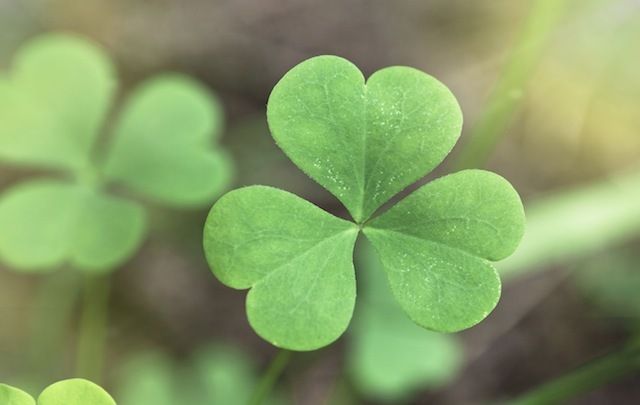
Shamrock
The Celtic symbol for luck and the unofficial, yet the most recognizable symbol of Ireland. The shamrock is a single-stemmed plant with three leaves and grows on the hills of Ireland. The shamrock is everywhere: postcards, t-shirts, cereal boxes, you name it – if it’s “Irish,” there’s typically a shamrock involved. The shamrock was made famous by St. Patrick, the Patron Saint of Ireland. Legend tells that he used the shamrock’s three leaves to help explain the Holy Trinity to the pagans during his mission to bring Christianity to Ireland.
Claddagh
The heart represents timeless love, the crown represents loyalty and fidelity, and the hands represent friendship.
Tricolour Flag
The Irish Flag has three vertical stripes, from left to right: green, white and orange. The flag was first used in 1848 and symbolizes hope and political peace. The green represents the Catholic population of Ireland, while the orange represents Irish Protestants. The middle stripe of white symbolizes a wish for harmony and unity between the two.

Love Irish history? Share your favorite stories with other history buffs in the IrishCentral History Facebook group.
Celtic Cross
The Celtic symbol for Christianity combines the traditional Christian cross with a ring through the cross’s intersection. Also referred to as the High Cross, the Irish Cross, and the Cross of Iona. The ring is considered a solar symbol of energy, a life source.
Celtic Tree of Life
Oneness with nature. The Celts had many tree symbols. Birch signifies youth, beginnings, and renewal. Ash signifies connection, wisdom, and surrender. Heather stands for dreams, romance, and feelings.
Celtic Horse
The horse is the Celtic symbol for victory at war. The Celtic horse-goddess Epona was known as the “Great Mare.”
Celtic Dragon
A mythical creature thought to be a Celtic symbol of fertility and power. It was believed that the dragon was created when the first living cell was born from the earth, and the sky fertilized it with the wind and water. Because of this, the dragon is associated with seasonal fertility and the energies of the earth. Christians later associated the dragon with Satan, and pagan evil.
This article was originally published in Ireland of the Welcomes magazine. Subscribe now!
Celtic Serpent
Celtic symbol for rebirth, healing, and wisdom, due to its cyclical shedding of its skin. The serpent was considered an immortal creature that came to life each year with a new skin. The Celts believed serpents slithered up from the inside of the earth, and they held all of the world’s secrets and divine wisdom. The serpent was the Celtic people’s “Earth Healer,” but later turned into the Christian symbol for the devil and paganism.
Celtic Hounds
Guardian figures and sources of healing power. Hounds are associated with various Celtic gods and goddesses, including the famous Irish mythological hero Cúchulainn. In ancient Celtic Ireland, hounds were given as gifts to honorable men, and many warriors and chiefs took the name as a title (as in “Hound of Culann”) to demonstrate their loyalty and courage.
Celtic Birds
This Celtic symbol stands for freedom and transcendence. Birds have the power to soar up into the heavens, and so they represented the liberation of the human soul. Birds were thought to bring messages of guidance and prophecy from the gods down to the earth, making them mediators between humans and the heavens.
Irish Ogham Alphabet
A gift from the Celtic god Ogmios, or the god of eloquence. The true origin of the alphabet remains a complete mystery.
Celtic Knots and Spirals
The knots and spirals with never-ending lines symbolize the Celts’ beliefs in eternal life and in humans’ complex relationship with the natural and the divine.
Triquetra aka the Trinity Knot
The most common knot. Unity and trinity of soul, heart, and mind. Three distinct yet interlocked levels: physical, mental, and spiritual.
Love this living art from Co. Sligo, a woodland Trinity Knot. More info http://t.co/aVCvzTzYQJ pic.twitter.com/e5ZCuxysG3
— Irish Archaeology (@irarchaeology) September 23, 2015
Triskelion
Like the trinity, the spiraled triskelion, or triskel, stands for unity of the three. In the case of Celts, this is the physical, mental and spiritual. It also symbolizes the eternal life, the flow of nature, and spiritual growth.
Triskelion https://t.co/ZZsMnOEZ2f #Symbolism pic.twitter.com/5Lj3rMZADk
— Phoenix Trilogy (@GoldHardShell) August 30, 2015
Triple Spiral
The triple spiral of life shows the continuity of life, and how it travels in cycles. As with the triskel, the existence of “the three” stands for mind, body, spirit; birth, death, rebirth.
http://t.co/dkaX1LcnTF Love this triple-spiral��❤️������ pic.twitter.com/35SxpsLoPN
— CharlieⓂ️ (@charm972) April 4, 2015
Tuim Knot
An interweaving, diamond-shaped knot that represents the four seasonal lunar holidays and the four elements: earth, air, fire, and water.
We love this Celtic Tuim Knot Necklace | The perfect gift for her http://t.co/E0a3KXF9aC pic.twitter.com/b0AoXuNiBP
— MyGiftClues.com (@MyGiftClues) August 7, 2015
Wheel of Being
The five-fold pattern, also known as the Wheel of Balance, is made up of four circles united by a fifth circle in the center. The structure stands for four powers or elements balanced by a fifth. The Druidic universe consisted of four Powers united by a fifth Balance.
* Originally published in 2013, updated in May 2023.
Comments