
On the eve of the 1916 Rising, Michael Mallin played the flute in the four-piece Workers’ Orchestra during a recital for the Irish Citizen Army in Dublin’s Liberty Hall. The next morning, Easter Monday, the planned rebellion began and Mallin commanded a garrison in St Stephen’s Green and, later, the College of Surgeons. As he prepared to lead out his men, Mallin, father to four young children and husband to a pregnant wife, turned to James O’Shea and, foreseeing his end, said: “We will be dead in a short time.”
Many of the 1916 leaders, including James Connolly, Patrick Pearse and Eamon de Valera, are seen as founding fathers of the Irish State. But Mallin, who became Chief-of-Staff – and second-in-command to James Connolly – of the Irish Citizen Army and was executed by firing squad for his role in the Rising, has been relegated to a footnote.
In a new biography – the first in a projected 16 Lives series by the O’Brien Press to publish biographies, between now and the centenary, of all 16 men executed after the Rising – historian Brian Hughes offers a vivid insight into a forgotten figure.
Short and dapper, Michael Mallin was a music teacher, devout Catholic and teetotaler who spoke in a gentle voice. He loved reading the history of South American and ancient Europe as well as the novels of Joseph Conrad. But he was also strict, impatient and frustrated by those whose commitment and discipline fell short of the high standards he set for himself. He had a strong sense of right and wrong, disliked swearing and his political and religious beliefs were easily offended.
Mallin was born in a tenement in the Liberties area of Dublin in 1874 at a time when whole families frequently lived in a single room. At 14, he joined the British army. While serving in India, his political beliefs changed dramatically. He began to sympathise with the rebels the British army were fighting and, in parallel, he believed that British rule in Ireland could only be removed by physical force.
Back in Dublin at the turn of the century, Mallin worked in various jobs – including setting up a chicken farm and opening a cinema – but his time as a silk weaver proved most significant. As secretary of the Silk Weavers’ Trade Union, he helped them strike for four months until their demands were met.
hortly after, James Connolly appointed Mallin as Chief-of-Staff of the Irish Citizen Army, set up to defend striking workers against the Dublin Metropolitan Police (DMP).
Mallin’s exclusion to the margins of the Rising’s history partly stems from two factors. The first relates to his failure as a garrison leader. Occupying St Stephen’s Green, an open park with almost no shelter, was militarily questionable but ordering his men to dig trenches – possibly influenced by newsreel from the first World War – was pure folly.
Worse, Mallin didn’t attempt to take the nearby Shelbourne Hotel. When the British occupied this building, they pounded the rebels in the Green and Mallin retreated to the College of Surgeons. But, barely one week after the start of the Rising and subdued by the British onslaught, Mallin surrendered – breaking down as he read the order.
Like most of the other garrisons, as Mallin’s men were marched to Dublin Castle by British soldiers they were jeered by Dublin citizens outraged by this attack on their city in what was seen as a cowardly betrayal of Irish men fighting on the Western Front. (By 1918, over 200,000 Irish men would fight and almost 30,000 would lose their lives in the first World War.) On Grafton Street, an angry mob attacked Mallin’s garrison and a British officer threatened to shoot the protesters before they finally withdrew.
On May 5 1916, Michael Mallin’s field general court martial took place. His conduct during this is the second reason the Dubliner has been largely written out of Irish history. During his defence, Mallin claimed that he had no prior knowledge of the Rising; that, when he arrived at the Green, Countess Markievicz ordered him to take charge of the garrison.
This was a blatant fabrication: Markievicz was, in fact, Mallin’s deputy in the Green (she actually wore an old Citizen Army tunic of Mallin’s). In a desperate attempt to avoid the death sentence, Mallin probably reasoned that the British would not, because of her gender, shoot Markievicz but it was a very risky gamble and, as Hughes suggests, “particularly dishonourable”.
In September 1916, under the headline “Destitution Killing Irish”, the New York American newspaper published a letter written by Mallin, on the evening before his execution, to Alderman Thomas Kelly.
he article aimed to raise funds in the US for the dependants of those killed during the Rising and the letter places Mallin’s treacherous behavior during his court martial in context.
“I have left my wife and children absolutely destitute,” he writes inconsolably, and Hughes argues that this was Mallin’s primary motivation in seeking to mislead the jury. While the letters of more celebrated 1916 leaders, written as they awaited the firing squad, emphasize their commitment to die for Ireland, Mallin’s reek of a humanity and awareness informed by the burden of his imminent death on his family.
Before his execution at Kilmainham Gaol in the early morning of May 8th, Mallin wrote to his wife that “this is the end of all things earthly” and touchingly enclosed the buttons of his tunic. The letter profoundly shaped the lives of his young son and daughter. Mallin asked his wife to dedicate Joseph and Una to the church and they subsequently joined the Jesuit and Loreto order, respectively.
If you take a train through south Dublin, you’ll pass Dun Laoghaire railway station. The station is officially called ‘Mallin Station’ but, tellingly, this title is almost never used. In a compassionate biography, Brian Hughes helps bring an unfairly neglected figure of Irish history alive on the page.
‘Michael Mallin’ is available from the O’Brien Press website
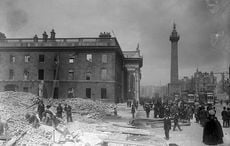
British soldiers opposite Liberty Hall after the suppression of the Rising. A flute, believed to have been played by Mallin before the Rising, was found in Liberty Hall when the building was searched by British soldiers. Credit: Lorcan Collins.
Comments