News


Uncovered remains likely to be victims of the Great Famine


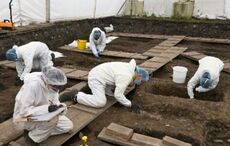
Workers of a public water project in north Galway have uncovered the skeletal remains of what are likely be victims of the Great Famine.

Guinness PubFinder Ad

Workers of a public water project in north Galway have uncovered the skeletal remains of what are likely be victims of the Great Famine, according to the Irish Independent.

Archaeologists were called in to examine the skeletons of up to a dozen people after contractors of the Tuam Public Water project found the remains close to where an old workhouse stood, on the Athenry Road on the outskirts of Tuam town.

Although a Victorian graveyard is located across the road, the indications are that the remains are probably linked to the workhouse, which was built to accommodate the starving local population in the late 1840s. It was demolished around 1970 for a local housing estate.

________________

READ MORE:

Homeless teen makes semi-finals of Intel national science contest

Meryl Streep gives amazing performance as Margaret Thatcher -- Iron Lady, warts and all, exposed in new biopic

Beara, West Cork - Ireland’s most beautiful landscape? - PHOTOS
___________________

The neatly arranged skeletons were found in a contained area and have all appeared to have been buried in coffins in a north-south direction.

"Most Christian burials saw the bodies laid in an east-west direction, so we are not sure why they are lying like this," Galway County Council archaeologist Finn Delaney told the Irish Independent.

The team of archaeologists has only just started excavating the remains.

Nster.com


17 Comments

See all comments

mamaginnty.Pure poetry you speak.You're not the long lost daughter of Peig Sayers are you?;))
In just 4 years, picture it. weekly dozens of men women and children dying on the roadside, no food and no home for many. Go into months, and it is in the hundreds, men women and children dead on the roadsides, then into that few years, it is into the thousands, of men women and children dead on the roadsides Now picture the ship loads of food that was being taken out of Ireland weekly monthly and yearly while over a million died a horrible death and weep for Ireland
That American maize was also not good nutritional quality and there was not much of it.The British government's efforts were concentrated primarily into creating employment.They continued Peel's work schemes (the Board of Works) although with the restriction that the cost had to be entirely met through local rates. The pay was low: 8 to 10 pence per day, which was not nearly enough to support a family,and the payment was often delayed.Joycean it wasn't so much that they didn't know how to cook it.The sh*t was rock hard and took hours to soften.When they got a bit the problem was they were soooo demented and out of their mind with hunger that they couldn't stop themselves eating it before it was soft.I can prove this point to anyone who is willing to eat one meal every two or three days for 6 months.I'll give you a bag of uncooked maize then and we'll see how long you leave it to cook.
rachelau, I have read that the exports went to England, to feed workers living in cities during the Industrial Revolution. In the 1840s in the Southern United States, the only part of the US where there were slaves, slaves primarily worked on plantations, large, self-sufficient farms. The farms grew enough food to feed everyone living on them, including the slaves. There would have been no reason to import food from Ireland. In fact, during the Famine, the US exported food to Ireland to help with the Famine, but the food they exported was corn (maize), and the Irish became very ill from it because they did not know how to cook it. Even today, Europeans think maize is animal food, while Americans love it.
Dano.I know Catholics played a part.But it was a very small part.There is a lot people don't realise about the famine.People often say why didn't they live on the abundance of fish on the coast.The answer is quite simple.They had small boats and if you had a few week of rough weather where you could not fish or the catch was poor.They ended up selling their nets to feed the family for a day or two.Most didn't even have boats or lived 10 miles inland where the 20 mile round trip consumed more calories than it was worth at times.When it came to land the law stated a Catholic farmer had to divide the land up evenly among all his sons.If a son became a Protestant he got all the land.That's why the farms got smaller and smaller.A son might get half an acre and the family were in fact were better fed than the families in industrialized English towns as long as the spud held up.It would have been natural to stick with family for support rather that move east.The population rise was no different to the rest of Europe at the time.Dano your understanding of the relationship between Catholics OR Protestants when it came to the poor is flawed.The RICH didn't care about the poor Catholic OR Protestant.It didn't enter their minds to help because they had the same religion.Dano their really wasn't a middle class of any size until the 20th century.
Cont)A French guy (Gustaft de Beumont *spelling??)traveled Ireland in the early 1840's and this is what he said.In every country you will see paupers but Ireland is a whole nation of paupers.In Skibbereen you had one bed for every 450 people.The people slept on straw.On the west coast there wouldn't even have been well off Catholics.Even some Protestant landlords went broke trying to help.Most didn't help though and bad landlords evicted which meant death to the family.Going to the workhouse was as good as death because of disease.The thing is Dano the Catholics couldn't have made matters worse.Nor would they have had money enough to help.It was so bad.They were to few.The export of food should have been stopped by the British Government but it wasn't.At that point in history the blame for Irelands ills can be laid firmly with the British Government and it's policy towards Ireland.That's not been a little fanciful.It's a fact.I could go into a lot more detail to prove this.On the other hand recent events are not the British Governments fault.But I do believe recent events are a product of the famine and the long term extremely vicious colonialism.According to writings directly after the famine.Irish good will towards each other died to a large degree.It set up a hardness and a mé féinism and begrudgery in the Irish mind that was handed down through the generations to this day in both Irish Catholics and to a much lesser degree Protestants but who felt marginalized after independence.
There never was a Famine in Ireland The CROPS were sent to the united STATES to feed the slaves it was better to keep them fed because they would work for the plantion owner's. the Irish refused to turn from thier reglion to please THE MONSTER cromwellmblood flowed through the streets of Dublin of the women and children.
Sirpete - I am not seeking to excuse the actions of the predominantly Protestant landlord class in this. But there were others who played a smaller part, including the Catholic middle classes. The Poor Laws laid the responsibility of supporting the poor on the local area, and they had to strike a rate to raise funds. It was in their interest to keep these rates small. The population of Ireland had increased from about a million in 1600 to by 1841 over eight million. By that time half a million Irish farms were smaller than 15 acres and almost two hundred thousand holdings were smaller than five acres. The west of the country, where there was less arable land, was the most densely populated. (Mayo in the west had 475 people to the square mile: Kildare, near Dublin, 187.) So the serious overpopulation, and lack of action by their fellow Catholics, helped to make matters worse, imo. If you want to believe the simplistic scenario that all Irelands ills can be laid at the door of the protestants/English/orange , as you frequently state, and without this you would live in Elysium, that is a little fanciful…as more recent events have shown.
I read a book called "Famine" by Liam O'Flaherty, a work of fiction. After reading it, I did not seem to care as much about actual facts because I felt that I knew just how it was. Mr.O'Flaherty had very good resources. These coffins are a mystery, I do not think very many,if any, found a coffin when they died.
Ta ceart agat, a Dhomhnaill, agus ta ceart agat, a Pheadar. All is not so neatly bifurcated in the real world that is ours. As the great Mairtin O'Cadhain so ably put it (and pls. excuse poor memory of exact words) "in any village in this world, you'll find both the fella who will give you the food he himself needs to survive, and the fella who would drive nails into the back of the donkey that bore Christ into Jerusalem". (pls. forgive. religious metaphor, but you'll get his point.) is mise, seamus
Very easy Dano.All Catholic-owned land was confiscated in the Act for the Settlement of Ireland 1652 and given to Scottish and English settlers, the Parliament's financial creditors and Parliamentary soldiers. The remaining Catholic landowners were allocated poorer land in the province of Connacht(West Ireland)—this led to the Cromwellian attributed phrase "To hell or to Connacht". Under the Commonwealth, Catholic landownership dropped from 60% of the total to just 8%.The Irish were forced west of the river Shannon Dano.The west could never properly support that amount of people there anyway.Dano there was a boom in church-building but it was AFTER the famine.There was no wide scale cathedral building during the famine worth a damn.The starving flocked to the towns to get a bit of work.Enniscorthy is on the East coast.They died in the West.Relief projects (walls and roads to nowhere) were a drop in the ocean and most were useless projects because the projects were not meant to be of benefit to anybody.Middle-class Catholics guardians taking ORDERS from the stingiest BRITISH Poor Law Unions rules.Your post is very misleading as usual Dano.It was British Protestant law and British Protestant rules and British Protestant exploitation.Red Herrings spring to mind Dano.There were more evictions after the famine that before it.And it wasn't Catholic land they were been evicted from.Profit for the Prods in cattle Dano.
No surprise to see the usual inaccuracies posted about the famine. Whisper it softly, but an entire class of Irish Catholics survived and prospered during the Famine years, witness the scale of church and cathedral building eg ENISCORTHY during the height of the famine, was that the best use of money raised entirely by the catholic community? Many of the guardians presiding over the stingiest Poor Law Unions (Responsible for relief projects etc.) were middle-class Catholics not Protestant landlords. The scale of the famine, and the thought that it would help to clear ‘overpopulated’ areas, mainly in the West, was certainly a factor many in many landlords calculations…The famine was a tragedy, and the poor were exploited by their richer and more powerful neighbours, and landlords, but it’s not as simple as portrayed here. How do you explain that independent Ireland never managed to repopulate the west?
I'm surprised that they were even given coffins...they probably made the poor souls work building them in exchange for the little bit of soup and a cold bed that they were given in the workhouses. And it happened in a country where there was plenty of food, but the English were stealing it all and taking it back to England. I'd have been stealing out of the English barns and larders and raising a rebellion.
Yes it was genocide-albeit by neglect and indifference by a rich Imperial power.Perhaps it was 'ethnic cleansing'long before the expression was coined.England's shame.
When visiting Ireland I took a bus tour through Connamara. The driver pointed out a large field where he said were buried famine victims thrown in a mass grave. All along the area around it were the roads to nowhere where these starving people were put to work to earn a piece of bread. They died all along the road. I cried then and each time I think of it.


Log into IrishCentral with your Facebook account


or sign-in directly

E-Mail:
Password:
 Remember me Forgot my password
Not a member? Register Now!
print this article Print
email this articleE-mail