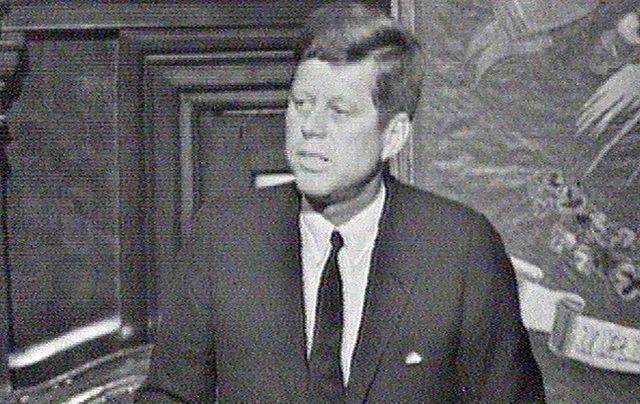
In March 2017, Irish Prime Minister Enda Kenny nominated John F Kennedy’s speech to the Irish parliament during his visit in 1963 as his favorite speech of all time.
Kenny told TheJournal.ie that, “I have always admired President John F Kennedy and often find myself recalling words from some of his many exceptional speeches, such as his address to the Irish Parliament during his historic 1963 visit when he spoke so eloquently in praise of ‘the little ‘five feet high’ nations’ and of the Irish people’s ‘remarkable combination of hope, confidence and imagination.’
"For me, the sentiment contained in that particular speech is as relevant today as it was almost fifty years ago. I believe and trust in the Irish people just as he did then – that our strength of spirit and determination will allow us to overcome any difficulties we may face.”
The full speech delivered by President John F Kennedy to members of the Dáil and the Seanad on 28 June 1963:
Mr. Speaker, Prime Minister, Members of the Parliament: I am grateful for your welcome and for that of your countrymen.
The 13th day of September 1862, will be a day long remembered in American history. At Fredericksburg, Maryland, thousands of men fought and died on one of the bloodiest battlefields of the American Civil War. One of the most brilliant stories of that day was written by a band of 1,200 men who went into battle wearing a green sprig in their hats. They bore a proud heritage and a special courage, given to those who had long fought for the cause of freedom. I am referring, of course, to the Irish Brigade. General Robert E. Lee, the great military leader of the Southern Confederate forces, said of this group of men after the battle: “The gallant stand which this bold brigade made on the heights of Fredericksburg is well known. Never were men so brave. They ennobled their race by their splendid gallantry on that desperate occasion. Their brilliant, though hopeless, assaults on our lines excited the hearty applause of our officers and soldiers.”
Of the 1,200 men who took part in that assault, 280 survived the battle. The Irish Brigade was led into battle on that occasion by Brigadier General Thomas F. Meagher, who had participated in the unsuccessful Irish uprising of 1848, was captured by the British and sent in a prison ship to Australia, from whence he finally came to America. In the fall of 1862, after serving with distinction and gallantry in some of the toughest fighting of this most bloody struggle, the Irish Brigade was presented with a new set of flags. In the city ceremony, the city chamberlain gave them the motto “The Union, our Country, and Ireland Forever.” Their old ones having been torn to shreds by bullets in previous battles, Captain Richard McGee took possession of these flags on September 2nd in New York City and arrived with them at the Battle of Fredericksburg and carried them in the battle. Today, in recognition of what these gallant Irishmen and what millions of other Irish have done for my country, and through the generosity of the Fighting 69th, I would like to present one of these flags to the people of Ireland.The President then unveiled the flag which was in
The President then unveiled the flag which was in position to the left of the dais.
As you can see, gentlemen, the battle honors of the Brigade include Fredericksburg, Chancellorsville, Yorktown, Fair Oaks, Gaines Hill, Allen’s Farm, Savage’s Station, White Oak Bridge, Glendale, Malvern Hills, Antietam, Gettysburg, and Bristoe’s Station.
I am deeply honored to be your guest in the free Parliament of a free Ireland. If this nation had achieved its present political and economic stature a century or so ago, my great grandfather might never have left New Ross, and I might, if fortunate, be sitting down there with you. Of course, if your own President had never left Brooklyn, he might be standing up here instead of me.
This elegant building, as you know, was once the property of the Fitzgerald family, but I have not come here to claim it. Of all the new relations I have discovered on this trip, I regret to say that no one has yet found any link between me and a great Irish patriot, Lord Edward Fitzgerald. Lord Edward, however, did not like to stay here in his family home “because,” as he wrote his mother, “Leinster House does not inspire the brightest ideas.” That was a long time ago, however. It has also been said by some that a few of the features of this stately mansion served to inspire similar features in the White House in Washington. Whether this is true or not, I know that the White House was designed by James Hoban, a noted Irish-American architect, and I have no doubt that he believed, by incorporating several features of the Dublin style, he would make it more homelike for any President of Irish descent. It was a long wait, but I appreciate his efforts.
There is also an unconfirmed rumor that Hoban was never fully paid for his work on the White House. If this proves to be true, I will speak to our Secretary of the Treasury about it, although I hear this body is not particularly interested in the subject of revenue.
I am proud to be the first American President to visit Ireland during his term of office, proud to be addressing this distinguished assembly, and proud of the welcome you have given me. My presence and your welcome, however, only symbolize the many and the enduring links which have bound the Irish and the Americans since the earliest days.
Benjamin Franklin, the envoy of the American Revolution, who was also born in Boston, was received by the Irish Parliament in 1772. It was neither independent nor free from discrimination at the time, but Franklin reported its members “disposed to be friends of America.” “By joining our interest with theirs,” he said, “a more equitable treatment … might be obtained for both nations.”
Our interests have been joined ever since. Franklin sent leaflets to Irish freedom fighters. O’Connell was influenced by Washington, and Emmet influenced Lincoln. Irish volunteers played so predominant a role in the American Army that Lord Mountjoy lamented in the British Parliament: “We have lost America through the Irish.” John Barry, whose statue was honored yesterday, and whose sword is in my office, was only one who fought for liberty in America to set an example for liberty in Ireland.
Yesterday was the 117th Anniversary of the birth of Charles Stewart Parnell —whose grandfather fought under Barry and whose mother was born in America—and who, at the age of 34, was invited to address the American Congress on the cause of Irish freedom. “I have seen since I have been in this country,” he said, “so many tokens of the good wishes of the American people toward Ireland…” And today, 83 years later, I can say to you that I have seen in this country so many tokens of good wishes of the Irish people towards America.
And so it is that our two nations, divided by distance, have been united by history. No people ever believed more deeply in the cause of Irish freedom than the people of the United States. And no country contributed more to building my own than your sons and daughters. They came to our shores in a mixture of hope and agony, and I would not underrate the difficulties of their course once they arrived in the United States. They left behind hearts, fields, and a nation yearning to be free. It is no wonder that James Joyce described the Atlantic as a bowl of bitter tears, and an earlier poet wrote: “They are going, going, going, and we cannot bid them stay.”
But today this is no longer the country of hunger and famine that those immigrants left behind. It is not rich and its progress is not yet complete, but it is, according to statistics, one of the best-fed countries in the world. Nor is it any longer a country of persecution, political or religious. It is a free country, and that is why any American feels at home.
There are those who regard this history of past strife and exile as better forgotten, but to use the phrase of Yeats: “Let us not casually reduce that great past to a trouble of fools, for we need not feel the bitterness of the past to discover its meaning for the present and the future.”
And it is the present and the future of Ireland that today hold so much promise to my nation as well as to yours, and, indeed, to all mankind, for the Ireland of 1963, one of the youngest of nations, and the oldest of civilisations, has discovered that the achievement of nationhood is not an end, but a beginning. In the years since independence, you have undergone a new and peaceful revolution, an economic and industrial revolution, transforming the face of this land, while still holding to the old spiritual and cultural values. You have modernized your economy, harnessed your rivers, diversified your industry, liberalized your trade, electrified your farms, accelerated your rate of growth, and improved the living standard of your people.
Other nations of the world in whom Ireland has long invested her people and her children are now investing their capital as well as their vacations here in Ireland. This revolution is not yet over, nor will it be, I am sure, until a fully modern Irish economy fully shares in world prosperity. But prosperity is not enough.
Over 150 years ago, Henry Grattan, demanding the more independent Irish Parliament that would always bear his name, denounced those who were satisfied merely by new grants of economic opportunity. “A country,” he said, “enlightened as Ireland, chartered as Ireland, armed as Ireland, and injured as Ireland, will not be satisfied with anything less than liberty.” And today, I am certain, free Ireland, a full-fledged member of the world community, where some are not yet free, and where some counsel an acceptance of tyranny—free Ireland will not be satisfied with anything less than liberty.
I am glad, therefore, that Ireland is moving in the mainstream of current world events. For I sincerely believe that your future is as promising as your past is proud, and that your destiny lies not as a peaceful island in a sea of troubles, but as a maker and shaper of world peace.
For self-determination can no longer mean isolation, and the achievement of national independence today means withdrawal from the old status only to return to the world scene with a new one. New nations can build with their former governing powers the same kind of fruitful relationship that Ireland has established with Great Britain—a relationship founded on equality and mutual interests. And no nation, large or small, can be indifferent to the fate of others, near or far. Modern economics, weapons, and communications have made us realize more than ever that we are one human family and this one planet is our home. “The world is large,” wrote John Boyle O’Reilly, “The world is large when its weary leagues two loving hearts divide, but the world is small when your enemy is loose on the other side.”
The world is even smaller today, though the enemy of John Boyle O’Reilly is no longer a hostile power.
Indeed, across the gulfs and barriers that now divide us, we must remember that there are no permanent enemies. Hostility today is a fact, but it is not a ruling law. The supreme reality of our time is our indivisibility as children of God and our common vulnerability on this planet.
Some may say that all this means little to Ireland. In an age when “history moves with the tramp of earthquake feet,” in an age when a handful of men and nations have the power literally to devastate mankind, in an age when the needs of the developing nations are so large and staggering that even the richest nations often groan with the burden of assistance— in such an age, it may be asked, how can a nation as small as Ireland play much of a role on the world stage?
I would remind those who ask that question, including those in other small countries, of these words of one of the great orators of the English language:
All the world owes much to the little “five feet high” nations. The greatest art of the world was the work of little nations. The most enduring literature of the world came from little nations. The heroic deeds that thrill humanity through generations were the deeds of little nations fighting for their freedom. And, oh, yes, the salvation of mankind came through a little nation.
Ireland has already set an example and a standard for other small nations to follow. This has never been a rich or powerful country, and, yet, since earliest times, its influence on the world has been rich and powerful. No larger nation did more to keep Christianity and Western culture alive in their darkest centuries. No larger nation did more to spark the cause of American independence, and independence, indeed, around the world. And no larger nation has ever provided the world with more literary and artistic genius.
This is an extraordinary country. George Bernard Shaw, speaking as an Irishman, summed up an approach to life: “Other peoples,” he said, “see things and say: `Why?’ … But I dream things that never were—and I say: `Why not?”’
It is that quality of the Irish, the remarkable combination of hope, confidence, and imagination that is needed more than ever today. The problems of the world cannot possibly be solved by skeptics or cynics whose horizons are limited by the obvious realities. We need men who can dream of things that never were, and ask why not. It matters not how small a nation is that seeks world peace and freedom, for, to paraphrase a citizen of my country: “The humblest nation of all the world, when clad in the armor of a righteous cause, is stronger than all the hosts of error.”
Ireland is clad in the cause of national and human liberty with peace. To the extent that the peace is disturbed by conflict between the former colonial powers and the new and developing nations, Ireland’s role is unique. For every new nation knows that Ireland was the first of the small nations in the 20th Century to win its struggle for independence and that the Irish have traditionally sent their doctors and technicians and soldiers and priests to help other lands to keep their liberty alive. At the same time, Ireland is part of Europe, associated with the Council of Europe, progressing in the context of Europe, and a prospective member of an expanded European Common Market. Thus Ireland has excellent relations with both the new and the old, the confidence of both sides and an opportunity to act where the actions of greater powers might be looked upon with suspicion.
The central issue of freedom, however, is between those who believe in self-determination and those in the East who would impose upon others the harsh and oppressive Communist system; and here your nation wisely rejects the role of a go-between or a mediator. Ireland pursues an independent course in foreign policy, but it is not neutral between liberty and tyranny and never will be.
For knowing the meaning of foreign domination, Ireland is the example and inspiration to those enduring endless years of oppression. It was fitting and appropriate that this nation played a leading role in censuring the suppression of the Hungarian Revolution, for how many times was Ireland’s quest for freedom suppressed only to have that quest renewed by the succeeding generation? Those who suffer beyond that wall I saw on Wednesday in Berlin must not despair of their future. Let them remember the constancy, the faith, the endurance and the final success of the Irish. And let them remember, as I heard sung by your sons and daughters yesterday in Wexford, the words: “The boys of Wexford, who fought with heart and hand, to burst in twain the galling chain and free our native land.”
The major forum for your nation’s greater role in world affairs is that of protector of the weak and voice of the small, the United Nations. From Cork to the Congo, from Galway to the Gaza Strip, from this legislative assembly to the United Nations, Ireland is sending its most talented men to do the world’s most important work—the work of peace.
In a sense, this export of talent is in keeping with a historic Irish role. But you no longer go as exiles and emigrants but for the service of your country and, indeed, of all men. Like the Irish missionaries of medieval days, like the wild geese after the Battle of the Boyne, you are not content to sit by your fireside while others are in need of your help. Nor are you content with the recollections of the past when you face the responsibilities of the present.
Twenty-six sons of Ireland have died in the Congo; many others have been wounded. I pay tribute to them and to all of you for your commitment and dedication to world order. And their sacrifice reminds us all that we must not falter now.
The United Nations must be fully and fairly financed; its peace-keeping machinery must be strengthened; its institutions must be developed until some day, and perhaps some distant day, a world of law is achieved.
Ireland’s influence in the United Nations is far greater than your relative size. You have not hesitated to take the lead on such sensitive issues as the Kashmir dispute, and you sponsored that most vital resolution, adopted by the General Assembly, which opposed the spread of nuclear arms to any nation not now possessing them, urging an international agreement with inspection and control, and I pledge to you that the United States of America will do all in its power to achieve such an agreement and fulfil your resolution.
I speak of these matters today not because Ireland is unaware of its role, but I think it important that you know that we know what you have done, and I speak to remind the other small nations that they, too, can and must help build a world peace. They, too, as we all are, are dependent on the United Nations for security, for an equal chance to be heard, for progress towards a world made safe for diversity. The peace-keeping machinery of the United Nations cannot work without the help of the smaller nations, nations whose forces threaten no one and whose forces can thus help create a world in which no nation is threatened.
Great powers have their responsibilities and their burdens, but the smaller nations of the world must fulfill their obligations as well. A great Irish poet once wrote:” I believe profoundly in the future of Ireland, that this is an isle of destiny, that that destiny will be glorious, and that when our hour has come we will have something to give to the world.”
My friends, Ireland’s hour has come. You have something to give to the world, and that is a future of peace with freedom. Thank you."

Comments