The Irish-American Heritage Archaeological Program is a collaborative effort between the Center for Irish Partnerships at UMass Lowell and the Centre for Archaeological Fieldwork at Queen’s University Belfast. On Wednesday July 18th, the Center for Irish Partnerships at UMass Lowell held a fundraiser to benefit the Irish-American Heritage Archaeological Program at the home of Co-Director Ann Marie Hurley in Lowell.
Dr. Brian Mitchell, former President of Bucknell University and author of the Paddy Camps, was in attendance and spoke at the event.
"This archeological dig near St. Patrick's Church is important because we do not have written records, by and large, to reconstruct what it was like at the point where the paddy camps of clannish laborers became the acre neighborhood of Irish Lowell. Lowell was the home to one of the first permanent Irish American communities of size and it became the largest planned industrial city in antebellum America. We can learn much from the material culture record left behind in the artifacts that are uncovered. These clues, when pieced together, unlock valuable knowledge about how immigrant communities take shape in America. St. Patrick's Church became the symbol for the new neighborhood, full of Irish families in the pre-Famine period whose sons would build the mills and power canals while their sisters replaced the Yankee farm women who made utopian Lowell famous as the great American experiment in paternal capitalism. Their story is that of a post revolutionary America coming of age as society evolved from an agricultural work rhythm to an industrial work cycle that is changing only today. The archeological dig is important because it is the story of how America happened and the critical role that the Irish played in its development."
The event on Wednesday evening helped to raise almost $10,000. In addition to supporting the visit of the team from the Centre for Archaeological Fieldwork at Queen’s University to excavate at St. Patrick’s Church this week, these funds will enable UMass Lowell’s three student participants, Ami Krawczyk, Katie Henckler and Marcelle Durrenberger, to travel to Northern Ireland to participate in a week of excavation at the Cummiskey Homestead in Crossan, Co. Tyrone.
This program enables students to gain a deeper understanding of the life of the Irish before and after the Great Irish Famine and the role played by the Irish in the development of America during the 19th century. It also provides students with a unique opportunity to participate in a global program that will increase their understanding of a particular moment, the period in which it belongs, and their knowledge of the archaeology of the region in which it is set.
Program sponsors included The Lowell Memorial Auditorium, The Old Court , The UMass Lowell Inn & Conference Center, The Massachusetts Medical Device Development Center, Amy and Jim Regan and The UMass Lowell Office of Community and Cultural Affairs.
In addition, we received an excavation sponsor on Monday night from Eastern Minerals courtesy of Shelagh Mahoney and Joe McNamee.
For more information and up to date news on the Irish-American Heritage Archaeological Program, check out a blog written by St. Patrick’s Parish archivist and historian, Dave McKean, click here .
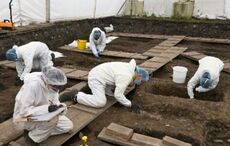
UMass Lowell students will be teaming up with archaeologists from Queen’s University in Belfast, Northern Ireland to dig for Irish history in Lowell. The group has been digging on the grounds of St. Patrick’s Church, once the site of an encampment by the city’s first wave of Irish immigrants. Those early settlers came to Lowell in the 1800s to build the city’s network of canals.
This is the third annual dig conducted by UMass Lowell students under the tutelage of representatives of the Centre for Archaeological Fieldwork at Queen’s University in partnership with UMass Lowell’s Center for Irish Partnerships. So far, the digs have uncovered hundreds of artifacts from life in the encampment at St. Patrick’s in the 19th century, including rosary beads, marbles and oyster shells as well as the remains of a shanty believed to have been home to the parish priest during the same time period.
Following the digging in Lowell, the group will travel to County Tyrone, Northern Ireland, to participate in a second excavation at the site of the Hugh Cummiskey homestead, the leader of the first group of Irish that walked up from Boston to Lowell in 1822 to dig the canals in Lowell.
The excavation at St. Patrick’s has been going very well. Dr. Colm Donnelly, Director of the Centre for Archaeological Fieldwork at Queen’s University who is leading the excavation said “The work that we are doing is building on the historical narrative by bringing an archaeological methodology to play in finding the structures and small things forgotten of the people who lived here in the period from 1822 to 1870.”
The excavation included re-opening a trench that had been excavated in 2011 to try and identify a structure that had been found in the second season of digging. It was determined that the item in question was 4.28 meters deep and would have sat next to the house on the property that belonged to Fr. McDermott.
In addition, the crew continued to find numerous artifacts associated with the period 1822 to 1870 including clay pipes, iron nails, pottery and animal bones. Excavation outcomes will include the dissemination of articles documenting the artifacts and the stories they reveal about the immigrant culture, exhibitions for public viewing, preservation of a National monument and an understanding of how our past impacts our present and the future.
The team will dig daily this week from 10 a.m. to 4 p.m. in Lowell.
Next month, the team will travel to Northern Ireland to dig at the site of the former homestead of Hugh Cummiskey, who led the first group of Irish laborers on the 30-mile walk from Boston to Lowell. The group first dug at the site last summer to gain insight into Cummiskey’s life before he immigrated to the United States.

Comments