Read more: Irish American Civil War hero honored in Montana
The first casualty of the American Civil War which began 150 years ago this week was an Irishman, Private Daniel Hough from Tipperary. He was 36-years old.
Daniel Hough was born in 1825 in Tipperary, Ireland. He emigrated to the US and enlisted in the US Army in October 1849. He remained in the army and was at Fort Sumter in April 1861 at the beginning of the Civil War.
He was one of the Union Army defending Ford Sumter when the Confederates began attacking 150 years ago this week.
An official account of his career states that he was an Irish immigrant who had enlisted in Battery D of the 1st United States Artillery Regiment.
After serving out his enlistment, he re-enlisted on December 6, 1859 at Ft. Moultrie, South Carolina.
This time he was assigned to Battery E, 1st United States Artillery. He was a native of Tipperary, Ireland.
His military record states that he had gray hair, blue eyes, a fair complexion, and was 5 feet, 8 inches tall.
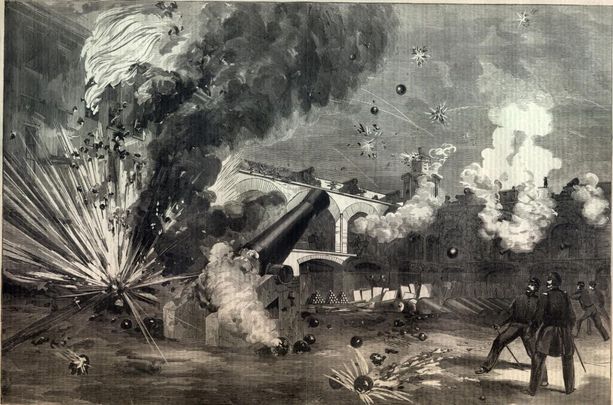
Private Hough was serving as an artillerist, posted at Ft. Sumter, out in Charleston Harbor, when the Civil War began on the morning of April 12, 1861. The garrison put up a spirited defense, and the bombardment lasted until April 14, when the fort's commander, Major Robert Anderson, decided to surrender the fort.
Confederate cannons had launched more than 3,000 rounds during the bombardment, said Rick Hatcher, a historian at Fort Sumter National Monument speaking to the Columbus Republic newspaper.
The cannonballs weighing up to 128 pounds destroyed the the outer walls and the Confederates then lobbed cannonballs heated in furnaces into the interior of the fort.
"They were coming down through the roofs of the barracks buildings and set those buildings on fire," Hatcher said.
The Union Army was offered an honorable surrender and to give a 100-gun salute to the fallen fort.
A cannon fired prematurely on the 47th round, killing Union Pvt. Hough, the immigrant from Tipperary, Ireland — the first death of the Civil War.
Unfortunately the location of his grave is unknown. It is believed that his mother, two sisters, and brother (William) lived in or near New York City in 1861. His family petitioned the US government to have his body returned from South Carolina to New York for a proper burial.
Alas the fate of Private Hough's body is still unclear. His remains were first interred in Ft. Sumter's parade ground shortly after his death. It is possible that he was re-interred in the Ft. Moultrie burial ground on Sullivan's Island nearby.
The location of this cemetery, however, is unknown today. His body may have been taken to the St. Lawrence Cemetery in Charleston. This cemetery has no records concerning Hough, however.
If Hough's remains stayed at Ft. Sumter, it is highly possible that they were destroyed by the heavy
Union bombardments of the fort during the 1863-1865 Siege of Charleston. Approximately seven million pounds of artillery projectiles were fired at the fort over the course of the siege, resulting in extensive damage to the fort.
Major General Abner Doubleday witnessed what occurred that April 14th 1861 when Hough died. ."It happened that some flakes of fire had entered the muzzle of one of the guns after it was sponged. Of course, when the gunner attempted to ram the cartridge down it exploded prematurely, killing Private Daniel Hough instantly, and setting fire to a pile of cartridges underneath, which also exploded, seriously wounding five men. Fifty guns were fired in the salute."
The following day, April 15, President Abraham Lincoln called up 75,000 federal militia members and the civil war began.
Read more: Irish American Civil War hero honored in Montana
16 Comments
-
-
-
-
-
-
-
-
-
-
-
-
-
-
-
-
Switch to the desktop site to post a comment.paddyRanger | Jun 24, 2011, 04:22 PM EDT
JamieLM welld one giving george a history lesson, that fool needs one (more than one)
JosephMaghe | Apr 17, 2011, 05:18 PM EDT
Nicely done. If you are interested in the irish in the American Civil War, check the Facebook page entitled "The Irish in America's Cicvil War Memorial".
jamieLM | Apr 14, 2011, 06:53 PM EDT
GeorgeDillon - I really wasn't trying to give you a history lesson. Right or wrong, at the time, the Federal govt. thought Ft. Sumter belonged to them. It was their point of view that they built it and put soldiers there. Lincoln didn't want it to become a symbol of Confederate independence. The U.S. flag was flown over it in 1865, not the state flag of South Carolina.
GeorgeDillon | Apr 14, 2011, 03:33 PM EDT
jamielm--Thanks, but I don't need a history lesson. The government of South Carolina was quite willing to let the federals keep what theirs, and offered very generous terms in order to avoid bloodshed. But Fort Sumter is and was part of the state of South Carolina. The federals had no business there once they were asked to leave.
jamieLM | Apr 14, 2011, 09:09 AM EDT
GeorgeDillon: Ft. Sumter was a U.S. army garrison and belonged to the Union. The United States didn't want to give up what belonged to them, not to the Confederacy, because it would signal legitimacy of Confederate independence, making the fort a symbol to both North and South. The U.S. flag was raised again over Ft. Sumter on Feb. 18, 1865. @Moonlighter: Many sources confirm the story of a death of a Union soldier at Ft. Sumter caused by the misfiring of a weapon.
Moonlighter | Apr 14, 2011, 01:25 AM EDT
Not true. The only casualty at Fort Sumter was a horse. The first blood shed and casualties of the war took place in Baltimore, Maryland on April 19, 1861. It was called the Pratt Street Riots. Perhaps the horse at Fort Sumter was Irish.
gwen1980 | Apr 13, 2011, 07:27 PM EDT
Typical stupid Tipp man
GeorgeDillon | Apr 13, 2011, 05:42 PM EDT
What was this guy doing in South Carolina anyway? The government of that state had repeatedly asked the Federal forces to evacuate Fort Sumter and turn it over to the state of South Carolina. How come they didn't do so? Hough and his fellows weren't wanted in the Palmetto State.
manhattan | Apr 13, 2011, 01:25 PM EDT
The priest who died at the towers was Father Mychal Judge.
manhattan | Apr 13, 2011, 01:22 PM EDT
The priest who died at the trade center was Father Mychal Judge.
bostonblakie | Apr 13, 2011, 12:55 PM EDT
During Union General Sherman's march to the sea more damage was intentionally inflicted upon SC than any other Confederate state; mainly because of Fort Sumter.
hooligan6a | Apr 13, 2011, 12:10 PM EDT
Does anyone have the name of that priest?
carrickcourt | Apr 13, 2011, 12:00 PM EDT
From the National Geographic book 'Eyewitness to the Civil War' - during the siege of Fort Sumter, "One frustrated Federal, Private John Carmody, defied orders and raced up to onto the parapet, where he fired off several big guns that were already loaded. It was 'Carmody against the Confederate States,' wrote Sergeant James Chester,'and Carmody had to back down , not because he was beaten, but because he was unable, single-handed, to reload his guns.'"
antoman | Apr 13, 2011, 10:49 AM EDT
Well it was hardly going to be an Englishman.Be like slaying one of their own seeing as how the war was engineered by the English Monarchy in a futile attempt to take America back.
srdools | Apr 13, 2011, 10:34 AM EDT
Trealach,don't look for that story to be told here unless the priest was said to have molested a child.
Trealach | Apr 13, 2011, 09:48 AM EDT
On 9/11, while those who could flee the Twin Towers did so, the First person to run INTO the ground floor of the Towers, was an Irish Priest. He died in the tower while ministering to the dying, wounded and dead. May they rest in Peace.