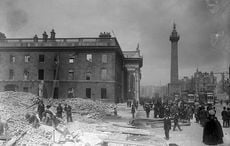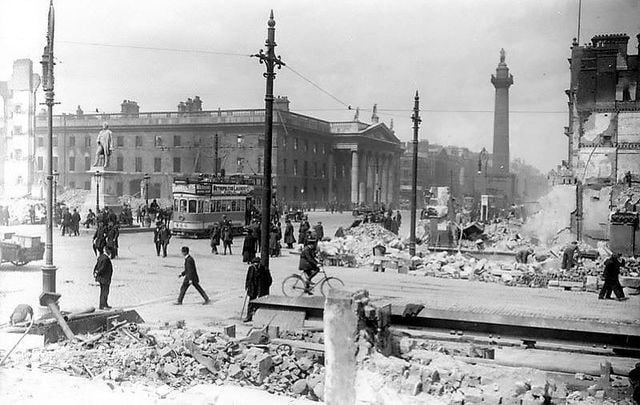
Nearly a century has passed since Ireland’s monumental 1916 Easter Uprising took place on the streets of Dublin. Today, the city still bears many of the scars as a result of the fighting between the Irish and British.
TheJournal.ie shared the expertise from author and Irish military historian Paul O’Brien, and senior lecturer at UCD’s School of Archaeology, Dr Joanna Brück, about the physical scars left by the 1916 Rising in Dublin.
The uprising began on Easter Monday, April 24, 1916. It was on that day that seven Irishmen proclaimed the establishment of the Irish Republic, with themselves as its government, attempting to break away from British rule.
Involved were the Irish Volunteers, led by Pádraig Pearse, the much smaller Irish Citizen Army, led by James Connolly, and members of Cumann na mBan.
The Irish force numbered around 1,600 people and occupied buildings around Dublin’s city centre, buildings that still hold the physical proof of the fighting that is nearly a century passed.
The week-long uprising cost about 1,500 - mostly civilian - lives, and left another 2,000 wounded. It also left its mark upon many spots around Dublin which are still palpable today.
Mount Street bridge and Northumberland Road
O’Brien says that, “One of the biggest battles of the rising happened on that road.
“25 Northumberland Road was occupied by Lt Michael Malone of the Irish Volunteers. The schoolhouse was occupied by another group of volunteers as well.”
The old schoolhouse is still standing today, but has since been converted into The Schoolhouse hotel and restaurant.
The battle there occurred when members of the British 59th North Midlands Division ran into 17 volunteers who were positioned on that street. 214 British soldiers met their deaths.
“They had them in cross fire – the British didn’t know what direction they were coming from or what position the Irish had,” explained O’Brien. “That battlefield is still there bar one building that was burnt down and is now an office block.”
St. James Hospital
While most of the hospital in Dublin 8 is new today, the area around it was the site of “fierce battles,” according to O’Brien.
“It was known as the South Dublin Union. It was a workhouse for the impoverished people. A man called Eamonn Ceannt was one of the Irish Volunteers and occupied the workhouse.
“The battlefield and the majority of the buildings are still there within the modern complex. You can see the nurse’s home; the convent is still there,” said O’Brien.

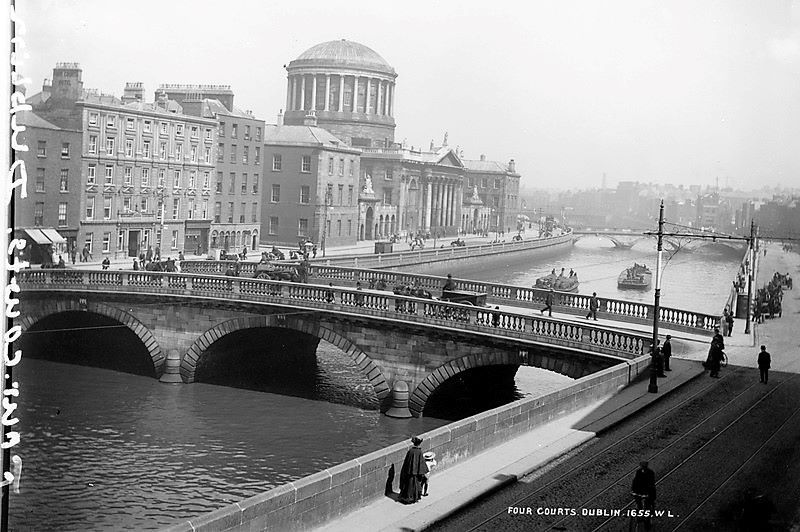
The Four Courts Area
“A lot of it was damaged or destroyed in the civil war – in relation to 1916, many battles took place in streets and alleyways behind the Four Courts,” said O’Brien. The area now is mostly new and rebuilt.
“Urban combat was very new to the British Army, and they had to adapt very quickly to what was happening in Dublin,” said O’Brien.
One of the biggest battles in the area happened at North King St, and involved the Irish Volunteers and the British South Staffordshire regiment. The army suffered heavy casualties at that spot, said O’Brien.
While many of the houses there were knocked down, some originals still remain. The Irish Volunteers occupied a public house at the junction of North King St that was called Reilly’s which is still standing, but under a different name. Similarly, the Capuchin hall, where Comdt Edward Daly set up his headquarters, is also standing.
Also near the Four Courts was a medical mission, where a group of British lancers took shelter after being intercepted making their way up the quays. This building still stands today, but “The whole front of that building is peppered with bullet holes.”
St. Stephen’s Green
Now a bustling hub for Dublin city, St. Stephen’s Green was used to dig trenches during 1916.
“The rebels dug trenches, probably at the four entranceways and other places – the written sources aren’t very specific about where they were.” Dr. Brück added that with it being a Victorian park, the Irish Citizens Army takeover of the area was quite symbolic.
“The rebels took St Stephen’s Green over on Easter Monday,” said Dr Brück. “There has been debate over whether it was a strategically good location to take over or not. Some would say it was stupid to take over Stephen’s Green as it was looked over by different buildings and they didn’t have enough men to take control of buildings overlooking the green. Others would say there is a water sources so that was good.”
The rebels were led by Michael Mallin and Countess Markiewicz - there is a limestone bust of Markievicz in the park today. There, they dug trenches and put barricades up around entrances and smaller entrances in the park, and also commandeered passing vehicles to help them in their task, said Dr Brück.
O’Brien added that “one photograph taken of the trenches for a newspaper at the time showed them facing straight down Dawson St.”
Today, you can see pock-marks and bullet holes on the Fusilier’s arch at the entrance to St Stephen’s Green.
Shelbourne Hotel
Still a popular spot in Dublin today, The Shelbourne Hotel became a takeover spot for British forces beginning on Easter Monday in 1916. At first light, they began shooting at the rebels from the windows of the hotel.
The soldiers barricaded downstairs in the Shelbourne, and some guests were wounded by fire from the rebels in the park. The guests were moved to the rear of the building to avoid more injury.
While the inside has since been refurbished, the outside of The Shelbourne remains the same as it was back then.
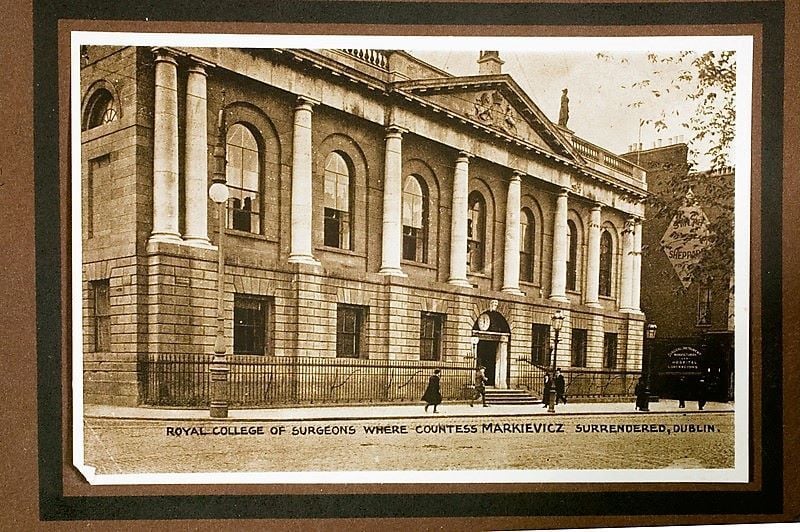
Royal College of Surgeons
“The buildings they took over were very symbolic,” said Dr Brück, with this spot being no exception. Irish rebels retreated to here and remained there until they surrendered on the Sunday. The masonry outside the college today still bears the pockmarks of bullets exchanged between the Irish and British.
GPO (General Post Office)
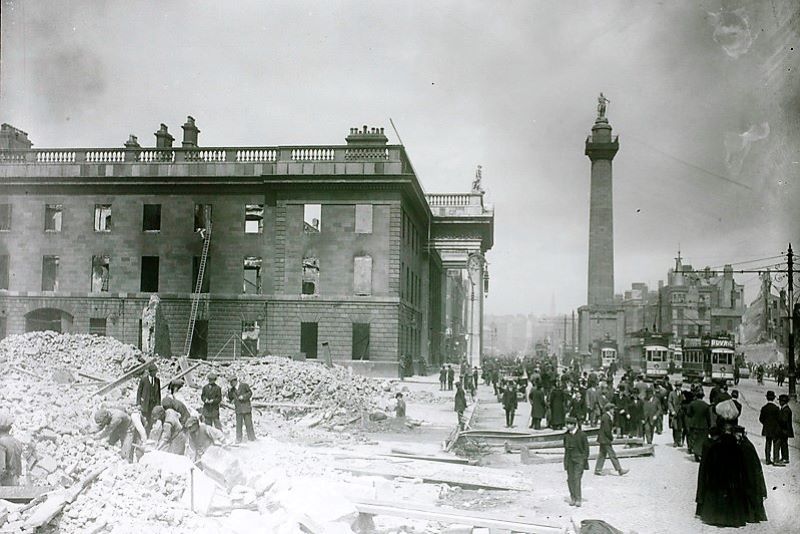
This landmark on O’Connell Street, then called Sackville Street, served as headquarters for the Irish Volunteers during the Uprising. Though it was burned down during the week of rebellion, its remaining facade bears the scars of bullet holes still visible today.
20 Comments
-
-
-
-
-
-
-
-
-
-
-
-
-
-
-
-
-
-
-
-
Switch to the desktop site to post a comment.bobby | Apr 04, 2013, 09:11 PM EDT
@Irishcentral. I use the name bobby on this site and another guy called bobby uses the same name. I did not post this. bobby | Sep 18, 2012, 10:46 AM EDT A few bullet holes in some buildings, most cities in Europe have this in old buildings from war.
Seanmor | Apr 03, 2013, 10:33 AM EDT
I'd like to know if those who disapprove of the executions of the 16 patriots for their roles in the Easter rising also object to the killings by the Paras in Belast of 9 Nationalists in the 2nd weekend of August, 1971, also the shooting dead of 5 other Nationalists by the Brits in that city in July of 1972? It appears as though it is acceptable to Southern Partitions for the "security forces" in the North to shoot dead any Nationalist who does NOT warmly embrace the Forces of the Crown.
seanomelb | Apr 02, 2013, 07:39 PM EDT
I'm a Duibliner idiot and I do not live in the U.S.A. Now you are "foolisher" than foolish. Maybe you should walk the streets of Cork city and ponder as to why the British army burned the centre of the city or why they murdered the lord mayor Thomas Curtin. Stevenstar your Irishness is in doubt I bet you live in England.
STEVENSTAR | Apr 02, 2013, 08:56 AM EDT
@@seanomelb | Apr 01, 2013, 09:36 PM EDT >>>>>>IF I GOTO DUBLIN FOR A WEEKEND ID NORMALLY VISIT MY FRIENDS. WE'D GO FOR DINNER A FEW BEERS GO TO SOME TRENDY BARS LIKE CFE EN SEINNE AND MAYBE THE ART GALLERIES AND MUSEUMS. THE MUSEUM OF NATIONAL ART IS FANTASTIC OUT NEAR CHRISTCHURCH AREA.. WHY ON GODS EARTH WOULD I WANT TO GO AND LOOK AT WHERE THE 'REBELLION' AS YOU CALL IT , TOOK PLACE, I HAVE BETTER THINGS TO DO WITH MY TIME IN THE YEAR 2013...!!! MOVE ON MATE.. IM SICK TO THE TEETH OF THIS AMERICAN CLAP TRAP OF DWELLING ON THE PAST AND ALL STIRTING UP ANTI BRITISHNESS.. GIVE IT A REST.. I DO NOT HAVE INTEREST IN YOUR AMERICAN RELATIONSHIPS WITH YOUR NEIGHBORS THE CANADIANS.SO MAYBE ITS BEST U MIND YOUR OWN BUSINESS. MOVE ON FOR GODS SAKE MAN.. ITS GETTING BORING NOW..
seanomelb | Apr 01, 2013, 09:36 PM EDT
Stevenstar you are making yourself look more foolish(if that's possible).Next time you visit Dublin hire a Dubliner to walk you around the city and point out the places where the rebellion took place.
curtisjohnson | Apr 01, 2013, 08:49 PM EDT
@89West "The question to ponder after nearly a century of debate; is whether or not it would have been better had Pearse and Connolly stayed in bed that morning." It would have been better for the british oligarchy but certainly worse for the Irish people as there is a chance they would still be chained to the terror state.
STEVENSTAR | Apr 01, 2013, 07:34 PM EDT
'''''Today, the city still bears many of the scars as a result of the fighting between the Irish and British'''' NOT AT ALL!!!! WHAT AN OFFENSIVE ARTICLE TO DUBLIN PEOPLE.. I LIVED IN DUBLIN FOR 7 YEARS AND BELIEVE ME ITS A THRIVING MULTICULTURAL CITY WITH GREAT CULTURE NIGHTLIFE AND SHOPS.. WITH MANY CULTURES FROM ALL OVER EUROPE LIVING THERE AND A GREAT CITY OF PEACE .. I HAVE NEVER SEEN ANY ''SCARS'' OR FIGHTING BETWEEN IRISH AND BRITISH PEOPLE.AND AS A MATTER OF FACT YOU WILL FIND 1000S OF IRISH AND BRITISH ALL SOCIALISING TOGETHER IN TEMPLE BAR AND NEVER ANY TROUBLE. I WISH THIS PUBLICATION WOULD THINK TWICE IN FUTURE BESIDES WRITING THESE OFFENSIVE ARTICLES WHICH ARE TRYING TO PUT A THRIVING MODERN CITY BACK INTO THE DARK AGES.. PLEASE TRAVEL AND VISIT DUBLIN AND COME BACK AND WRITE AN ARTICLE MORE APPROPRIATE TO A GREAT CITY AND NOT ALL THIS DOOM AND GLOOM NEGATIVE CLAP TRAP !!
WoundedKnee | Apr 01, 2013, 03:26 PM EDT
Carrickcourt: Wrong Biscuits. De Valera occupied Bolands Factory, on the Southeast side of the city. Did nothing all week, even though they must have heard the firing from the terrific gun battle at Mount Street, just a few blocks away. Strange he never sent reinforcements (the Mount Street Volunteers were all wiped out, after inflicting huge losses on the British) but preferred to just sit there.
bunkerhill | Apr 01, 2013, 03:24 PM EDT
Wonderful article and we will get the book. We did find a great book in Killarney containing rememberances passed down through families in Dublin at that time. It was almost like being there. As a result of these brave Irish men every Irish person is an equal to anyone just as we in the USA can thank our Founding Fathers for making us all equals. In American Historian Thomas McCullough's book he writes that the concept of equality for all actually originated in Ireland. We could never live in a country where we were called commoners.
Searlit | Apr 01, 2013, 12:45 PM EDT
Those buildings where the Irish Army retreated should be saved. A beautiful memorial Park could be made there. That would be a great visitors attraction. I have been to Stephens Green. I didn't know that I was walking on such sacred ground at the time. I only knew it was a beautiful place, in Dublin.
carrickcourt | Apr 01, 2013, 12:41 PM EDT
What Jacob's Biscuit Factory? Dev and Company occupied this location.
darragh S | Apr 01, 2013, 11:07 AM EDT
People somewhere have been attempting to post stories that the IRB were actually the IRA. I think it has something to do with trying to deny how the current British Irish political climate changes everything which would allow the use of terrorism related legislation to snoop on people whose ancestors were in the IRB not the IRA and have them thrown in Guantanamo Bay.
89west | Apr 01, 2013, 10:08 AM EDT
The question to ponder after nearly a century of debate; is whether or not it would have been better had Pearse and Connolly stayed in bed that morning.
IrelandNorth | Sep 21, 2012, 09:00 AM EDT
Photograph caption should read: "A view of O'Connell Bridge [after] the 1916 Easter Rising." You'd be a brave (or foolhardy) photo-journlist (pooper) scooper to venture out during high-noon on Sackvill Street. Have seen a photo of if before and after. Truly dramatic! Could have read: "Pearse Connolly & Assocs - Demolition Contractors - Radical Streetscape redesign a speciality - Constitutional Feng Shui. By [dis]Appointment to HM - the King. Free quotes. No job too small. GPO Box 1916, Sackvill Street.
Seanmor | Sep 20, 2012, 06:30 PM EDT
The Irish Republic declared in 1916 specifically included "the whole nation and all its parts" (an tír uile agus gach roinn di). When we call the former Free State territory the Irish Republic, we make a mockery of Pearse, Connolly and all the other great leaders from al parts of Ireland who fought so gallantly to liberate all of Ireland from British control. Those who still support Irish Reunification are proponents of Lincolnian democracy, Lincoln being the greatest of all the U.S. presidents.
cillowen | Sep 19, 2012, 11:24 AM EDT
it tells us of a conglomeration of Anglophiles that run the place still.
curtisjohnson | Sep 18, 2012, 09:51 PM EDT
Pádraig Pearse, a true visionary and gift to the nation.
WoundedKnee | Sep 18, 2012, 03:06 PM EDT
Irish central: Perhaps the intern who did so would like to explain why s/he removed the post in which I offered a critique of those who run Dublin and who have left the most historical quarter of all go to dereliction. I refer to the area behind and to the north of the GPO. These were the streets to which the 1916 Volunteers retreated when their position in the GPO became untenable. These streets and buildings have now been left derelict by a combination of the useless Dublin government and greedy Irish capitalists. Why did you censor my post, Irish central? Is someone you know among the capitalists who are trying to knock down all the historic buildings in this part of Dublin ?
bobby | Sep 18, 2012, 10:46 AM EDT
A few bullet holes in some buildings, most cities in Europe have this in old buildings from war.
aloistmartin | Sep 17, 2012, 04:26 PM EDT
James Connolly ... Now those were the days !