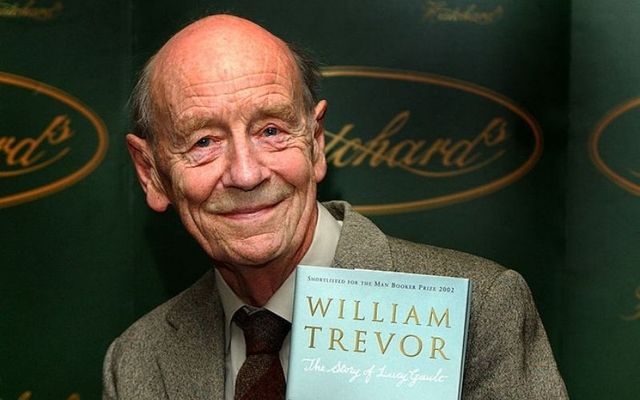
William Trevor, the beloved, brilliant and prolific Irish writer, died aged 88 on November 20, 2016. Celebrating the great writer's legacy, here we recall a 2009 interview with Trevor, on the publication of his novel "Love and Summer."
For writer William Trevor there comes a moment when it’s time to stop. Whether drafting a novel or a short story he arrives at a moment of completion, the point at which all work is done. He will have written, rewritten and reworked elements of the story numerous times, agonized over the plot, fussed with characters, toyed with the rhythm and flow of sentences and made a final arbitration on every contentious word. And in the end, if he feels that everything fits as it should, it’s time to just let go.
Having typed the manuscript on blue pages using a manual Olivetti typewriter, he will close it and pass the finished draft to his literary agent for release into the conveyance of international publishing. It will be proofread one more time before the manuscript returns as a printed book but after that, the author will not look at it again. “I’m never tempted to go back – there’s not an awful lot of point in doing so really,” he says, sounding more like a midwife than mother. “You know you’re finished writing a book when you’re getting bored stiff with it.”
Novelists are highly diligent before committing to print but William Trevor is especially fastidious in his attention to detail. Clare Alexander, a former publisher at Viking, remarked that Trevor’s “process of writing and revising was a private one, more so perhaps than with any other writer I have known.”
Readers will be quite unaware of the care he takes of his art. It passes off as a casual fluency, like a consummate performer whose dedication to rehearsal offstage makes his performance onstage look beguilingly simple. Almost effortless.
Now aged 81 years, the Cork-born author is doing publicity interviews for his latest novel, “Love and Summer”. Set in mid-century rural Ireland, it revisits favored Chekhovian themes – the fragility of marriage, the burden of religious and societal convention and the aching impossibility of love.
A slim novel, running at 212 pages, “Love and Summer” feels like an extended short story, a pocket-sized love drama ripe with desire and longing. Trevor creates a claustrophobic universe out of small-town Ireland, but in the early stages of drafting the book, he goes far beyond the doomed tryst of protagonists Ellie and Florian. In his mind, he plots and creates the full continuum of their lives. Only when he sees the whole picture will he decide where their story should end in print. And so he usually writes far longer than the published book will actually go.
“I do an awful lot of rewriting,” he admits. “And I amass an enormous amount of paper compared to the amount of paper that ends up in finished form on the bookshelves. It’s not that the story marks the end of the road for the characters. They have got to go on living in the mind of the reader.
“That’s quite an important thing for me, and actually I leave a lot to the reader. This book is a very good example. Lots of things haven’t happened yet. There’s a whole life ahead for Florian on leaving Ireland; there is a question of whether Ellie is pregnant or not.”
Which leaves ajar the possibility of writing a sequel. Is this his intention? “Not at all,” he laughs. “In fact, I’ve already done a sequel to it. And then I’ve cut and chopped it down to the point that there’s not a lot there that shouldn’t be there. I’ve taken the characters further and so I know where their journeys will take them – I’ve done that but I’m not going to tell you! Once the book is done you’ve reached the end of a road – but it’s more the end of my road. The characters will go on.

Love Irish history? Share your favorite stories with other history buffs in the IrishCentral History Facebook group.
“It’s something you do. There’s a point when you have to establish ‘That’s the end.’ It could go on, have a sequel, but all that is another option. That occurs with every novel ever written. It’s a question of order. I’ve found in writing novels and short stories that what you are doing is creating order out of the mess you make. Out of that raw material you hack your way back.”
The son of a bank manager, William Trevor Cox was born in Mitchelstown, Co. Cork. The family moved whenever and wherever his father’s job dictated, so the banker’s clutch ended up as commercial gypsies – posted to Enniscorthy, Skibbereen, Youghal, Tipperary and beyond – a constantly shifting landscape of homes, schools, acquaintances.
Education was scattered across 13 different schools punctuated by unofficial holidays in between. At the end of an uneasy adolescence – his estranged parents would eventually separate – Trevor graduated in history from Trinity College Dublin. He then switched tracks completely and became a full-time sculptor, something he feels analogous to his subsequent commitment to the written word.
For each story, the impulse of an original creative idea is his raw material. From this starting point, he finds where the idea will take him and then pares it away, continually shaping the narrative by identifying the key elements, developing them and discarding the rest. To fashion the story, he follows the simple adage that less is more. It’s a slow, methodical process, but the hallmark of Trevor’s writing is a spare, lucid style bereft of extraneous detail. The sculptor may have become a writer, but his 16-year dalliance with clay – he gave it up when he found his work becoming “too abstract” – has certainly informed his approach to print.
After marrying his college sweetheart Jane Ryan, to whom he ritually dedicates every book, the couple moved to England. The first of two sons was born in London where Trevor got a job as a copywriter – “not a good copywriter and I was very lucky to be kept on.” He reflects warmly on his spell at Notley’s advertising agency as “a rackety time,” but creatively it was a fallow period. Even so – he now laughs at the notion – it was on company time that he penned his first novel, “A Standard of Behaviour,” in 1958. Some 18 novels later he reflects on his debut as “rubbish.”
The idea of secretly writing a novel from the catchy embrace of an advertising agency suggests a scene from Ricky Gervais’ groundbreaking comedy TV series “The Office.” Trevor is familiar with the series, likes it and sees how fruitful a setting the workplace can be for a writer.

Looking for Irish book recommendations or to meet with others who share your love for Irish literature? Join IrishCentral’s Book Club on Facebook and enjoy our book-loving community.
“It’s a very interesting life,” he says. “I had never worked in an office before and at first I found it very different. Looking back, it’s a very rich area – there are a lot of relationships, people brought together to the same place every day, falling in love with the wrong person. I think office life is a great harbor for that kind of thing. There’s something extraordinary about people coming in and sitting in the same office all day and then going home. In the same way, an ordinary house, the domestic side of life at home, is what interests me. The small things.”
He might humbly dismiss his first novel, but in writing it the novice author unconsciously established a set of practices he has observed ever since. Copywriters at Notley’s used blue stationery, and from there on blue became the only kind of paper Trevor will use for writing fiction. Alterations are made by cutting and pasting new sections with scissors and glue. Final corrections are made longhand by pencil.
“That’s pure affectation,” he responds self-consciously before offering a better explanation for these practices. “Creature of habit stuff, really. Blue is a very restful color – I prefer it to white but [the book] ends up on white paper in the end.”
Even with a strong suite of novels to his name, the short story is the form with which William Trevor is most associated. He has previously described himself as a short story writer who wrote a few novels rather than a novelist who wrote a few short stories – in fact, he has written hundreds of short stories. Either way, the same process applies. Paring down, paring away, the reductionist appeal of a former sculptor.
“I don’t think it’s quite a question of appeal,” he says when asked why he is strongly drawn to the discipline of a short story. “It’s a natural thing, like an athlete – a fella who can run 100 meters but not so good over 220 meters. It’s about finding your length.”
Academics have probed deeply into Trevor’s biography in an effort to reason why he continually explores particular themes. Scholarly theses have been written on whether his sensibilities are informed by the fact that he moved from place to place as a child, his Anglo-Irish background, or whether he was emotionally scarred by his parents’ “absolutely appalling marriage” – he once wrote openly about “their shattered relationship” for The New Yorker magazine.
He remains curious but resistant to further scrutiny. One senses he is even a little bemused by all the attention. “It’s not fair to condemn interpretations outright, but generally speaking, people do read too much into fiction. They go too far and get the wrong end of the stick.”
Instead, he delights in referring to Swiss tennis champion Roger Federer or West Indies star cricketer Viv Richards. Sports fans enthralled by their natural brilliance on courts and creases will readily accept that genius does not always invite an explanation.
“It’s a comparison I often use because I’m often asked to analyze the reasons behind a book after writing it,” he begins, preferring to avoid the question whenever he can. “People like Federer playing tennis or Richards playing cricket often say they don’t know how they did what they did. And that’s the same for me. You can analyze these things far too much. You can talk about it and talk about it – actually I think you can talk it out completely. I’m very bad at analyzing how I do anything. I’m a storyteller. I just sit down and write stories. That’s what I do.”
As a tutored observer of life, he is prepared, however, to acknowledge that his formative years shaped his own perspective. “I think the advantage for me growing up in so many different towns is that what struck me was the difference rather than the similarity between them,” he reflects. “Something to sharpen up the beady eye of the novelist. I think that changing scene of childhood was very good for me. Nothing was ever settled. Being settled and being happy is probably not the best training for someone who wants to write about the human condition. It’s not much help if it’s too easy.
“At the time as a child you just trundled along happily – or in my case, sometimes unhappily because of my parents’ quarrels and the difficulties they had – and if you put it all together it’s a huge tapestry that’s there in the memory. You will always go back to it.”
Maybe it is Trevor’s gently formal style – don’t be deceived that his prose can’t pack a punch – but it often feels like he writes with a sort of nostalgia, particularly in his Irish dramas. He’s more provincial than urban, more country than city. One of his most memorable short stories, “The Ballroom of Romance,” was beautifully adapted for RTE (Irish television) by director Pat O’Connor, evoking the simplicity and strictures of a bygone age in a remote country dance hall. Is it easier to write about the past?
“No, it’s not,” he replies firmly. “One would be lost without the present. The present is an area, oddly enough, I prefer. I go back to the past quite often, but Ireland today has changed. That’s fascinating. And at such a tremendously speedy rate – I’m sure my father never saw the world in the way I have been able to. And I’m very lucky to be given that opportunity.
“I visit Ireland too often not to be used to the ‘new Ireland.’ It’s quite extraordinary and all so different to my childhood. Those changes have been absorbed, but beneath them, with that absorption there are so many faces, names, traits that ring a bell immediately. Superficially, yes, things have changed hugely, but I don’t think a lot has really changed. And the recession now makes it feel like a returning to the 1950s. There’s still that strange and odd Irish friendliness, something that’s unique the world over.”
“Love and Summer” has been nominated for the prestigious Man Booker Prize. On four previous occasions in the past 39 years he has been shortlisted (“Mrs. Eckdorf in O’Neill’s Hotel,” “The Children of Dynmouth,” “Reading Turgenev” and “The Story of Lucy Gault”) but never won the Booker. With his literary reputation firmly established and his international standing assured, the 2009 destination of this elusive prize will not fret him unduly.
“You never want to belittle prizes because they might stop giving them,” he quips wryly, recalling his days as a young sculptor in Dublin when he shared top prize for the International Year of the Political Prisoner art competition in 1952. The award enabled him to continue sculpture and encouraged him to believe he was on the right track. That’s quite a while ago, but the memory of morale-boosting recognition has not left him.
Soon afterward he traded his choice of raw material and has picked up numerous literary accolades along the way. “It’s like giving a sweet to a child,” he suggests with the sort of avuncular wisdom you might expect. Baubles can be very welcome, but in the end it’s all about the work. “Prizes are fine but they aren’t quite as important as they might seem to be.”
* Originally published in Irish America magazine, in 2016, updated in Nov 2023.


Comments