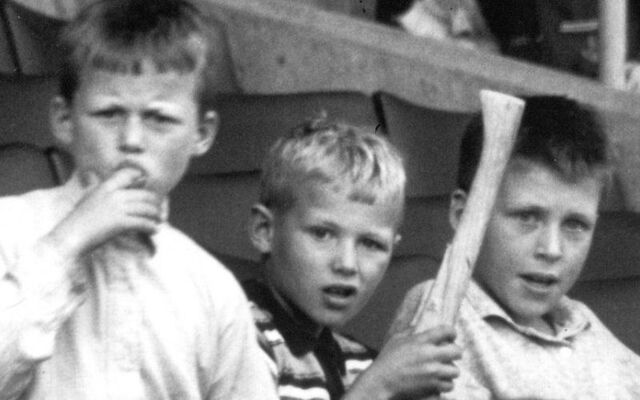
Ireland in the 1960s was a nation frozen in time. While Beatlemania, Vietnam, hippies, and free love gripped the West, we had Father Michael Cleary (the singing priest) and the Irish Censorship Board. Peter Lennon's "Rocky Road to Dublin" examines a country that had won independence but shied away from the 20th century.
Our church-controlled educational system produced young students who fretted about original sin years before they were capable of conceiving one. Our government acted as if church and state were indistinguishable. We were shut-ins, defiantly turning our backs against the 20th century and the modern tide.
In "Rocky Road to Dublin", Peter Lennon’s 1968 documentary about the state of Ireland in that transformative decade, Lennon captures a nation teetering on the cusp of enormous social change. It makes for startling viewing, and the Irish Film Institute is to be commended for placing this groundbreaking film before the public again.
It’s a true saying - prophets are never recognized in their own land. Especially when they’re holding a bright polished mirror up to their fellow citizens. But it’s usually love, and not contempt, that drives them.
In 1968 the majority of Irish critics were profoundly shocked by Lennon’s home truth-telling, to the point where they blasted him for his lack of patriotism rather than admitting he had a point.
How did it happen? How did Ireland turn the key on itself and the 20th century for so long?
Well, according to writer Sean O’Faolain, we betrayed our republican ideals almost immediately after achieving independence.
James Joyce knew all about it. So did George Bernard Shaw, John McGahern, Edna O’Brien, Brendan Behan, Austin Clarke, Benedict Kiely, Kate O’Brien, Frank O’Connor and O’Faolain himself.
Each of them (and many others) had their books banned for decades by censorship laws that the writer Robert Graves called “the fiercest literary censorship this side of the Iron Curtain.”
In 1926, in a foretaste of what was to come, the then Irish Minister for Justice Kevin O’Higgins appointed the Red China sounding Committee on Evil Literature. The committee consisted of three laymen and two clergymen who decided that it was the duty of the state to take action to prevent the circulation of literature considered to be obscene and morally corrupting. Within a year they had created the draconian Irish Censorship Board.
For decades before we were celebrating our great Irish writers, we were dismissing them as deviants and lunatics and depriving them of their livelihoods. We even had our moral watchdogs to sound the alarm at the first sign of ideological impurity.
Organizations with militaristic or bluntly religious monikers like the Boys Brigade, the Catholic Headmasters Association, the Catholic Truth Society of Ireland, the Catholic Writers Guild, Comhairle an Fhainne, the Irish National Teachers Organization, the Irish Retail Newsagents Association, the Irish Vigilance Association, the Schoolmasters Association and the Young Men's Christian Association all made recommendations about banning material that had scandalized them. If an Irish writer made their list his or her books disappeared overnight.
There was a terrible irony about all of this. In throwing off one form of oppression (British colonial rule) we reflexively shouldered another (Roman Catholic rule). Lennon’s sardonic film quietly but emphatically makes this point.
In the Irish society of 1967 priests are everywhere -- at weddings, baptisms, funerals, high-toned sporting events, working-class concerts, horse shows, dances, hospitals, orphanages, anywhere and everywhere the Irish public congregated in public or private. But they were also in government too, exerting a proxy political power that was completely unassailable.
“The close involvement of Irish politicians with the clergy is not so much a villainous conspiracy as a bad habit,” Lennon narrates, and you can hear the exasperation in his voice.
A scene where Lennon films Father Michael Cleary singing "The Chattanooga Shoeshine Boy" to a women’s maternity ward is a remarkable moment, as is Cleary’s passionate defense of priestly celibacy and the church’s attitude to sex.
There’s poignancy in the fact that Cleary would later go on to secretly father two children with his 17-year-old housekeeper, Phyllis Hamilton. The couple was even secretly together when Lennon made this film.
The film concludes with a wedding party, with Cleary staring at the rows of dancing couples. He’s prevented by his position from joining them.
With hindsight, it’s a hilarious image and it’s also unspeakably sad. It’s an emblem of the conflicted attitude the Ireland of 1967 had about its past and its future.
It’s moments like these in "Rocky Road to Dublin" that say it all about who we were and where we’re going.
Watch Peter Lennon's "Rocky Road to Dublin" here:
* Originally published in 2010, updated in March 2024.
Comments