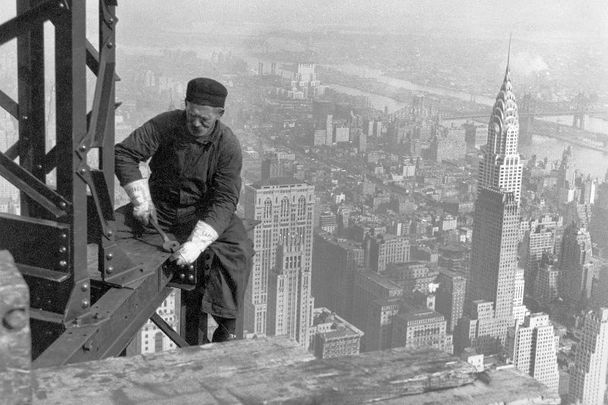
In 1908, acclaimed photographer Lewis W. Hine snapped a simple portrait titled “Irish Steel Worker.”
The aged laborer has a weathered face and sad eyes. A pipe sprouts from his mouth. He sports suspenders, a thick handkerchief in his front pocket, and a woolen cap atop his head.
Hine, born in Wisconsin in 1874, would go on to become one of the great photographers of the Progressive Era. As Jacob Riis did a generation earlier, Hine used the camera to document social inequities and spur reform.
The same year he snapped the Irish steelworker, Lewis W. Hine also created one of his more famous series of photographs, entitled “Child Labor: Girls in Factories.”
But it was a decade and a half later that Hine would find his true muse. Hine’s most famous subject was not even a person. It was, instead, the tallest building in the world, a monument to enormity and audacity that just so happened to begin rising as the nation sank into a deep depression.
Construction of the Empire State Building began in March 1930 on the site of the old Waldorf-Astoria Hotel at 350 Fifth Avenue at 34th Street. It was completed 14 months later and opened on May 1, 1931.
At 102 stories, it was, at the time, the tallest building in the world. It is presently the ninth-tallest building in America.
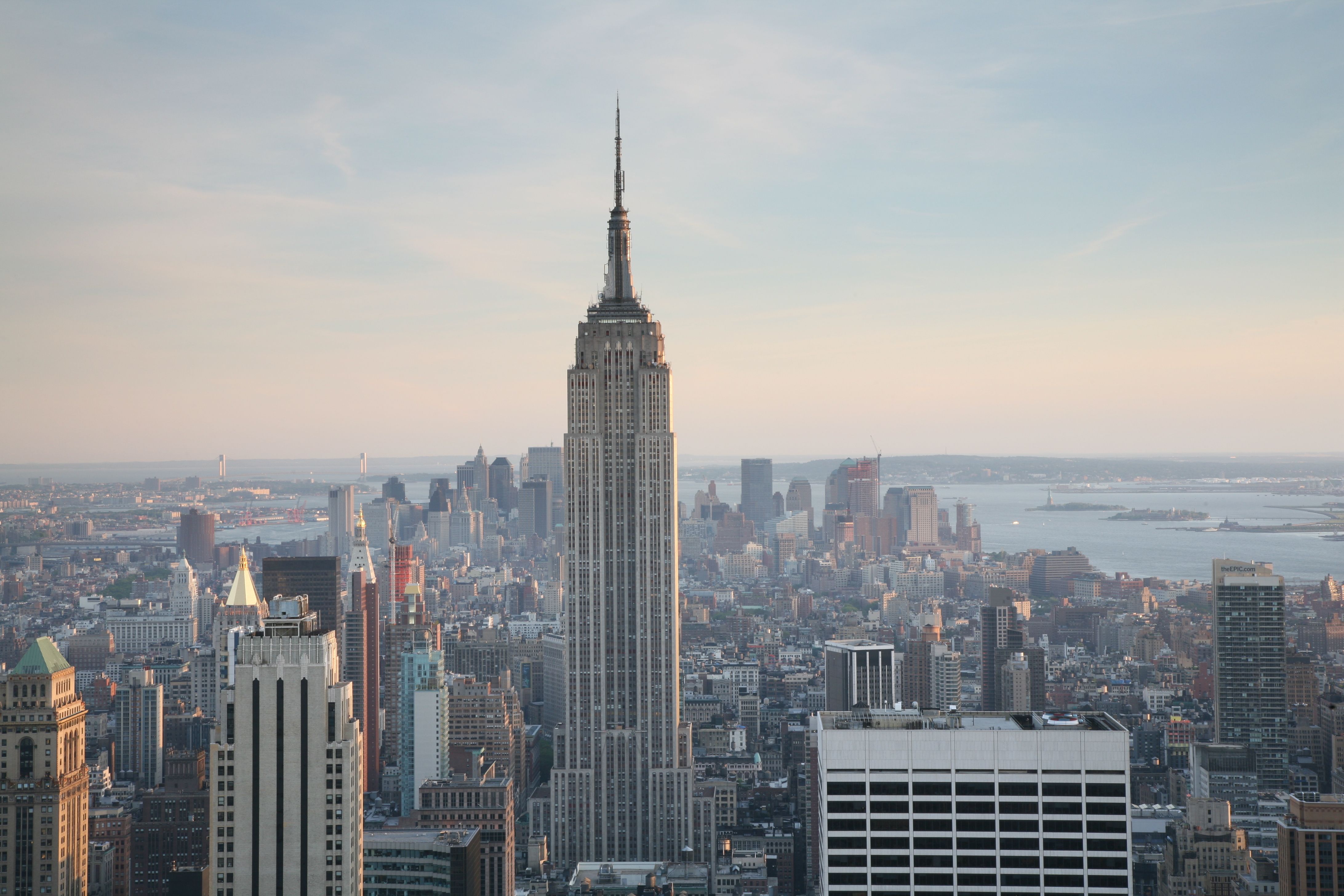

The Empire State Building, an iconic structure in the Manhattan skyline of New York City.
Hine’s photographs of the building's construction capture the wonder, romance, and artistry of the skyscraper and its builders.
Almost as an afterthought, though no less important, the photos also capture a project on which Irish Americans played a central role, from the power brokers who envisioned this unprecedented undertaking to the laborers who built the Empire State Building in just over one year.
Hine captured the determination of the men who stirred the concrete and stacked the steel. But it’s important to note that Irish-American power brokers also played a key part in the Empire State Building’s rise.

"Icarus, Empire State Building", by Lewis Hine.
First, there was Al Smith. A child of Manhattan’s Lower East Side, Smith often claimed that the only degree he ever earned was an FFM degree, as he had to go to work at the Fulton Fish Market after his father died. Smith emerged from Tammany Hall in an unlikely fashion: without the whiff of corruption. He served as a popular, progressive New York governor in the 1920s, but then made a doomed run for the presidency in 1928.
Smith was the first Catholic candidate to run for the White House, and many in middle America considered him an agent of Rome who hailed from the mongrelized metropolis. The Ku Klux Klan burned crosses on the campaign trail. Even Smith’s opposition to prohibition was seen as deeply unsavory. Add in the fact that the economy was booming, and you get the picture. Herbert Hoover trounced Smith.
Though it devastated him, Smith did not vanish into obscurity after this loss. He was named president of the Empire State Building Corporation, whose job it was to erect a towering new building on the former site of the Waldorf-Astoria Hotel.
Another important figure in the Empire State Building's planning stages was John J. Raskob. Raskob’s father was of Alsatian descent, but his mother was of Irish Catholic heritage. The self-made man from Lockport, New York, first got a job with the Du Pont family in the early 1900s and made enough money to invest in Manhattan real estate just in time for the roaring 1920s.
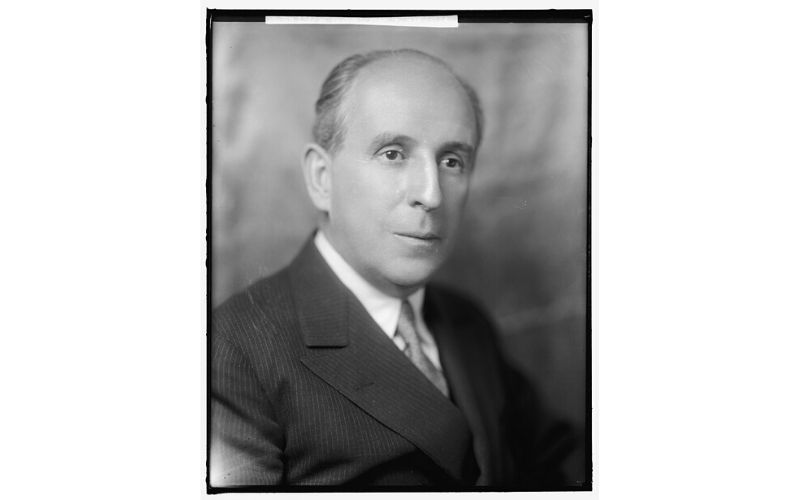
John J. Raskob.
On August 29, 1929, Raskob, Smith, and a group of investors took aim at the biggest real estate investment New York had ever seen: The Empire State Building.
Less than two months after this announcement, the stock market experienced a significant crash. Raskob, Smith, and the other bigwigs who saw dollar signs at the vast corner of 34th Street and Fifth Avenue would have to adjust their vision. The Empire State Building would still go up. The problem? It might turn out to be the biggest real estate boondoggle in American history.
Still, the project was good news for at least one group of people: Irish American laborers, who were desperate for work, men like Irish immigrant Michael Briody.
Laborer Michael Briody would probably be forgotten had he not been New York Irish novelist Tom Kelly’s great-uncle. Kelly had heard family stories about his uncle. Briody got mixed up in some shady business, was murdered, and buried in the Bronx. Kelly decided to look more deeply not only into his uncle’s past but into the celebrated skyscraper he helped build. The result was his thrilling 2005 novel, Empire Rising. Although it is a work of fiction, Empire Rising offers a rich and informative look at how the Irish contributed to the construction of the Empire State Building.
There are no hard statistics on exactly how many Irish immigrants and Irish Americans contributed to the construction of the Empire State Building. But it is generally accepted that Irishmen, as well as Scandinavian Americans, were the dominant group at the worksite.
One reason for this is that a new wave of Irish immigrants had swept into New York City. As with the Irish immigrants (such as Mike Quill) who founded the Transit Workers Union (TWU) in 1934, more than a handful of Empire State laborers were Irish republicans on the run from the grueling civil war that broke out in Ireland in the 1920s, following the Easter Rising and partition.
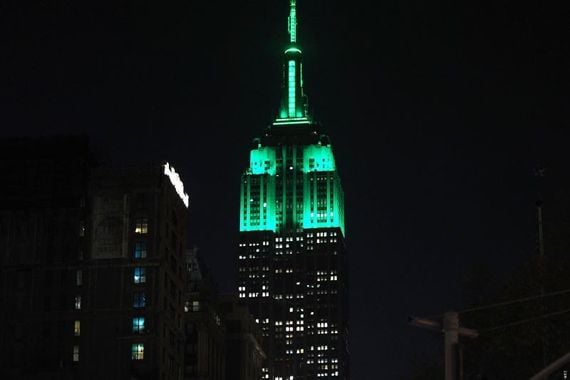
The Irish hands that built the Empire State Building, in more ways than one!
For these Irish immigrants, who fled a war-ravaged land just in time to hit the Great Depression in the US, a job on a project such as the Empire State Building seemed a blessing from the sky. It was a chance to put the past behind them and help create an American icon.
Unbeknownst to all the men working on the Empire State Building, a man with a camera was documenting their work. Just as he’d been documenting laborers and immigrants for the previous 30 years.
Lewis Hine was in his late 20s and had been in New York City for only a few years when he and his camera were drawn to Ellis Island in the early 1900s. The Irish were still coming (such as the laborer whose memorable portrait he took in 1908), but these were also the days of the so-called “new” immigration. Waves of Italians and Jews from Eastern Europe were arriving every day at Ellis Island, along with Finns, Germans, Poles, and Hungarians. From 1904 to 1909, Hine documented the hardships as well as the happiness, mystery, and daily grind of the Ellis Island immigration process.
It was the first of many progressive photographic projects for Hine. Born in the progressive hotbed of Wisconsin, Hines' political outlook was further honed at the University of Chicago. He brought this belief in progress and reform to New York in 1901. He became a teacher at the Ethical Culture School and, according to biographies, took up the camera around this time, believing that images could be as powerful, if not more so, than words.
Following his Ellis Island series, Hine’s photos of child laborers opened many eyes and were part of a broader movement to expose and put an end to the use of child labor. By this point, Hine’s work was coming to be considered not just crusading but sociological. His portraits were studied for all that they revealed about their subjects. He photographed conditions in Europe for the Red Cross after World War I, then returned to Ellis Island in the 1920s to document efforts to improve conditions at the immigration center.
Then, in March of 1930, just seven months after Smith and Raskob announced the construction of the Empire State Building, Hine was commissioned to document the skyscraper’s rise.
The men in Hine’s photos are lean and muscular. Often they seem to be floating, even dancing gracefully. Of course, they are actually a slip of the hand or foot from death. (Interestingly, it is believed that only five people died during the construction of the Empire State Building.)
In Hine’s photos, the sun and sky create stark black-and-white contrasts. The steel and machinery often gleam, in contrast to the hazy, seemingly insignificant buildings in the distance. The photos ultimately capture the awe that such a skyscraper, and its construction, inspired in the 1930s, a feat difficult for modern audiences to grasp, now that nearly every medium-sized city in the world has skyscrapers.
In the end, Hine, Smith, Raskob, and the Irishmen who helped erect the Empire State Building produced a collaborative work of art of concrete and steel, shutter, and lens. When the Twin Towers were destroyed in 2001, the sight of the Empire State Building was, among many other things, a beautiful comfort. For it too had had its plane crash. On July 28, 1945, a US Army B-25 bomber lost in the fog hit the 79th floor, causing 14 deaths and $1 million in damages. But the building stood and continues to function as an office building and the main tourist attraction in New York City.
When deciding what the first line of Empire Rising should be, Tom Kelly ultimately chose this very telling line: “This one, they say, will stand forever.”
* Originally published in August 2016, updated in April 2026.


Comments