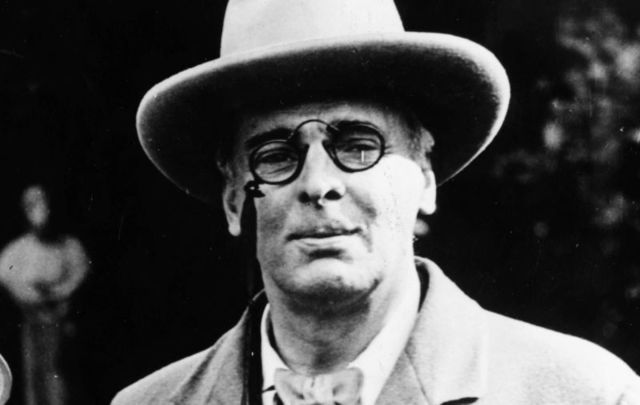
William Butler Yeats was not only one of Ireland’s greatest poets, but also a writer whose imagination was deeply shaped by the women around him, from Maud Gonne to his wife, George Hyde-Lees. In a new examination of his life and work, James Flannery shows how those relationships fueled Yeats’s creativity and helped produce some of his most memorable poems and plays.
Editor's Note: Yeats was a pillar of the Irish and British literary establishment and in his later years, he served as an Irish Senator for two terms. He was a driving force behind the Irish Literary Revival and, along with Lady Gregory, Edward Martyn, and others, founded the Abbey Theatre. In 1923, he was awarded the Nobel Prize in Literature as the first Irishman so honored for what the Nobel Committee described as "inspired poetry, which in a highly artistic form gives expression to the spirit of a whole nation."
Below, James Flannery, Winship Professor of Arts and Humanities and Director of the W.B. Yeats Foundation at Emory University, looks at the book “W.B. Yeats and the Muses” and how nine women influenced the great poet’s works.
It will come as no surprise to admirers of W.B. Yeats that this greatest of modern poets was a celebrant of the art of love from the beginning to the end of his long and immensely productive career. But now, thanks to a brilliant and magisterial work of scholarship by Joseph M. Hassett, we can fully appreciate how much Yeats owed to the women in his life – nine women, to be precise, whose alluring mystery held him in thrall and inspired in him the heightened state of consciousness he believed necessary for creative expression.
As Hassett explains, from the outset of his career, Yeats was convinced that art at its most sublime springs from the influx of a supernal form of knowledge far beyond the realm of ordinary discourse. In following this belief, Yeats was predisposed to accept the Greek idea that poetry is inspired by the Muses, as expressed in Plato’s dictum that “all good poets…compose their beautiful poems not by art [techne] but because they are inspired and possessed” by the Muse who speaks through them. In Ireland, this concept was also part of the courtly love tradition imported by the Normans in the twelfth century and grafted onto the highly spiritualized love poetry of the Gaelic bardic order.
Read more
In the Irish version of courtly love, a leanansidhe, or fairy mistress from the otherworld, afflicted the poet with an overwhelming desire to celebrate the beloved's magical wonders and thus win her for himself. Such profound feelings did the leanansidhe inspire that to be deprived of her presence was equivalent to losing one’s faith in God. Hence, the theme of love and loss recurs over and over again in the hauntingly beautiful love songs of Gaelic Ireland – a tradition with which Yeats was thoroughly familiar from his study of Irish folklore.
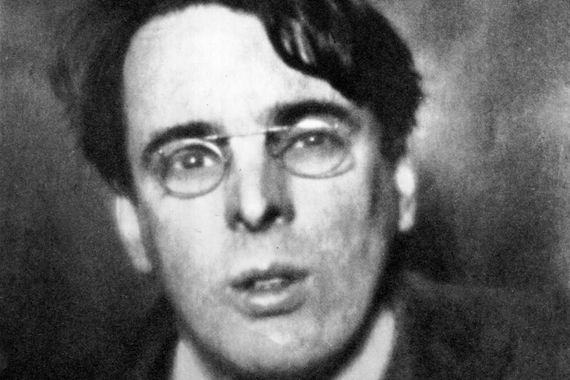

W.B. Yeats.
In the courtly love tradition, the Muses were deliberately wooed by the poet to extend his spiritual and aesthetic capacities to their furthest possible reaches. Dante’s pursuit of the unattainable Beatrice – “the suffering of desire,” in Yeats’ phrase – inspired him to become, again in Yeats’ words, “the chief imagination of Christendom.” The sheer unattainability of the beloved was one of the essential components of the relationship between the poet and his Muse – that and the terrible frustration of thwarted love. This deliberately cultivated torment for the sake of art is, as Hassett explains, the only plausible reason for Yeats’ 28-year fruitless pursuit of the Irish revolutionary leader Maud Gonne.
Has there ever been a more ardent, exalted, emotionally expressive or tortured tribute to a real-life Muse than that contained in the poems and plays of Yeats inspired by Maud? She was everything to him, including the way she symbolized an Ireland proud, solitary, and stern that had thrown off the bonds of British colonialism and become a beacon of enlightenment in the modern world. An impossible dream, yet much of Ireland’s eminence in the arts today is due to the fact that the poet gave it voice. The frustration of Yeats at his inability to win the hand of Maud also inspired some of the most heart-scalding poetry ever penned. But, as Hassett emphasizes, the suffering of the poet was justified by the awareness on the part of both his Muse and himself that the pain he endured was a necessary condition of service for the higher purposes of art and nation.
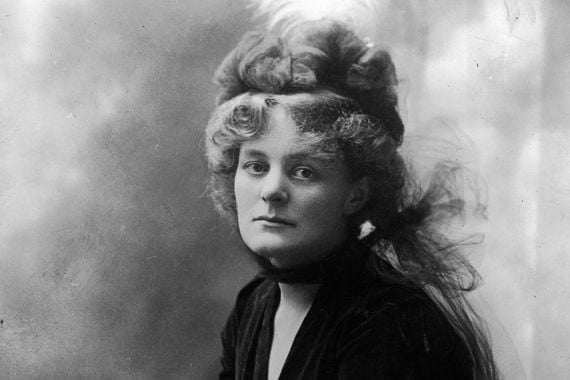
Maud Gonne. (Getty Images)
Had this book only been confined to an examination of the relationship between Yeats and Maud Gonne in light of the courtly love tradition, it would have been a major achievement. But Joseph Hassett also considers the poetic enterprise of Yeats as affected by eight other women who functioned, each in a uniquely different way, as living incarnations of the Muse. Chief among these was his wife, George Hyde-Lees, a gifted woman of only 25 when, in October of 1917, she married the then world-famous poet who was twice her age. Yeats came to the marriage partly to escape the emotional turmoil of his relationship with Maud, yet he nonetheless feared that domesticity would cost him his poetic inspiration.
On their honeymoon, George astonished her distracted husband by suddenly assuming the voice of a messenger from the otherworld with secrets to impart. To his delight and enchantment, George's communicators revealed to him that the moment of sexual union was a portal to knowledge of the spiritual world – a knowledge that carried with it a metaphorical language rooted in a belief system of stunning power and richness.
Read more
Some 3600 pages of the automatic writings dictated over a five-year period to George by her ghostly messengers provide a tangible record of this strange but highly productive Yeatsian encounter with a Muse in the form of his own wife. The poems and plays that resulted from this experience represent the most significant transformation and growth of his entire career and include such masterpieces of literary modernism as Michael Robartes and the Dancer (1921) with “Easter 1916,” “The Second Coming” and “A Prayer for My Daughter” as well as The Tower (1928) containing “Sailing to Byzantium,” “Meditations in Time of Civil War,” “Leda and the Swan” and “Among Schoolchildren.”
None of this would have been possible without his marriage and what the eminent Yeats biographer and critic Richard Ellmann described as the “great exfoliation of his talent” that followed. Ellmann avers that had he died in 1917, Yeats would have been known as simply “an important minor poet.” Instead, the new confidence from which he began to write was directly due to the esoteric knowledge and symbolic language his wife gave him access to. Henceforth, he would be recognized, in the words of T.S. Eliot, as “one of those few whose history is the history of their own time, who are a part of the consciousness of an age that cannot be understood without them.”
Perhaps the most startling and intriguing of all the living Muses who inspired Yeats was Iseult Gonne, the daughter of Maud, who possessed a lithesome loveliness, playful flirtatiousness, and a remarkably advanced intellectual sophistication when in 1912, at the age of eighteen, she began to exert an uncanny influence on Yeats’ imagination during a period when he was beginning to fear that his creative fires were extinguished. Yeats, then a middle-aged man of forty-seven, found himself struggling over his increased infatuation with Iseult even as in lyrics such as “A Memory of Youth” he acknowledged how “Love,” or inspiration, would have died were it not for the intervention of “a most ridiculous little bird [who] Tore from the skies his marvelous moon.” The little bird is, of course, Iseult, while the moon, in the tradition of the White Goddess of courtly love, is a source of the wisdom required by the artist for meaningful expression.
In a letter to Yeats, Iseult described herself as both his “pupil” and his “teacher.” At several points in their relationship, they even considered marrying each other. Yeats was relieved when the “wild gusts of feeling” provoked by the Lolita-like Iseult subsided in favor of “a new life of work and common interest” with George. Nonetheless, it would be a mistake to view their relationship as simply the clichéd obsession of an older man with an attractive younger woman. As Hassett makes clear, their friendship was founded upon profound intellectual and spiritual communion. That and Yeats’ awareness that Iseult was capable of reviving his creative life in the capacity of an alluring but incorporeal Muse who stimulated a desire that must forever be deferred.
From the outset, Iseult seemed aware of her role of Muse for Yeats, though as Hassett points out, in a touching and somewhat rueful poem of hers, she proclaimed that being a Muse was but “a strangely useless thing.” This and many other aspects of Iseult made their way into the philosophical essays, poetry, and plays of Yeats written between 1912 and 1917. His subsequent rebirth as a writer under the influence of George could not have occurred without the intervention at a crucial moment in his life of a youthful Muse who variously oscillated in his poetic imagination as a girl-woman of immense self-possession, grace and charm, a seductive but unattainable object of desire and a source of revelation about the process of creativity itself.
One of the most remarkable aspects of Yeats’ relationship with women is, as Hassett emphasizes, how much of their wisdom he absorbed and then garbed in his own redolent verse. Several of the Muses discussed by Hassett also inspired the psychologically rich and subtle characters in his plays. The Only Jealousy of Emer (1919), for instance, explores the complex interrelationship among human and spiritual forces unleashed by the poet’s powerful feelings for Maud, Iseult, and his wife George. The play opens with an exquisite lyric directly inspired by Iseult that at the same time functions as a meditation on the unfathomable longings stirred in the poet by the eternal feminine as “romantic and mysterious, still the priestess of her shrine.”
A woman’s beauty is like a white
Frail bird, like a white sea-bird alone
At daybreak after a stormy night
Between two furrows upon the ploughed land.
A sudden storm, and it was thrown
Between dark furrows upon the ploughed land.
How many centuries spent
The sedentary soul
In toils of measurement
Beyond eagle or mole,
Beyond hearing or seeing,
Or Archimedes’ guess,
To raise into being
That loveliness.
Perhaps the most haunting of all the Muse relationships discussed in the book concerns Olivia Shakespear, an extraordinarily beautiful, deeply cultured and compassionate woman with whom Yeats conducted a brief love affair in the mid-1890s in yet another earlier effort to overcome his feelings for Maud Gonne. Olivia, as Hassett says, “introduced him to the real experience of what fascinated him so much as metaphor: the sexual union of men and women.” Their communion of body and soul was intensely fulfilling and exerted a profound influence on Yeats’ emotional and creative life that lasted until Olivia’s death in 1938. “A Poet to His Beloved,” with its delicate evocation of a “White woman that passion has worn / As the tide wears the dove-gray sands” conveys Yeats’ endless fascination with the White Goddess of his poetic imaginings – an image as elusive and haunting as the ever-changing phases of the moon. Yeats’ love affair with Olivia Shakespear taught him that poetic language must be “as subtle, as complex, as full of mysterious life as the body of a flower or of a woman.” The poems inspired by Olivia were, as Hassett comments, “an intensely crafted use of language to open the door to the Beauty long faded from the world.”
Despite the love he felt for Olivia, Yeats found himself unable to efface Maud’s image from his mind, a situation that gave enormous pain to Olivia, as evidenced in the incredibly moving sentiment of “The Lover Mourns for the Loss of Love”:
Pale brows, still hands and dim hair,
I had a beautiful friend
And dreamed that the old despair
Would end in love in the end:
She looked in my heart one day
And saw your image was there;
She has gone weeping away.
It was, according to Hassett, the very availability of Olivia as a woman that made her unsuitable as a Muse. Nonetheless, her erotic allure combined with her empathy remained with Yeats to the end as an iconic image of love experienced as enduring friendship and, as these tender lines are written in 1929 indicate, a testimony to the enduring power of physical love to stir the human heart:
Speech after long silence, it is right,
All other lovers being estranged or dead,
Unfriendly lamplight hid under its shade,
The curtains drawn upon unfriendly night,
That we descant and yet again descant
Upon the supreme theme of Art and Song:
Bodily decrepitude is wisdom; young
We loved each other and were ignorant.
Yeats was sixty-four when he wrote these lines and had but another decade to live. Amazingly, this decade, when he was impotent but still full of desire, gave rise to yet another phase in his relationship to the Muse. This time, however, rather than seeking inspiration in an outer manifestation of his creative impulse, Yeats came to the realization that the source of his art lay in the intersection of masculine and feminine energies contained within his own psyche. Yeats explained this as a recognition that his creativity arose from an engagement with “the woman within me.”
In one stunning poem and play after another, Yeats demonstrated how passionate his imagination became when expressing itself through the persona of a woman for whom sexual desire was the exact equivalent of spiritual longing. In effect, Yeats became his own Muse by assuming a woman’s sexual identity in the Crazy Jane poems and in plays like "A Full Moon in March" which insists on an ideal of love that survives the decrepitude of the body and death itself.
Read more
Joseph Hassett’s W.B. Yeats and the Muses is a magnificent achievement. What he demonstrates with clarity, discretion and profound insight is that Yeats is a consummate poet of love. In exploring what is essentially the love life of a genius, Hassett’s intention has nothing to do with satisfying the prurient curiosity that seems to infect much discourse today within and without the academy. For this reader, the most impressive aspect of Hassett’s research lies in the fresh and elegantly nuanced interpretations he brings to a number of Yeats’ most significant works. Through his careful analysis of how the love and sexual passion of a great artist can infuse his creative life with inspiration and power, Hassett has made a major contribution not only to Yeats studies but also to a more enlightened understanding of how ordinary human beings can live more productively engaged and fulfilled lives.
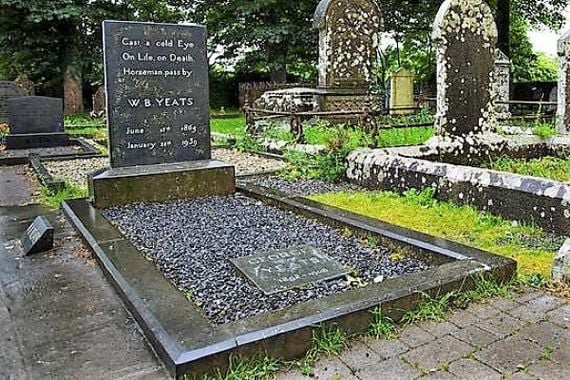
Yeats' grave. (Ireland's Content Pool)
Yeats once proclaimed of his mystical pursuits that “an Adept must be always seeking ways of giving the purest substance of his soul to fill the emptiness of other souls.” Hassett’s record of Yeats's engagement with the various living Muses who inspired his work is a vivid depiction of the creative process at work. His analysis of the art resulting from that effort is a living testimony to the ways in which Yeats maximized his talent by engaging himself openly, passionately and courageously with his deepest and most intimate aspirations and drives. As such, Yeats’ life-affirming artistic achievement is at one with his religious convictions. The incredible poetry and plays of Yeats are, like the mercies of sainthood, a gift to mankind. Joseph Hassett deserves enormous credit for teaching us that lesson. His study of how the sanctifying energy of love functions in the life of a great artist is itself a labor of love and a much-needed corrective to those who would dismiss the art of Yeats by dismissing the torturous, sacrificial methods by which it was created. Like his subject, Hassett’s book is a work of great intellectual and human significance that will stand the test of time.
"W.B. Yeats and the Muses." Oxford University Press, $110. James Flannery is the Winship Professor of Arts and Humanities and Director of the W.B. Yeats Foundation at Emory University.
*Originally published in the December / January 2011 issue of sister publication Irish America magazine. Updated in June 2026.

Comments