Take an aerial view of a dreary road in Walthamstow, a soulless part of the East End of London, and you will easily spot which house Sean Sexton lives in.
For there, nestled among the rows of uniform, somewhat neglected, and overgrown urban backyards, you will see a garden poetically “planted” with artifacts and statues, paying homage to their owner’s passion for Greek and Roman mythological and historical figures.
It is in this incongruous setting that Sean Sexton, an erudite Irishman from Co Clare, immerses himself in his work as a collector and dealer of early photos and cameras of world-class distinction.
The critically acclaimed Sexton collection of photos has been published in several books, including “The Irish: A Photohistory” with remarkable photos depicting Ireland’s history from 1840 to 1940, and exhibited in many countries.
Step inside his office, and you will be in a room packed with chests of drawers, bookshelves, and tables all stacked with books about Picasso, Max Ernst, Richard Avedon, William Klein, James Joyce, and Samuel Beckett. On a side table is a Kodak camera dated 1902.
Opening a drawer crammed with old photos, Sean Sexton rifles through his eclectic collection, pulling photos out with interest and enthusiasm as though seeing them for the first time.
“Look at this one” – he points at an image of a naked man with enormous testicles.
“He’s deformed by venereal disease. The strange thing is, there is almost an art to it.
“And look here, this is history for you,” he continues, showing a photo of Mussolini and Chamberlain. “That’s when they said, ‘We will have peace in our time,’” he muses ironically.
More photos emerge: a battalion of young boys in an “anti-tobacco campaign” in 1890, alongside other photos of French fashions from the 19th century, a slave in North Africa, and Laplanders standing outside an igloo.
There is one of Anthony Eden as a young boy, along with images of an African witch doctor, a blind beggar, and mummified victims of Vesuvius from 2,000 years ago, taken in the 1880s or 90s.
“This is stuff I buy and sell to fund my Irish collection,” explains Sean, emphasizing, “I never have sold any of my Irish collection. I will never break it up.”
“Sean Sexton’s collection of Irish photos is the greatest in the world,” declares Michael Hoppen, an expert collector and a leading gallery owner in London.
“Sean is incredibly knowledgeable and he has a great eye. He spots amazing things,” informs Hoppen.
“I was at a Christie’s sale in the early 90s,” describing their first meeting. “And I’d seen Sean in the sales rooms before; you’d see all these guys lurking around. Photo dealers are not ‘bib and tuckered.’ You know, you’d go to a Fine Arts or Old Masters show and people tend to look very prosperous; photo dealers are more like detectives, they hide in the shadows, perhaps because they have an understanding of what light can do.”
“I found a wonderful leather binder of some incredible photographs by a man named Sir Frank Brangwyn, a Royal Academician; he was one of the painters of Rockefeller Center in New York,” continues Hoppen.
“I spotted these pictures and they were estimated at £300–400. I decided no one else would have spotted them, they were ‘sleepers.’ I tucked them back under the box, left my bid for £1,300 or £1,400 – triple the estimate – and off I went to a meeting with Mark Getty because I’d started to work with Getty Images. I just assumed no one would be interested in this pile of ‘rubbish’ that I’d tucked under the box.
“Anyway, Sean Sexton comes along and puts up his hand and buys them for £1,500 – four months later he drops them into a Sotheby’s sale, properly cataloged, and makes a killing,” Hoppen laughs, “and they are now on offer by a dealer in America for about $375,000-400,000.”
Another time when Sexton’s “eye” triumphed was when he acquired a set of 19th-century photos of vegetables by Charles Jones, reputed to be worth around £25,000.
“I go to fairs,” recounts Sean. “A lot of it is ‘undiscovered’ 19th-century material which I get very excited about.
"With the Charles Jones photos, I knew I’d hit something really big. I was late for the market in Bermondsey [London]. I took one look and thought ‘works of art.’
“There was a guy there who has a gallery in New York who said ‘These are only of vegetables – they couldn’t be any good,’" smiles Sean. “That guy should have known, especially being American, about modernism, because those photos were taken in 1900 when you had mainly mawkish, sentimental art, ‘chocolate boxy’ art photos.”
Sean explains, “It’s like if Lester Piggott or Vincent O’Brien were looking at a yearling with the view that it might win the Derby in two years’ time – they don’t consult books – they know you either have the ‘eye’ or you don’t.”
“Sean Sexton is a proper collector in the sense that he doesn’t just buy from galleries,” says Hoppen. “He is somebody who is on the ground and really turns every stone. These are the real collectors who are prepared to dig deep.”
Asked where he thinks his aesthetic “eye” comes from, Sean replies, “Basically what influenced me as a child was the landscape in the west of Ireland, where I grew up on a farm in a very beautiful part of County Clare.
"The cliffs and water were behind me and in a distance on a clear day I could see Connemara and the mountains of Kerry.”


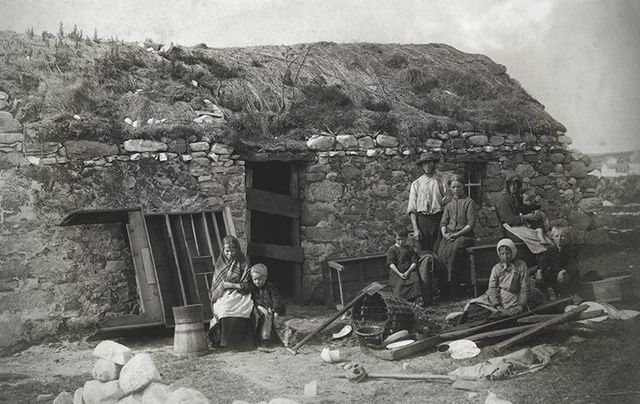
Children in Galway, c 1930.
One of seven boys, Sean describes his humble beginnings. “We had no running water and my father plowed the land with a horse and plow. We walked three and a half miles to school without shoes, but we had fifty acres of good land where all the food was grown and, more importantly, we had great parents.
“I was always an avid reader and a big influence on me was my schoolteacher, Barney O’Higgins. He imbued me with a sense of Irish identity, I suppose, especially Irish history.
“After national school, I went to secondary school in County Mayo. We were taught by priests. The priest who influenced me most was from County Kerry, a very tall, aesthetic-looking man who was supposed to teach us Latin.
“He’d been educated in Rome. Of course, Latin is all tied up with Roman history and, given any excuse, he was showing us photos of sculptures and paintings by Michelangelo and that’s where, I believe, my eye came from.”
“Sean obviously has a wonderful ability to tie everything together and he understands the relationships between things,” informs Hoppen. “So, you are not just looking at beautiful pictures, you are looking at the shoes in this particular village hall because they are all made by this cobbler, and here is a picture of this cobbler himself and there’s the guy who brought the leather into town so Sean can tie all this together and it makes fascinating reading,” Hoppen continues.
“Part of what photography should do is to preserve and record history, and Sean has found a way, if you look at his Irish books and other things he has done, to preserve this material for generations to come.
“As far as the Irish collection is concerned,” Sean says, “you had the Irish professors who were employed at Oxford and Cambridge Universities who started ignoring and trivializing Ireland’s history, lest perhaps they might be seen as giving credence to the republican crowd in Ireland.”
“They were saying that during the famine,” – but here Sean stops to qualify. “We, the Irish people, and the Irish historians must get the terminology right, because there wasn’t a famine. The word ‘famine’ evokes the idea that the rains failed, or that the crop failed. There was no famine, there was a great starvation.

Haymakers in Cork, c 1860.
“The coffers were full in London, they could quite easily have alleviated the starvation. They [the British administration in charge of Ireland at the time] spent nine and a half million, I think, on the ‘famine’ – they spent sixty million on the Crimean War, but because of the eruptions and the fights for independence over hundreds of years, the powers that be in Britain made excuses to themselves, saying that it was God’s will or that the Irish deserved it.
“A lot of writers, such as Dickens and Carlisle, were not very kind either,” argues Sean. “It wasn’t ignorance on their part, it was racism.
“Also, [about the hunger], having said all that, there were a lot of people in England, the upper echelons of society such as the Quakers, like Coutts Bank, who helped the Irish,” concludes Sean.
“What Sean has done is amass this fantastic collection, and, not simply because it’s a large one, but because it’s one of the great, in-depth collections of a particular society,” insists Hoppen,“ it should end up in a museum and Sean Sexton should be the person to document it and arrange it for the museum.
“Sean’s very congenial, with a great sense of humor. He’s very generous and he’s maturing in a very unusual way – he has not lost his spark and he hasn’t lost his edge or inquisitiveness,” Hoppen recounts. “He’s very particular. I invited him to lunch at the Chelsea Arts Club to have a nice bottle of red wine and a good steak-and-kidney pudding,” says Hoppen fondly. “Sean opted for sandwiches, which he wanted cut in squares because he hates them cut on the diagonal.
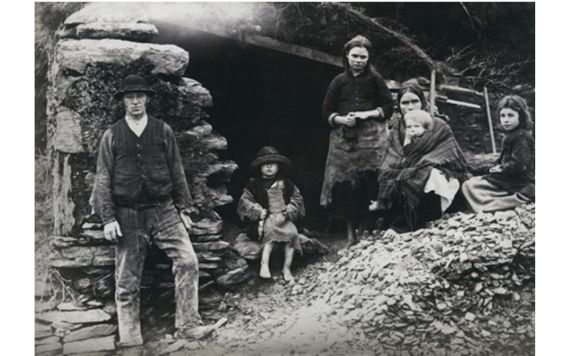
Killarney, 1897.
“And, of course, they came out of the kitchen cut diagonally and Sean said, ‘I can’t eat that. They are cut the wrong way.’ I love that, the fact he enjoys simple things and always pays attention to detail.”
Giving some insight into the mind of the collector, Hoppen says, “The ownership is not the fun [part] for a collector – the hunt is much more fun than the ownership. The head of Christie’s works the sharp end of the business, with his gavel he sells millions of pounds’ worth of fine art and photography, but at heart he’s just like Sean and me – he can’t really sleep unless he’s found a good picture that very day.
“With his Irish collection, Sean’s not collecting photographs to make money or to sell. Sean’s puzzle is to reassemble a photographic history of Ireland and Irish life and Irish ways.”
Sean has the final word. “A collection like this is evidence at the court of human history,” he says. “This is Ireland’s history coming from the photographer’s viewpoint. There are over 20,000 pieces of evidence observed by over 300 photographers.”
He quotes from a Latin inscription of 1589: “Of what use are lens and light for those who lack in mind and sight?”
*Originally published in 2010, with permission from Irish America magazine.
Comments