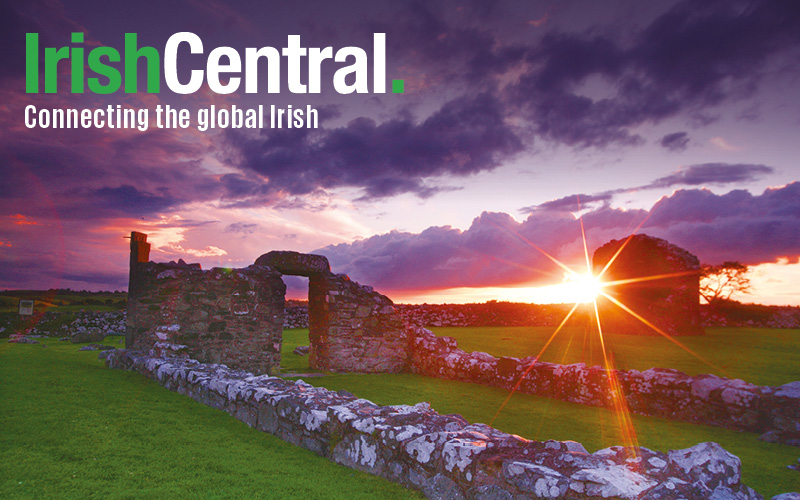
The kings of Ireland were not inaugurated in Christian churches as were other European monarchs. The chieftains stood on the high hills that enclosed the tombs of their tribal ancestors during the ceremonial rites that made them king. This image, given to us by Eamonn Kelly, keeper of Irish Antiquities, National Museum of Ireland, resonated with our group. We were Irish American, in Ireland to explore the land of our ancestors, hoping to find the place that belonged in a special way to each of us.
We spent an amazing two days with Eamonn, known as Ned, and his wife, archaeologist Erin Gibbons and found an insight into the layered richness of a heritage that belonged to us in a more profound sense than we had ever imagined.
We were touring sites in Galway important to my historical novel Galway Bay, which was set in the years 1839 until 1893. The group contained a number of friends from childhood along with readers of the book I had never met but responded to the news of this first Galway Bay tour. As each one signed up I urged them to gather as much information about their family history so they might be able to do what I had done after many years of research – find the place in Ireland where their people were from and stand on that piece of ground. Two of the group, Mary Lou Queeney and Rosemary Durkin Snyder, though both from Chicago, did not know each other. Neither had much information about their Irish connections but each had heard that a cousin was tracing their family roots and would inquire. A week before we left, two excited e-mails came. “I know the town,” said Mary Lou. “I found the place,” wrote Rosemary. “Bohola, County Mayo,” they each reported. What are the odds?
During the trip Mary Lou would attend Mass in the church where her great-grandparents were married and still living in the family home. They would show her the marriage certificate and she would discover that one of the witnesses, a cousin of hers, was also a cousin of Rosemary’s. Both families came from adjoining townlands, and Rosemary and Mary Lou were related.
But now, as we listened to Ned’s speech, the real significance of finding one’s place emerged. The kings seemed to gather their strength from a physical connection to the land, literally standing on the shoulders of those who went before. Ned told us that most family names in Ireland could be traced to particular locations where families had lived, possibly since the Stone Age. His own Kellys had been in the Dublin mountains since ancient times. He told us of a remarkable incident in County Clare where the DNA taken from ancient remains found in a cave matched exactly the DNA of two children currently enrolled in a local school. Both had names long associated with County Clare. We Irish Americans looked at each other and smiled. Suddenly being away 150 years or less seemed no time at all. If our ancestors had been here since the Stone Age, we belonged to the place in a more profound way than we had ever understood. When writing about the Great Starvation in the novel Galway Bay, the sense of loss and cataclysmic tragedy sometimes overwhelmed me. The need to bear witness was what kept me going. But now I felt that the ancestors themselves were calling us home as if our very presence could heal the immense rift between then and now, here and there. Here were people on the tour being guided by distant cousins.
I had connected with Erin and Ned because my great-great-grandmother Honora was the daughter of John Keeley, a fisherman, in Barna, County Galway. But I couldn’t find any more Keeleys in the area. When I discovered that a cluster of Keeleys who emigrated to Chicago were from the Ard peninsula near Carna in Connemara I went to investigate. The Keeleys were once lords of Connemara and when I saw the beautiful area that was their stronghold, I decided that I’d love for these to be my kin. I met Padraic Keeley who graciously allowed that, yes, we could be cousins – somehow. Another visit brought an e-mail from Erin Keeley Gibbons who was related to Padraic and married to Ned Kelly. She is working on a history of the Keeleys and has excavated many significant sites in the area and throughout Ireland. She arranged for Ned to give a presentation on the Bog Bodies, one of the many subjects on which he is an expert. The most famous corpse, the Gallagh Man, comes from right near the ruins of the stronghold of 14th-century William Boy O’Kelly, famous for the nine-month party he hosted. In Irish “Fáilte UíÌ Cheallaigh” still means a very warm welcome. I chose Gallagh, now Castle Blakeney, as the home place of Michael Kelly, the character based on my great-great-grandfather. Our group had that day visited the Heritage Center where its director, Valerie Kensella, true to the tradition of hospitality, gave us apple tarts and a concert by the All-Ireland contestant singers of St. Cuan’s College. And now Ned Kelly, a renowned authority and editor of a forthcoming book on the Bog Bodies had travelled to us to share his knowledge. Fáilte UíÌ Cheallaigh, indeed! For me, who’d been piecing together my understanding of Ireland bit by bit over forty years and had often struggled with text, alone and confused, Ned and Erin were a gift and a revelation. Our whole group felt it. They have the knowledge in such an organic way, and combine scholarship with deep personal connections, that they seem to illuminate every subject. They made us see the landscape itself differently. Through her friend Martin O’Malley, Erin even arranged a boat trip to MacDara’s Island, site of an important scene in Galway Bay. And then she told me that another scene I had set on an island on Ballynahinch had more relevance than I even realized. I’d emphasized the castle belonging to Grace O’Malley situated there without realizing that that same island had once been a Keeley stronghold.
Another one of our guides was Sister Maire MacNiallais, the keeper of the church archives in Galway, who had found Honora’s baptismal record in an 1822 ledger. She spoke to our whole group about the responsibility she feels to help Irish Americans connect to their ancestors. They deserve to be remembered.
So even if the resting places are unmarked, and if some of our great-great-great-aunts and uncles, grandmothers and grandfathers lie in the mass graves with other victims of the Great Starvation, when we return we honor them. Just as the kings of Ireland found strength standing on the bones of their ancestors, so will we.
Comments